 NexSms官方博客
In cross-border e-commerce operations, AI tool subscriptions, and US social media matrix building, US phone number verification (area code +1) has always been the segment with the highest demand and the most intense risk control confrontation.
Entering 2026, many users accustomed to traditional verification methods have found that the registration processes they used to complete with a random US temporary number costing a few dozen cents now either directly pop up "This phone number cannot be used for verification" when entering the number, or the page shows the verification code has been sent, but the receiving end remains silent. More troublesome is that some accounts are registered successfully, but when binding a bank card or initiating the first transaction, they are asked to re-verify the phone number, and because the original number cannot be found, the account is directly invalidated.
Why has the verification threshold for +1 numbers suddenly increased this year? To smoothly receive codes and keep accounts on mainstream US platforms, you first need to understand the two new thresholds at the bottom of North American communication networks and platform risk control, and then choose the right number according to business scenarios.
I. Two Invisible Thresholds for US Phone Number Verification in 2026
In the past, discussions about not receiving verification codes often focused on "whether the number segment has been overused." But in 2026, US local communication compliance policies and financial-grade identity verification mechanisms have completed a new round of upgrades, directly filtering out a large number of low-quality number sources from the bottom.
1. Millisecond-Level LNP Database Checks (Direct Rejection of Virtual Numbers)
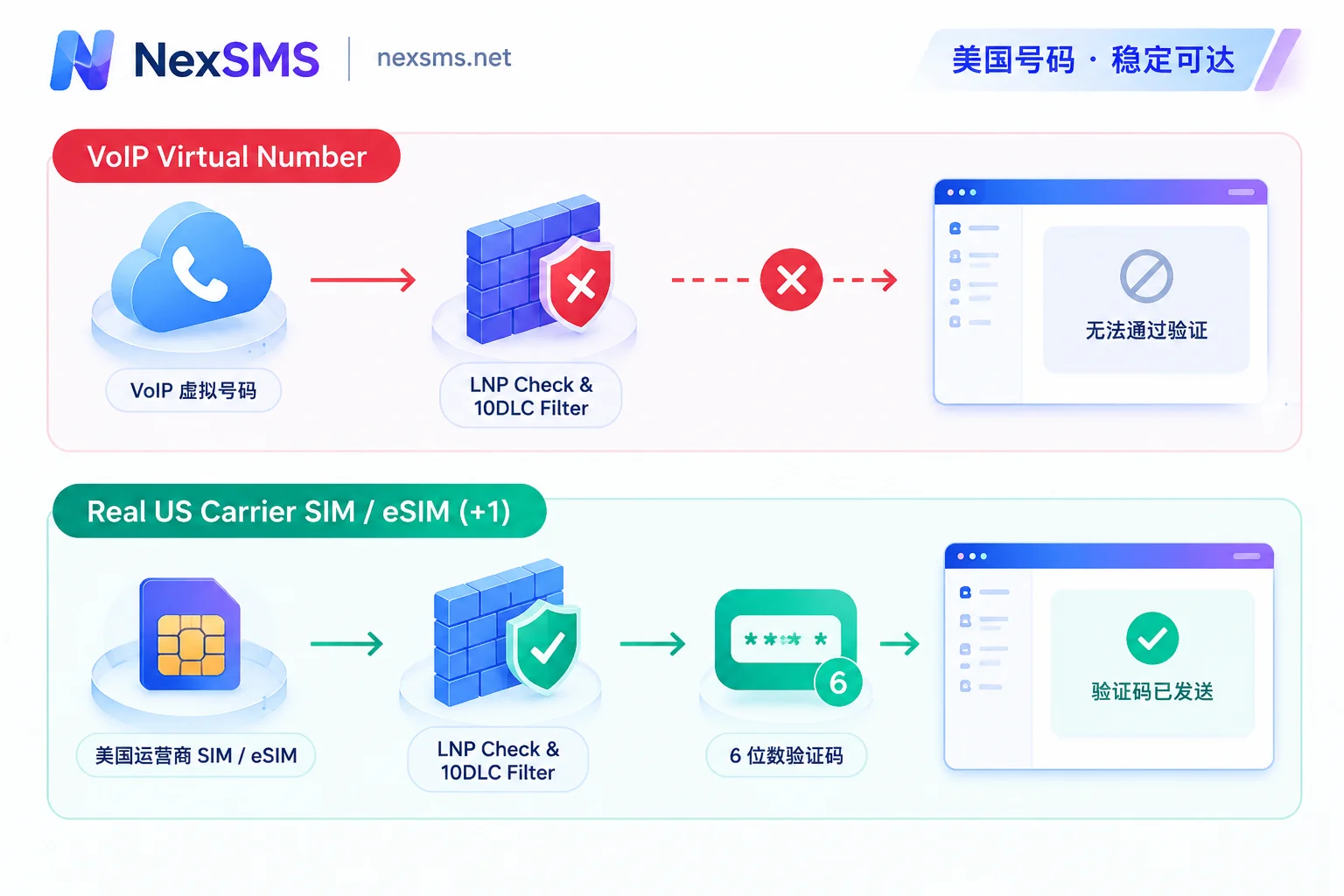
Every US phone number is registered in North America's Local Number Portability (LNP) database and carrier Home Location Register (HLR). When you enter a +1 number into the verification box of US PayPal, Amazon Seller Central, or OpenAI, the platform completes an underlying query in a fraction of a second, reading the line attributes of the number: Mobile (real mobile cellular network), Landline (landline), or VoIP (VoIP).
As we also mentioned in "Google Voice Frequent Account Bans and Recycling, TextNow Hard to Pass Verification", over 80% of mainstream US platforms will directly close the door on virtual landing numbers marked as VoIP at this step, and will not even trigger the downstream SMS gateway.
2. Tightened A2P 10DLC Commercial SMS Compliance (Silent Blocking)
Many times the platform does send a verification code, but you don't receive it. This is often related to the A2P 10DLC (Application-to-Person 10-Digit Long Code) compliance requirements fully tightened by US carriers. From 2025 to mid-2026, mainstream US carriers have further blocked or restricted commercial verification traffic that is not compliantly registered or flows to abnormal number pools. If the verification platform uses cheap virtual gateways or flagged high-risk shared SIM pools, the OTP SMS will be silently dropped at the carrier routing layer—what you see on the web page is "countdown ends, no error, no code received."
II. Four High-Frequency US Scenarios: Which US Number Should Your Business Use?
Facing LNP screening and risk control re-verification, using the same temporary number for all US applications not only wastes budget but also drags down your carefully built network and device environment. According to the principle of "Allocating Phone Numbers by Account Value Tiers", when choosing US numbers, we need to break down target applications by risk control cycle:
| US Target Scenario | Typical Platforms | Platform Risk Control and Verification Characteristics | Recommended NexSMS Number Type |
|---|---|---|---|
| Cross-border Payments and E-commerce Sellers | PayPal, Amazon, eBay | Financial-grade LNP checks, strictly reject virtual numbers; card binding, withdrawal, and remote login trigger secondary SMS re-verification | Long-term premium numbers (real carrier local SIM/eSIM, support renewal for long-term holding) |
| AI Productivity and Core Passes | OpenAI, Claude, Apple, Google | Strict checks on native mobile lines; accounts accumulate subscription fees or bind multiple services, original number needed for unblocking upon anomalies | Long-term premium numbers (high-value main number) or short-term regular numbers (for one-time testing only) |
| US Social Media and Private Domain Matrix | TikTok, WhatsApp, Telegram, X (Twitter), Instagram, Facebook | High demand for bulk account testing; but core sales accounts (e.g., TikTok US accounts) require phone re-verification upon traffic anomalies | Use short-term regular numbers for test accounts; use long-term premium numbers for main operations accounts |
| Insignificant Web/Function Testing | Temporary info sites, ordinary whitelist forms | Basically no line attribute checks, no subsequent re-verification needs | Free public numbers or short-term regular numbers |
💡 Reminder about free public numbers: NexSMS official website provides several free US public numbers. After logging into your account, you can view received verification codes on the web page. However, since SMS received by public numbers are visible to everyone and are very easily抢先 registered or trigger recovery by others, never use them for any important accounts or platforms involving personal privacy or financial transactions.
III. Three Ways to Choose US Phone Numbers on NexSMS
Physical SIM cards are slow to ship from overseas and troublesome to maintain with monthly fees (as we analyzed in "Giffgaff Roaming Clearance, Tello Order Cuts and Bans" regarding number retention pain points), while the core advantage of online verification is instant use. To adapt to the US risk control environment in 2026, NexSMS has split its US verification service into three clear delivery forms that you can combine as needed:
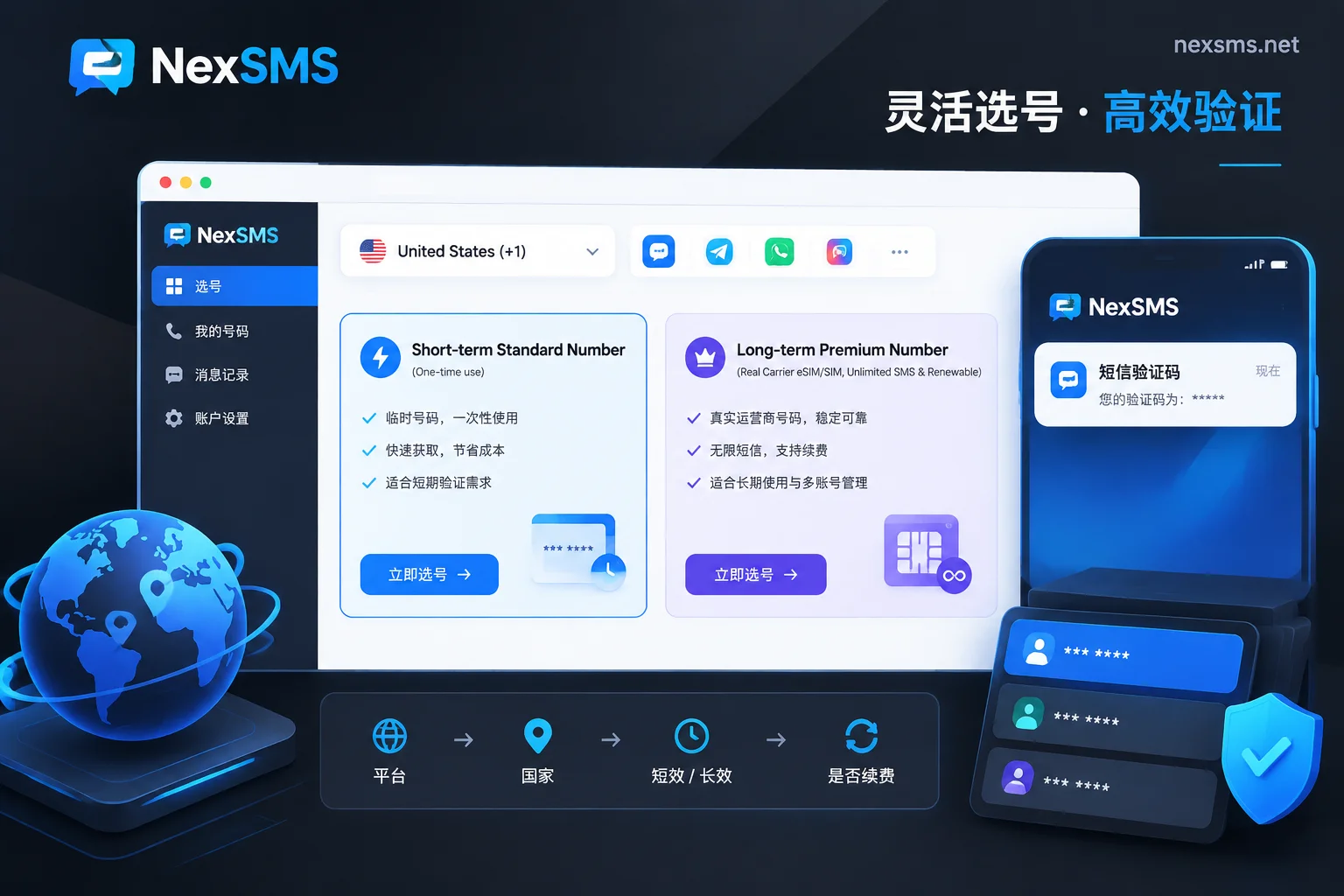
1. Short-term Regular Numbers: Low-Cost One-Time Acquisition and Testing
If you are doing functional testing of foreign applications, or bulk registering a batch of ordinary social accounts that do not require high subsequent re-verification, you can choose short-term regular numbers.
- Billing and Rules: Pay-per-use, short validity period; a number is only used to receive a verification code for one target application, used up and done, no renewal, and the same number cannot be used to receive a second verification code.
- Applicable Considerations: Suitable for temporary verification scenarios pursuing low single-cost and short account lifecycle.
2. Long-term Premium Numbers: Real Local Carrier Lines, Protecting Core Assets
For scenarios like US PayPal, Amazon, Apple ID, TikTok main store groups where "losing the number means losing the account and funds," you must choose long-term premium numbers.
- Line Nature: Uses real carrier local numbers (based on local physical SIM and eSIM, definitely not cheap virtual landing numbers), with real mobile network attributes in platform underlying detection.
- Re-receiving and Renewal: Within the validity period, the same number can receive SMS verification codes unlimited times; actively renew before expiration to continue holding the number. Whether it's card binding verification on the 7th day after registration or triggered security re-verification half a year later (see "Why Keep a Long-term Verification Number Even with an Authenticator"), you can view codes in real-time on the web page and pass verification.
3. Developer API Integration: Write Number Acquisition and Code Receiving into Automated Processes
For R&D and studio teams that need high-frequency automated testing and bulk business verification, manually refreshing web pages is obviously not efficient enough. NexSMS supports integrating number acquisition and code receiving capabilities into your own programs via API, and API code receiving and web real-time code viewing can work in parallel. Since the platform does not provide public API documentation, teams with integration needs can directly contact 7×24 Telegram customer service for integration methods.
IV. US Verification Practical Guide: 4 Details to Improve First-Time Pass Rate
No verification platform can promise 100% verification success on all third-party platforms, because the final success depends on the target platform's dynamic risk control rules at the time. But doing the following four operational details can significantly reduce the probability of "not receiving codes" or "instant bans":
- First lock "country + application" to see inventory and price: Since high-quality US number sources change dynamically with inventory, it is recommended to first go to the price and inventory page or directly log into the NexSMS Workbench, and simultaneously check "United States (+1)" and the specific application you want to register (e.g., OpenAI or PayPal). The system will filter out real inventory and real-time starting prices applicable to that service, avoiding blind number acquisition.
- Pay attention to the
+1area code format: The US and Canada share the international code+1, followed by 10 digits (3-digit area code + 7-digit number). When the target website's dropdown already defaults toUS +1, only enter the following 10 digits in the input box, and never repeat entering1or+1, otherwise it will cause number format validation errors and SMS cannot be sent. - Confirm network environment self-consistency before sending SMS: Risk control systems simultaneously compare your network exit with the number's attribution. If you are requesting
+1SMS verification code while using a network node from another region or using a blacklisted IP from a data center used by thousands of people, the platform often directly blocks the code sending request at the risk control layer. - Flexibly manage account balance and renewal ledger: NexSMS supports top-ups via Alipay, WeChat, and cryptocurrency (USDT/BTC), and account balances do not expire. If you enable long-term premium numbers to bind core business, it is recommended to record the business account and expiration time corresponding to each number, and renew in time before expiration.
Want to learn more about operational details for specific platforms? You can visit the NexSMS Application Solutions Center to view dedicated verification instructions and FAQ troubleshooting for over ten mainstream platforms including Google, Apple, Telegram, WhatsApp, TikTok, Xiaohongshu, WeChat, Amazon, etc.; or directly go to the NexSMS Login and Order Page to choose your own US local number.