 NexSms官方博客
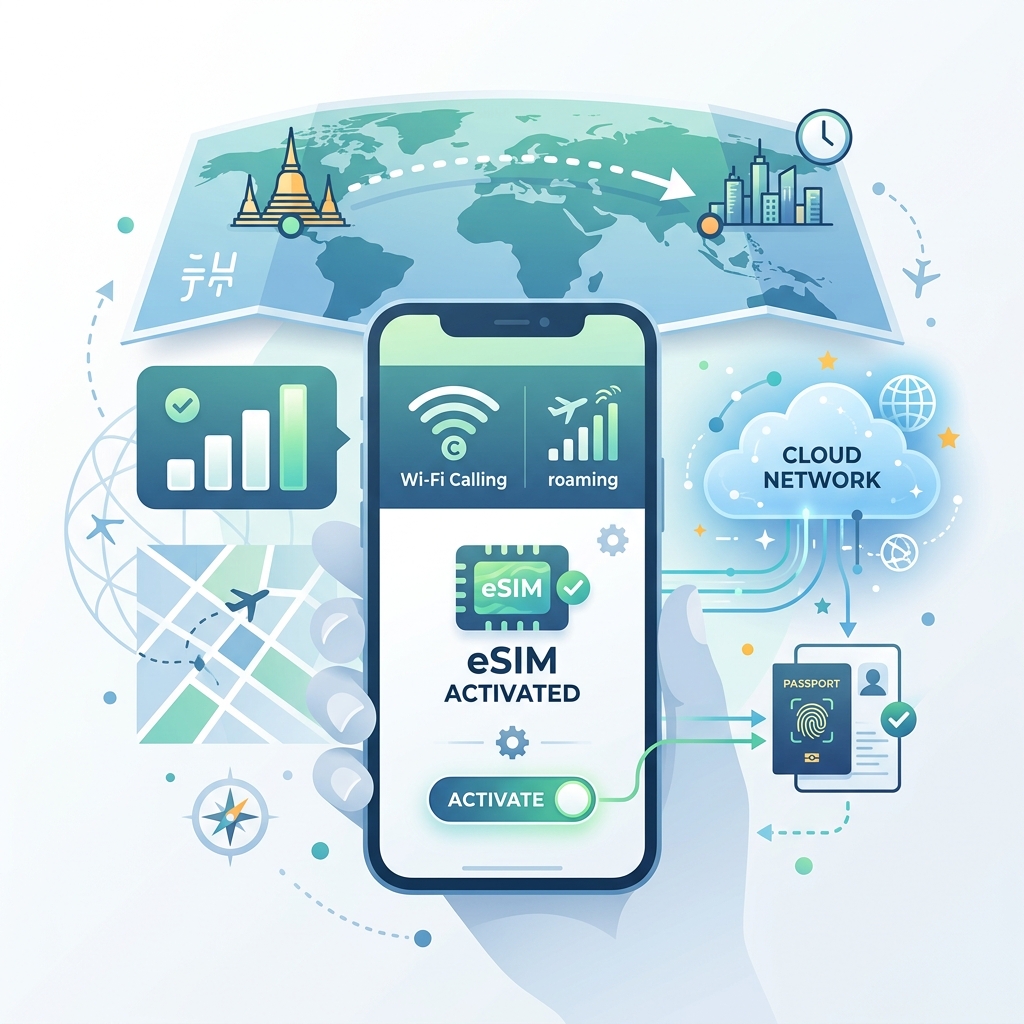
**Introduction** In the realm of global roaming and low-cost number retention, Thailand's top operator AIS (Advanced Info Service) has long been favored by digital enthusiasts and cross-border travelers for its stable signal, rich services, and strong roaming capabilities. However, since 2023, AIS's policies and system risk controls have changed multiple times, rendering many early tutorials obsolete.
To help you avoid pitfalls, we have compiled a new "Thailand AIS Card New Play Guide" based on the latest 2026 test feedback, assisting you in smoothly completing card activation, enabling Wi‑Fi Calling, and using low-cost international calls.
### 1. Purchasing and Basic Activation: Complete Digital Identity Setup in Minutes
The most common method is to directly purchase an eSIM online.
- **Purchase Channel**: You can order via the AIS official eSIM tourist page: `ais.th/esim-traveller/#/`.
- **Plan Selection**: The recommended plan is "399 THB / 8 days / 6GB Asia-Pacific data package" (approx. 83.65 RMB).
- **Payment and Activation**: The official site is friendly to domestic users, supporting WeChat Pay, UnionPay, Visa, and Mastercard. After payment, you will first receive an electronic invoice, then an email with a QR code link.
- **KYC (Identity Verification)**: Click "SEND EMAIL" in the email to complete online KYC. Prepare your passport and complete facial recognition (usually a relaxed review). After approval, scan the QR code to download the eSIM, and wait a moment to receive 4G mobile network signal.
_(Note: KYC on the web and AIS App are independent. For smoother subsequent operations, it is recommended to also complete identity registration in the AIS App.)_
### 2. Solving the Core Difficulty: How to Enable Wi‑Fi Calling While in China?
For users not in Thailand, Wi‑Fi Calling is one of the most valuable features of this card. However, its activation strategy is currently somewhat "mysterious". **Do not waste time trying USSD codes or sending emails**; customer service will basically not handle it, and may even ask you to visit a physical store.
**2026 latest and tested method: Call customer service directly**
1. **Preparation**: First confirm that you have completed identity registration in the AIS App.
2. **Call the hotline**: Dial `1175` directly using this number (note: calling customer service while roaming is **free**).
3. **Communication skills**: After connecting, first say "Sawadee ka, English please." **Do not look for Chinese customer service**; based on tests, Chinese customer service often does not understand this service.
4. **Provide information**: After being transferred to English customer service, state that you want to enable Wi‑Fi Calling. Verification details vary by agent: some only confirm your phone number, while others may ask for your full name and ICCID (SIM card serial number). Cooperate as required. If you speak Thai, Thai customer service is equally efficient.
5. **Activation time**: Customer service usually says it will take effect within 50 minutes, but tests show system delays—sometimes up to about 9 hours. After patiently waiting, connect to local Wi‑Fi and try to enable Wi‑Fi Calling. If the corresponding indicator appears, it is successful.
### 3. Signal Degradation Remedy and "Ultimate" Number Retention Solution
**1. What to do when the roaming package expires and signal drops to 2G?** If you fail to enable Wi‑Fi Calling for various reasons, after the 8-day roaming package expires, the signal will automatically drop to 2G. **Method to restore 4G**: Simple—open the AIS App, go to "Network Set," toggle "International Roaming" off and then on again. 4G signal is usually restored.
**2. Ultra-low-cost number retention** AIS's number retention policy remains generous: **Every recharge of 10 THB (approx. 2.1 RMB) extends validity by 1 month**. Validity can be accumulated, and a single card can be recharged up to 6 times per day. That means spending just over two yuan per month to retain this overseas number for receiving verification codes from international platforms—highly cost-effective.
### 4. Pitfall Warning: Recharge Not Credited and "Secondary Identity Verification" Risk Control
Recently (early 2026), some users have encountered a situation where a normal recharge deducts money but the credit does not arrive.
If this happens, don't panic. It is usually triggered by the system's **risk control mechanism**, requiring "secondary identity verification." The process is simple: contact customer service, who will provide a designated number. Send your passport number for manual verification. Once approved, the credit will be applied.
### 5. Advanced Money-Saving Tips: Flexible Use of Low-Cost International Call Codes
When making international calls via Wi‑Fi Calling without a prefix, costs can be high. AIS offers several low-cost prefix codes. Dialing format: **long-distance code + country code + specific number**.
- **003 (Recommended for high-quality voice)**: Requires contacting customer service to enable. Supports over 230 countries and regions. Calls to mainland China (+86) landlines or mobile phones cost **3 THB/minute (approx. 0.63 RMB)**. Charged per minute, with partial minutes rounded up.
- **00500 (No activation needed, use directly)**: Also covers over 230 destinations. Rates for popular low-cost areas (e.g., mainland China, Hong Kong, Macau, Taiwan, USA, Canada, Singapore) are approximately **3-5 THB/minute (approx. 0.63–1 RMB)**; calls to medium-cost areas like Japan and the UK cost about 1.26–3.14 RMB.
- **009 (Ideal for short calls)**: No monthly fee. Usable after enabling basic international calling (dial `*125`). Its feature is **per-second billing** (after the first 60 seconds, every 6 seconds). Calls to mainland China cost about 2.5-3.0 THB (approx. 0.21 RMB), to USA/Canada about 0.4 RMB, perfect for brief conversations.
**Industry Observer Commentary**
In the current overseas SIM card market, AIS remains in the top tier. As long as you understand its latest 2026 rules (especially enabling Wi‑Fi Calling through English customer service and using the App switch to reset 4G signal), this card offers strong cost-effectiveness and versatility—whether as a data card for business trips to Thailand or as a low-cost secondary card for number retention and code reception in China. We hope this tested guide helps you truly master AIS.