 NexSms官方博客
Quick Conclusion: When Facebook Verification Codes Aren't Received, First Distinguish Between "Not Sent", "Blocked", and "Sent Elsewhere"
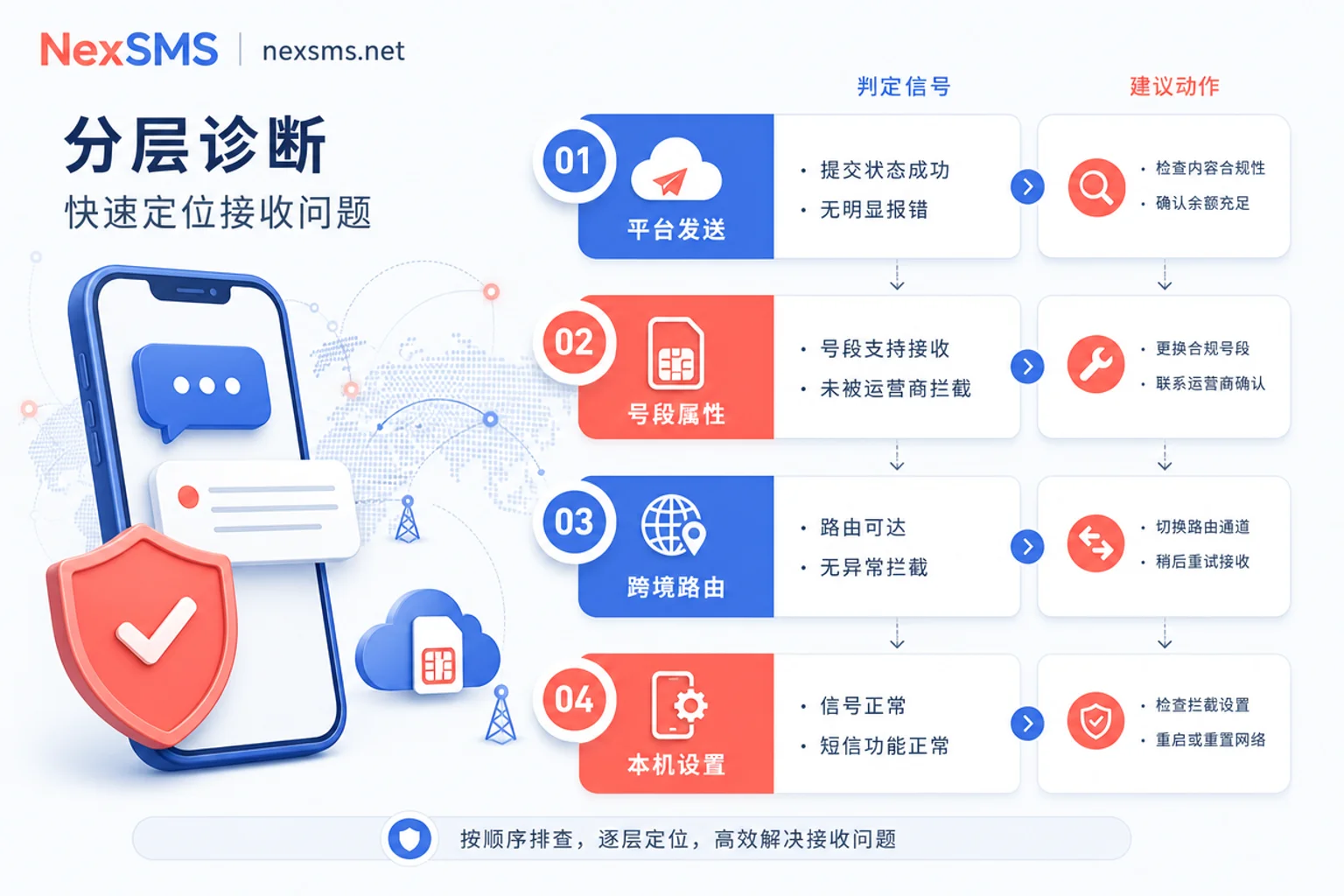
To diagnose Facebook verification code issues, check four conditions: Did the platform actually send it? Is the number type being validated? Is cross-border routing delayed? Is local interception happening? By following this order, most cases can be resolved without changing numbers. Note that Meta’s number segment risk controls are tightening: WhatsApp's official help center updated rules in 2026, explicitly stating that VoIP, free shared numbers, and premium numbers cannot be used for personal accounts or new WhatsApp Business registration verification. While this is WhatsApp's explicit rule, it can serve as a reference for Facebook scenarios.
Layer 1: Platform Didn't Send – Number Reuse, Account Risk Flags, and Verification Method Diversion
Sometimes the code isn't received because the platform never triggered sending. The same number repeatedly bound in the Meta ecosystem, accounts under risk review, or the system diverting to other verification methods like email or in-app notifications. Facebook hasn't disclosed specific limits on how many accounts a single number can bind, but you can observe these signals: Does a "Resend" countdown appear after entering the number? Does it prompt to try other methods? Is there an in-app notification verification? If none appear, the platform may not have sent it. In that case, avoid repeatedly clicking resend; wait 60 seconds before retrying and check for any abnormal login alerts on your account.
Layer 2: Number Type Validation – WhatsApp's Official Prohibited List Reflects Meta's Number Type Judgment Direction
If an immediate error occurs after entering the number without a countdown, it's likely a number type validation block. WhatsApp's official help center, updated in 2026, explicitly lists VoIP (virtual numbers), toll-free numbers, premium numbers, and shared numbers as prohibited for registration. As products in the same Meta ecosystem, Facebook likely has a similar direction in judging number types—but this is a reasonable inference, not an explicit Facebook official clause. If your number falls into these categories, it's basically confirmed as number type risk control. Waiting further is pointless; consider changing the carrier number. Refer to the article WhatsApp Virtual Numbers for guidance on number type selection.
Layer 3: Cross-Border Routing and Carrier Filtering – How Long to Wait Before Considering It Lost
After ruling out the first two layers, if there's still no SMS, it's likely a cross-border routing issue. Cross-border SMS goes through international routing, landing carrier filtering, and queue backlog, so actual arrival time can be as long as 5-10 minutes. Suggestion: wait 5 minutes initially; if not received, wait another 2 minutes then click resend. If three consecutive resends fail, it's likely a channel issue. Note: Frequent resend clicks trigger risk control cooling, which can slow down the verification process. Refer to the general troubleshooting ideas in Receiving Verification Codes Failed, but prioritize Facebook's actual behavior.
Layer 4: Four Self-Checks on Your Device – Country Code Format, Resend Interval, Interception Rules, and Dual SIM
The last layer is zero-cost self-check; many cases actually originate from device settings. Check four places:
- Country Code Format: International country codes must include the plus sign and country code; accidentally adding extra zeros makes the number invalid.
- Resend Interval: Continuously clicking resend may trigger frequency limits; wait at least 60 seconds.
- Interception Rules: System or security apps' unknown SMS interception features might swallow the verification code.
- Dual SIM Devices: Ensure the default data or SMS SIM matches the registered number; otherwise, codes may be sent to the other SIM.
If all the above are normal, the issue is likely identified in the previous layers.
Four-Layer Troubleshooting Table: Signals and Actions (Wait / Change Channel / Change Number)
| Layer | Observable Signal | Action |
|---|---|---|
| Platform | No countdown, prompt to use other methods | Check account status, switch to email verification |
| Number Type | Immediate error after entering number | Change carrier number |
| Cross-Border Routing | Countdown exists but no SMS for long time | Wait 5 minutes, control resend frequency |
| Device Settings | SMS intercepted, dual SIM mismatch | Adjust device settings and retry |
Using this table, you can diagnose the layer within 5 minutes, avoiding the most expensive action of changing numbers immediately.
Four Things to Confirm Before Changing Numbers, and Whether Email Verification Can Substitute
Before changing carrier numbers, confirm the following four things:
- Is the current number already bound to another account? Unbind before changing.
- Are you in a risk control cooling period? Changing numbers then may be futile.
- Does the target market match the number's country of origin? Different markets have different number type requirements.
- Are there alternative verification methods available, like email or in-app notifications?
Regarding "Can Facebook verification codes be sent to email?"—Email can serve as an alternative verification in some scenarios, especially during account recovery. However, in high-risk environments, the platform may still force number verification. So email verification is supplementary and cannot fully replace number verification.
Why Low-Quality Shared Number Sources Are Rapidly Failing: The Number Source Shuffle from FCC's Proposed KYC Rules
If you frequently encounter number type blocks, it might not be just bad luck. The U.S. FCC published a proposed rule in the Federal Register on May 26, 2026, in CG Docket No. 17-59, intending to mandate strict KYC checks for voice and VoIP providers, requiring collection of government ID, physical address, and backup phone numbers. In August 2026, it received joint support from 50 state attorneys general and the American Bankers Association. Key point: The rule is still in the proposal stage; final terms and enforcement dates are undetermined. But the trend is clear: the issuance of shared, low-quality virtual numbers will be restricted at the source, accelerating their failure. This means relying on free public SMS platforms will become increasingly unreliable.
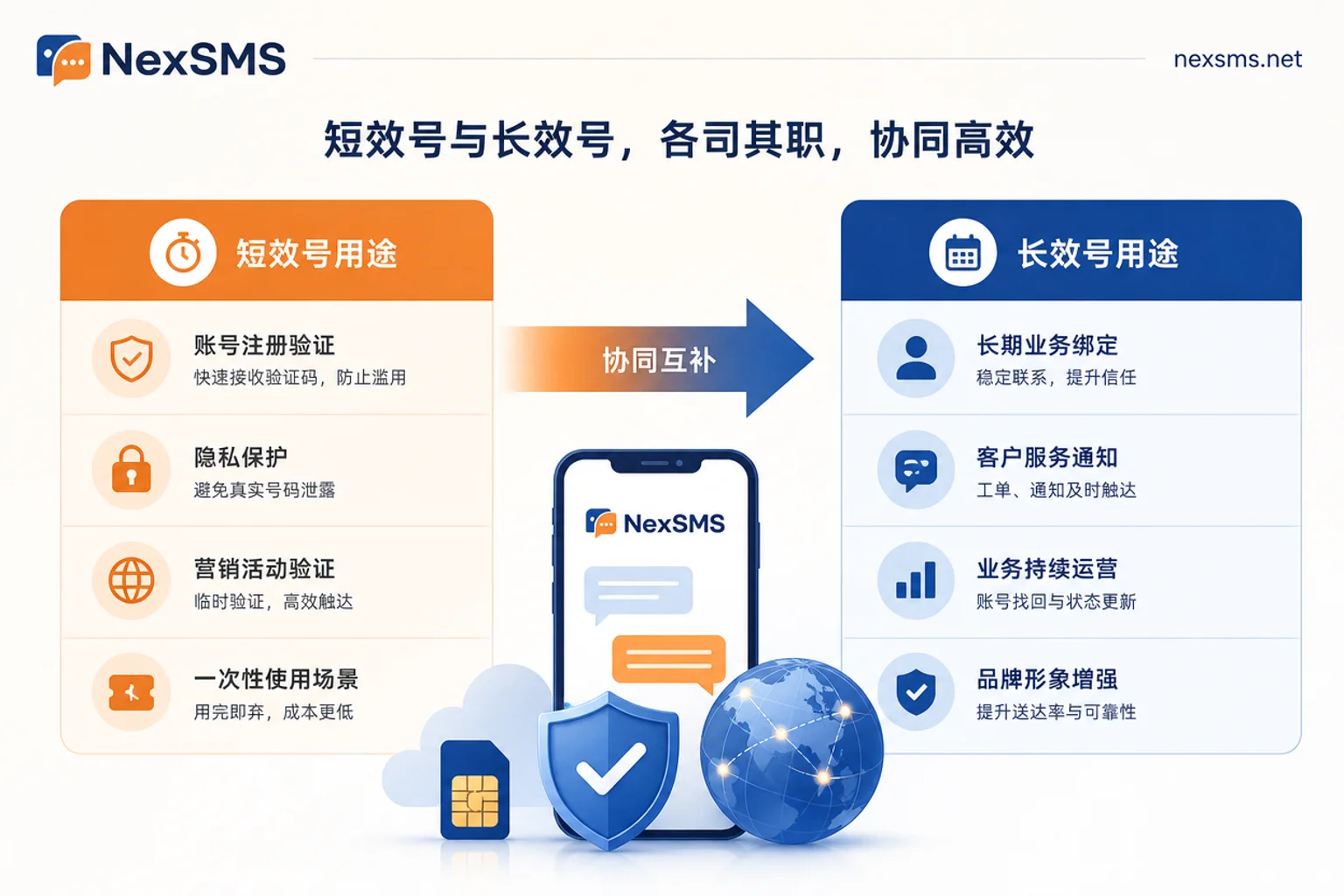
Carrier Number Reorganization: Use Short-Term Numbers for Registration, Renewable Long-Term Local Numbers for Long-Term Login and Recovery
To address the above trend, divide numbers by purpose: use short-term numbers for registration and initial verification to control costs; but for long-term login, two-factor verification, and account recovery entry points, you must bind renewable long-term local numbers to avoid losing recovery channels after number recycling. Also, the number's country of origin should match the account's target market to reduce regional risk control probability. This aligns with the compliance direction of number sources after regulatory tightening.
Implementing with NexSMS: Country Selection, Web SMS Receiving, and API Receiving Legal Usage
When you confirm the need to change carrier numbers, you can look into NexSMS, which offers multi-country number selection, web SMS receiving, and developer API capabilities. Recommended usage order: first select the number's country according to your target market; for registration scenarios, choose short-term one-time numbers, while for long-term verification, choose renewable long-term local numbers. API is suitable for bulk operations but must be used for legitimate business verification; we don't promise any number will pass platform verification. For the division of labor between short-term and long-term numbers, refer to Difference Between Short-Term and Long-Term Numbers.
Pre-Operation Self-Check Checklist
- [ ] Four-layer diagnosis order: Platform, Number Type, Routing, Device
- [ ] Waiting and resend rhythm: First 5 minutes, resend interval at least 60 seconds
- [ ] Before changing numbers: Number occupancy, cooling period, market match, backup entry
- [ ] Number purpose division: Short-term for registration, long-term for long-term use
FAQ
How Long to Wait Before Considering Facebook Verification Code Failed
After waiting 5 minutes normally, if not received, click resend; wait another 2 minutes; if still nothing, it's basically a failure. If three consecutive resends fail, pause operations to avoid risk control cooling.
Can Facebook Use Virtual Numbers to Receive Verification Codes?
Some virtual numbers may be recognized as VoIP numbers and blocked. It depends on the number type; it's better to choose physical mobile number segments. You can try, but success isn't guaranteed.
What to Do When Facebook Registration Says the Number Cannot Be Used
If it says "Number cannot be used," it's mostly that the number type is deemed unsupported. Don't keep retrying; change the number or use email verification.
How Many Facebook Accounts Can One Phone Number Register?
Facebook hasn't disclosed a specific limit, but repeated binding of the same number easily triggers risk control. Generally, it's recommended that one number corresponds to one account to reduce the risk of being restricted.
Can Facebook Use Email Instead of Phone for Verification Codes?
In some scenarios, yes, such as account recovery. But in high-risk environments, number verification may still be required; email is only supplementary and cannot fully replace numbers.


Comments(0)