 NexSms官方博客
In 2026, for developers, QA test engineers, and multinational operations teams relying on automated scripts to handle overseas business, the underlying SMS verification code reception logic is undergoing a complete reconstruction.
On one hand, an industry veteran platform that had been operating for nearly a decade officially shut down at the end of 2025, and some alternative platforms have recently experienced frequent service instability or even inaccessibility (see Guide to Shutdown of Established SMS Platforms and Selection of Stable Platforms), forcing a large number of scripts originally running in CI/CD pipelines or business backends to urgently seek new SMS verification APIs; on the other hand, the popularity of Playwright multithreaded end-to-end (E2E) testing and AI Agent automated workflows has multiplied the concurrency density of interface calls.
In the actual migration and reconstruction process, many technical teams have found that simply replacing the request URL and API Key in the code is far from enough. If the "cross-code" under concurrent states, retry timeouts, and the operator attributes of the underlying number sources are not resolved, the automated pipeline will still frequently get stuck. This article will dismantle how to build a high-availability SMS verification API call architecture in 2026 from the practical perspective of engineering concurrency control and operations fallback.
I. Hidden Dangers Behind Compatibility Layer Migration: Why Do Scripts Still Frequently Report Errors After Changing the Endpoint?
When many developers look for alternative interfaces, they habitually prioritize low-cost platforms compatible with the old handler_api parameter format, attempting seamless migration by changing only one line of Base URL. But in the actual production environment of 2026, this kind of "drop-in replacement" often steps on two hidden engineering pitfalls:
1. "Pre-interception" and Invalid Idle Spinning under HLR Real-time Polling
Today's overseas applications (such as OpenAI, Claude, Google, etc.) have long upgraded their risk control engines. Within milliseconds of the front-end click on "Send Verification Code", they query the operator type and base station characteristics of the number in real time through HLR (Home Location Register).
If the SMS verification API is connected to a cheap traditional VoIP virtual number segment at the bottom layer, the target platform may not even trigger the sending action, or directly intercept and report an error at the front end (for specific troubleshooting logic, please refer to 2026 Overseas App SMS Verification Error Troubleshooting Guide). At this time, because your backend script cannot perceive the specific front-end risk control interception, it still rigidly executes HTTP polling (Polling) until it times out and exits after a few minutes. This not only slows down the execution efficiency of the entire Worker node, but also triggers interface rate limits (Rate Limit) due to frequent invalid requests.
2. Midnight Shutdown Caused by Black-box Billing and Inventory
Some overseas interfaces set high minimum recharge thresholds, or have unreasonable terms such as regular balance clearing; even worse, when the number source for a certain country or application is exhausted, the interface fails to return a clear inventory status, causing unattended scheduled tasks at night to report errors collectively.
II. Core Challenges of Multithreaded Concurrent SMS Verification: Anti-Cross-Code and Stale Verification Code Filtering
When a team uses Playwright or a self-developed framework to simultaneously launch multiple browser instances (Parallel Workers) to run registration, login, or rebinding processes, SMS verification codes are often the hardest hit area that causes tests or tasks to become "flaky". To use the SMS verification API stably in concurrent scenarios, the following three points of isolation must be done well at the code and resource layers:
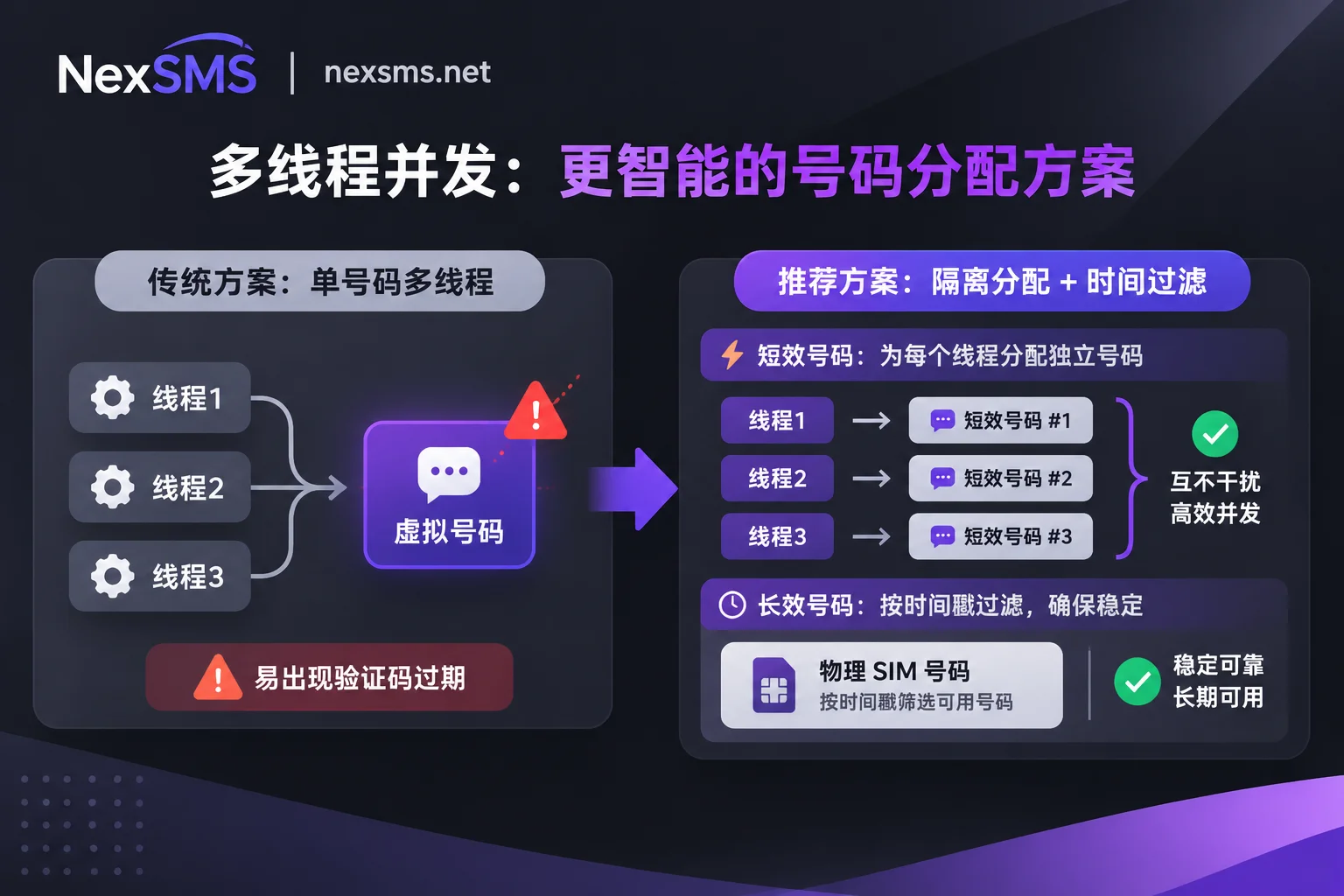
1. Eliminate Multiple Threads Sharing the Same Number (Worker-level Number Source Isolation)
In concurrent tasks, if two threads simultaneously request verification codes for the same platform from the same number, the later arriving SMS will overwrite the earlier one, or Thread A reads and consumes the OTP triggered by Thread B, causing both verifications to fail.
- Countermeasure: For one-time registration or temporary verification scenarios, the principle of "one number per task" must be followed. In NexSMS's product feature system, short-term ordinary numbers adopt a pay-per-use model with a short validity period, strictly limiting a number to receive only one verification code (no renewal, no second reception). Mapping such short-term numbers to independent concurrent Workers and discarding them after use can completely eliminate concurrent cross-code at the physical level.
2. Addressing the "Stale Code" Trap in Secondary Re-verification
For core business accounts that need long-term maintenance (such as Amazon stores, PayPal financial accounts, or enterprise-level Telegram / WhatsApp accounts), we cannot change to a new number every time; instead, we need to bind a fixed long-term premium number (real operator local physical SIM cards and eSIMs, unlimited SMS reception for the same number within the validity period, and renewal before expiration allows continued holding).
When an automated program operates these old accounts to trigger two-factor authentication (2FA) and calls the API to read SMS, "stale verification code misreading" is very likely to occur—that is, network delay causes the new SMS not to arrive yet, but the script reads out the old verification code left from a few minutes ago or even the previous task and fills it in, causing verification errors and triggering platform risk control locking.
- Countermeasure: Before calling the API to trigger the target platform to send SMS, the program must first record the current precise timestamp (
since_timestamp) or the unique ID of the previous SMS. When polling the SMS verification interface, be sure to add time and status filter conditions to ensure that the extracted OTP is an SMS newly arrived after this click on the "Send" button.
3. Pre-check Inventory and Multi-country Routing Verification
Inventory of number sources for different countries and applications changes dynamically at different times. To avoid scripts getting stuck at the number acquisition stage, it is recommended to first check NexSMS's country SMS verification pages (such as the US SMS verification page) and the price and inventory query page to understand the starting price, available number count, and common verification requirements of the target application, and configure reasonable alternative country routes in the code. (For the basic selection and number tiering logic of SMS verification API integration into automated workflows, you can further read our previous Developer Selection and Anti-Disconnection Guide.)
III. Breaking Pure Black-box Operations: Building a Human-Machine Collaborative Defense Line with "API + Web Parallel SMS Reception"
In real cross-border business operations, no automated program can guarantee 100% that it will never encounter accidents. The target platform suddenly changes its UI pop-up, temporarily adds extra identity verification, or the verification process is interrupted due to adjustments in the platform's risk control rules at that time—these are commonplace.
If the SMS verification API used by the team is a pure command-line "black box" (i.e., numbers obtained through the API cannot show real-time SMS in the web backend, and manual intervention is impossible), once the script gets stuck at the last step, developers neither know whether the verification code was actually sent nor can operations personnel manually take over and fill in the code. The number that has already been paid for and the previously completed process can only be wasted.
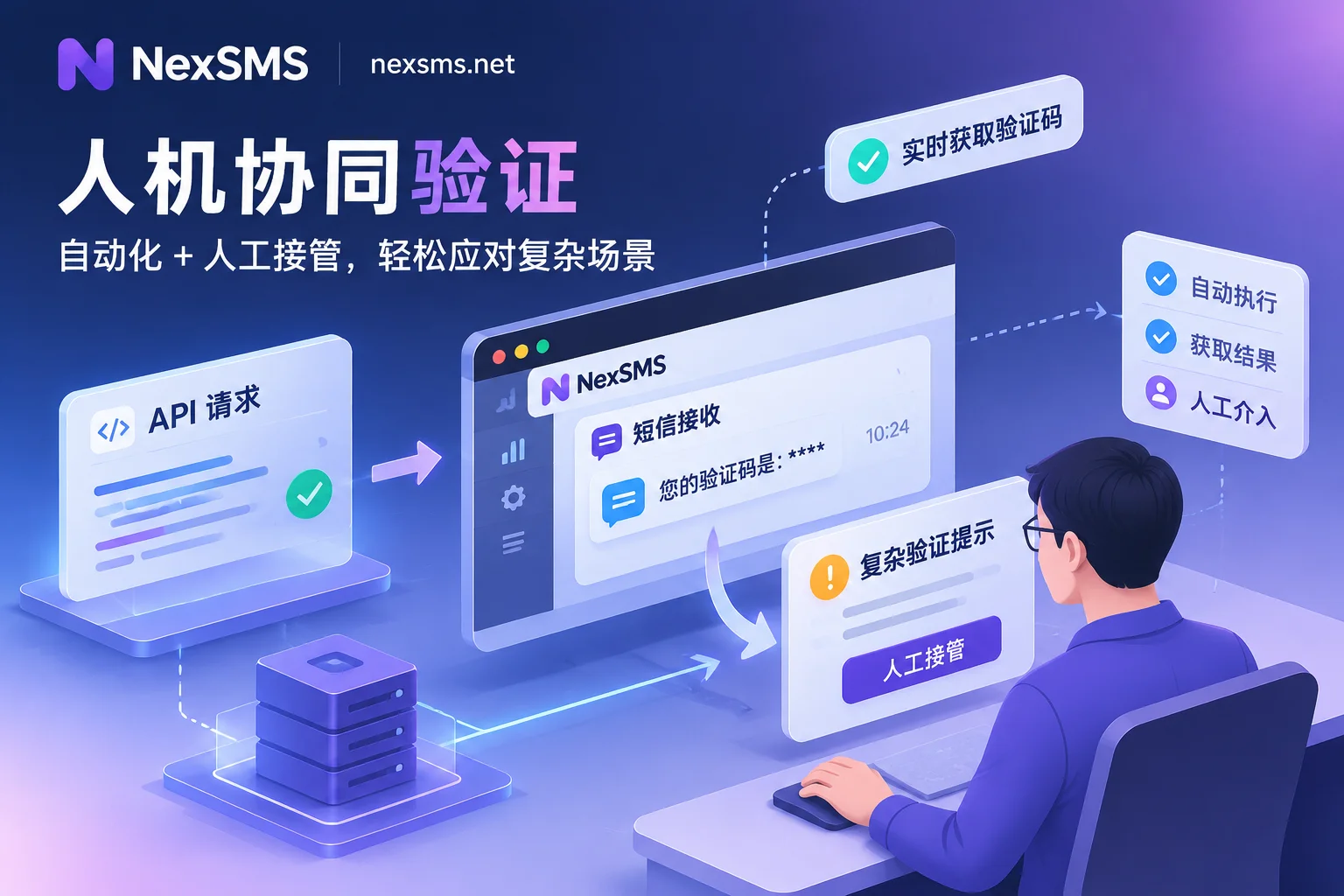
To solve this pain point, NexSMS natively supports a mechanism of "program number acquisition and SMS reception in parallel with web SMS reception" when designing the developer API:
- Real-time status synchronization: Whether the number is pulled by the program through the API or manually ordered in the user console, the received verification code will be displayed in real time on the web page.
- Seamless takeover of exceptions (Human-in-the-loop): When an automated script is performing rebinding or abnormal appeal for high-value accounts (such as Apple, TikTok, or X (Twitter)), if a complex pop-up triggers an alert, operations personnel can directly log in to the web backend to view the verification code arriving in real time for the same number, manually fill it into the browser to complete the rescue, without rerunning the script from scratch.
- Clear resource and fund management: NexSMS account recharge supports cryptocurrencies (USDT/BTC), Alipay, and WeChat, and account balance does not expire (non-transferable), which is very suitable for R&D and operations teams to flexibly allocate budgets according to project cycles, without worrying about funds being cleared by the platform during low-frequency testing periods.
IV. How Can Developers Quickly Integrate NexSMS SMS Verification API?
It should be specially noted that, to prevent API abuse and protect line stability, NexSMS does not have public API documentation. If you or your team need to integrate number acquisition and SMS reception into internal systems or automated test scripts, you can proceed steadily according to the following process:
- Step 1: Web sandbox verification of number source matching
Since no SMS verification service can promise 100% verification success for a specific platform (whether it actually passes depends on the platform's risk control rules at that time), it is recommended to first consult the corresponding application SMS verification instruction page before writing code for integration, and test a small amount of short-term ordinary numbers or long-term premium numbers for the target country on the web to run through the real business loop. (Note: Although the official website provides several US free public numbers, the received verification codes are visible to everyone after login, and the official website explicitly warns not to use them for important accounts or formal business testing.) - Step 2: Contact customer service to obtain exclusive access method
After confirming that the number source meets the business scenario, go directly to the Contact Us page to find the 24/7 online Telegram customer service, explain your call scenario and concurrency requirements, and obtain the specific access method and technical support for the developer API.
Under increasingly stringent platform risk control and high-concurrency automation demands in 2026, the criterion for choosing an SMS verification API has long shifted from "whose interface is cheaper" to "whose underlying number source is more real, whose concurrent state is more controllable, and whose exception handling is more flexible." By precisely isolating short-term and long-term numbers and making good use of NexSMS's parallel API and web SMS reception capabilities, your automated workflow can truly achieve cost reduction, efficiency improvement, and security fallback.