 NexSms官方博客
People who have just searched for "long-term SMS verification" usually want to clarify these four things: how long a number can be used, whether the underlying line is a physical SIM card, whether it can stably pass risk control, and how to buy it cost-effectively.
Let's put the conclusion first:
- Long-term SMS verification is not a "permanent purchase", but holding the same number on a periodic basis and securing the right to receive SMS by renewing before expiration; if it expires without renewal, the number may be reclaimed or reassigned.
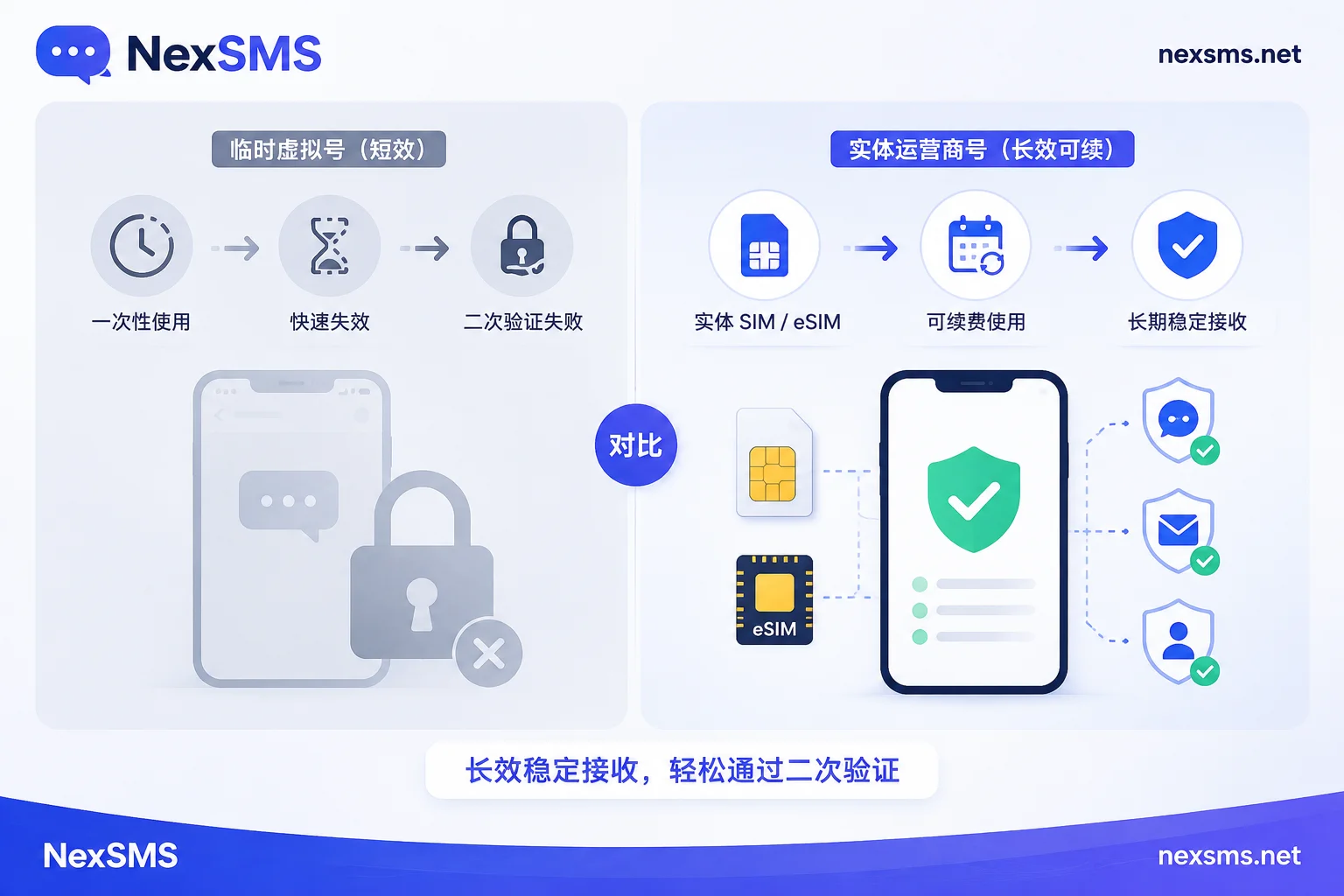
- Even if it's called "long-term rental", whether it can pass verification depends on the line type: only real carrier local numbers (physical SIM or eSIM) can withstand high-frequency two-factor authentication; virtual landline numbers (VoIP) packaged and rented monthly are still easily rejected.
- The key to saving money is "cross-platform reuse" rather than "multiple accounts on the same platform": numbers that allow unlimited SMS reception within the validity period are suitable for binding independent main accounts on different platforms simultaneously, amortizing the cost per platform; but never use the same number to repeatedly register on the same app.
- Check four things before ordering: first check the target app and country inventory, confirm the balance will not expire and reset, check whether it supports real-time web viewing and API parallel processing, and stay away from false advertising claiming "100% verification pass".
Once you understand these four bottom lines, you won't encounter "lost contact" just after you've built up your account when choosing long-term SMS verification.
1. How long can long-term SMS verification actually be used? Don't mistake "periodic holding" for "permanent purchase"
Many people new to SMS verification easily fall into two extremes: one is spending a few cents on a one-time number that can only be used for ten to twenty minutes, only to find days later when the account triggers re-verification that the original number is long gone; the other is trusting ads for "permanent SMS verification" or "lifetime buyout numbers", only to have the platform shut down or the number segment reclaimed, and the account still locked.
In real communication logic, any legitimate overseas mobile number has ongoing line maintenance costs, and there is no model of "pay once, receive SMS for free forever". A reliable long-term SMS verification service essentially locks in a dedicated period for you:
- Repeated use within the validity period: during the holding period, the same number belongs to you for receiving corresponding verification SMS, and will not be automatically destroyed after tens of minutes.
- Renew before expiration to extend permission: as long as you still need this number for login verification, rebinding, or recovery, you can continue to hold it by renewing before expiration; it is recommended to handle renewal three to five days in advance to avoid missing the deadline on the expiration day. For specific timing, refer to How to renew long-lasting numbers before expiration to avoid disconnection.
If you are registering for AI tools, social main accounts, Apple or Google accounts that you plan to use long-term, you should configure long-lasting numbers on a periodic basis from the start, rather than making do with one-time numbers.
2. Why do some numbers still fail to receive verification codes even though they are labeled "long-term rental"?
"I clearly rented a number for a month, why does it still say the number is unavailable when I enter it into OpenAI or WhatsApp, or simply fail to send SMS?"
This is the most common and frustrating situation in long-term SMS verification. The problem is usually not that the "rental period is not long enough", but rather two hidden pitfalls at the underlying number level:
1. Packaging virtual landline numbers (VoIP) as "long-term rental numbers"
Many low-cost SMS verification platforms, in order to keep costs down, package bulk-generated VoIP virtual numbers as long-term rental packages. On the surface, the number segment may belong to the US +1 or UK +44, but the target platform checks the communication routing attributes before sending the code—once it identifies a network virtual number segment, it blocks it directly and never sends the SMS. For the underlying differences between the two, you can compare What is the difference between real carrier local numbers and virtual landline numbers.
2. Numbers have been repeatedly abused before rental
If a number has already been used by dozens of users to bulk register on the same batch of popular apps before entering the long-term rental pool, it may have already hit platform limits (such as the registration cap per mobile number) or been flagged as a high-risk historical number by risk control systems.
Therefore, when choosing long-term SMS verification, be sure to confirm that the platform provides real carrier local numbers (local physical SIM or eSIM), and avoid using free public numbers open to everyone to bind important accounts—every verification code received by a public number is visible to everyone, and the number segments have long been tested to death by various scripts.
3. Can one long-term SMS verification number bind multiple platforms? How to calculate the most cost-effective way
Many people feel that the unit price of long-lasting numbers is significantly higher than one-time numbers, and wonder: is it worth buying a long-term number? In fact, this account should be calculated based on "cost allocated per platform", not by comparing the single-use price with one-time short-term numbers.
The key is to distinguish the boundaries between "cross-platform binding" and "multiple accounts on the same platform":
- Multiple accounts on the same platform (not recommended): The same platform usually limits the number of accounts a single mobile number can bind, and if multiple accounts on the same platform share one mobile number, once one triggers a violation or anomaly, it can easily affect the others. For a risk breakdown in this regard, see What are the risks of multiple overseas accounts sharing one number.
- Independent main accounts across platforms (high cost-effectiveness usage): If you have a set of daily cross-border work or personal overseas toolchain—for example, you need to maintain 1 Google, 1 OpenAI, 1 Claude, and 1 daily social account—as long as the long-lasting number you choose supports unlimited SMS reception within the validity period, you can use this same number to handle registration and subsequent two-factor authentication for these different platforms separately.
Calculated this way, the cost of possibly dealing with multiple overseas physical SIM cards and bearing high roaming monthly fees to keep numbers is directly consolidated into a single web backend for unified management; and even if one platform temporarily triggers risk control re-verification, you don't have to search everywhere for a physical SIM card to swap in and out.
Tip: If it involves core payment collection or store main accounts with large fund settlements, it is still recommended to "one number per account" and physically isolate them from daily testing or ordinary social media accounts.
4. Four checks before ordering: A pitfall avoidance checklist for long-term SMS verification
Before recharging on any SMS verification platform, it is recommended to check the following four items:
1. Check compatibility and inventory first, don't "recharge first then look for numbers"
Different apps' acceptance of number segments from different countries is constantly changing. The reliable approach is to first check the verification instructions of the target app and current country inventory, confirm numbers are available and check the price before ordering. Don't blindly lock a large amount of funds into an account with unclear inventory.
2. Check the recharge threshold and balance validity period
One of the most hidden losses in the SMS verification industry is "fund sedimentation": some platforms set high minimum recharge thresholds, or hide clauses in user agreements that "unused balance will be automatically reset after half a year/year". Users who use long-term SMS verification infrequently or on demand must choose platforms that support small recharges and explicitly state that account balances do not expire (for related pitfall avoidance details, see Avoid balance reset and recycling traps).
3. Confirm the SMS viewing method and automation scalability
Individual users value the ability to directly refresh and view codes in real-time on the web page without downloading additional clients; while teams or developers care about whether they can integrate number acquisition and SMS reception into their own workflows, achieving parallel processing on both web and API.
4. Beware of false promises of "100% verification pass"
No SMS verification platform can make decisions for third-party apps. Even with the cleanest real local physical SIM, whether an account can receive codes and pass review ultimately depends on the target platform's risk control rules at that time (including your network environment, device fingerprint, and registration behavior). Platforms that dare to state this clearly and also provide stable customer service to assist with troubleshooting are actually more trustworthy.
5. How to choose numbers and get started with NexSMS for long-term SMS verification?
If you are looking for a platform that clearly distinguishes "temporary one-time verification" from "long-term stable SMS reception" and does not require you to deal with overseas physical SIM cards and roaming packages yourself, you can directly choose numbers on NexSMS (nexsms.net) according to your needs.
On NexSMS, number types are directly divided into two categories by usage period to avoid choosing the wrong one:
- Short-term ordinary numbers: charged per use, short validity period, a number can only receive one verification code and cannot be renewed, only suitable for one-time registration or temporary verification that does not need to be retained.
- Long-lasting premium numbers: if what you need is a stable long-term SMS verification solution, choose this category. It uses real carrier local numbers (local physical SIM and eSIM, not virtual landline numbers), allows unlimited SMS reception on the same number within the validity period, and can be held by renewing before expiration. It is specifically designed for two-factor authentication, account recovery, and cross-platform binding.
The most reliable way to operate is to follow these three steps:
- Check instructions and inventory first, then log in and order: first go to the App SMS verification solution page to check common verification scenarios of the target platform (e.g., OpenAI SMS verification instructions), then go to the Country SMS verification page (e.g., US number SMS verification page) or Price and inventory page to filter by country and app, verify the real-time starting price, available number count, and applicable services, and then go to the Console to order. The specific validity days, real-time prices, available countries, and inventory are subject to the current pages on the official website.
- Recharge as needed, no worry about balance expiration: NexSMS supports Alipay, WeChat, and cryptocurrency (USDT / BTC) recharges, and account balances do not expire (non-transferable). You can recharge flexibly according to your actual current needs.
- View codes in real-time on the web, or contact customer service for API integration: verification codes are displayed in real-time on the web page. If you are a developer and need to integrate number acquisition and SMS reception into your program and run them in parallel with web SMS reception, since the platform does not provide public API documentation, you can directly contact the 24/7 Telegram customer service for integration methods.
In addition, the NexSMS official website also provides several US free public numbers (currently you need to log in to view verification codes), which are only suitable for casual testing. SMS received are visible to everyone, and must not be used to bind any important accounts. Finally, a reminder: NexSMS does not promise that any platform will definitely pass verification; whether it passes is determined by that platform's risk control rules at the time. If you have any questions about choosing numbers or usage, feel free to contact Telegram customer service to confirm.