 NexSms官方博客
In 2026, when preparing for cross-border e-commerce promotions, trying overseas AI tools, and maintaining daily social media matrix operations, getting mobile number verification done is almost the starting point for all business. However, many people looking for an SMS verification code receiving platform have experienced this frustrating cycle: after finally choosing a number and successfully receiving the code to register, the target platform triggers secondary verification two days later. Returning to the SMS receiving website, the temporary number from that time has long been released and reclaimed, and the account configured with great effort is scrapped on the spot.
As major overseas platforms become increasingly capable of identifying virtual number segments (VoIP), and some established SMS receiving websites shut down or reduce services, relying solely on "finding the cheapest temporary number" is no longer enough to complete the full business loop. If you do not want to waste money on top-ups, number selection, and re-verification, before using an SMS verification code receiving platform, you need to first clarify the most common pitfalls and align number types with your account lifecycle.
1. The Three Most Common Pitfalls When Using SMS Verification Code Receiving Platforms in 2026
In the past, people judged whether an SMS receiving platform was good often only by "a few cents per code" and "how many seconds to receive." But under the current risk control environment, what really causes heavy losses are usually the following three hidden issues:
1. Binding "one-time temporary numbers" to core assets that require re-verification
Many short-term numbers charged per use are designed for single verification and disposable use. Once the verification code is received or the brief window of around ten minutes passes, the number is reclaimed by the system. If you use such numbers to register for Google, Apple ID, PayPal, or cross-border e-commerce stores that require long-term login, once an unusual login prompt requires the original number to receive an SMS, you will completely lose control of the account. For why you still need to keep a number even with a 2FA authenticator bound, see our previous analysis: Why keep a long-term SMS receiving number even after binding an authenticator to the account?.
2. Blindly mixing public shared number pools, triggering instant rejection and privacy leaks
There are many completely public free code receiving pages online that require no registration. Such numbers are used by hundreds or thousands of people for testing every day and have long been marked as high-risk blacklists by major platforms' risk control systems. Entering them often prompts "number unavailable" or the SMS simply cannot be received. More dangerously, every verification code received by a public number is visible to everyone. Using one to bind any account involving personal information or funds is equivalent to "running naked."
3. Opaque top-up rules and the "balance expiry reset" trick
Many individual users or small studios do not receive codes frequently every day; they may only need to register a batch of accounts every month or two. Some platforms on the market set high minimum top-up thresholds and even hide clauses such as "if the account is unused for a certain period, the balance is automatically reset to zero." By the time you urgently need to log in next time, you discover the funds are gone. For a comprehensive platform-level check, you can also read How to choose an SMS verification platform: a 2026 selection checklist from the shutdown of established platforms and risk control upgrades.
2. How to Choose Among the Three Types of SMS Receiving Numbers? Match Based on Account Lifecycle
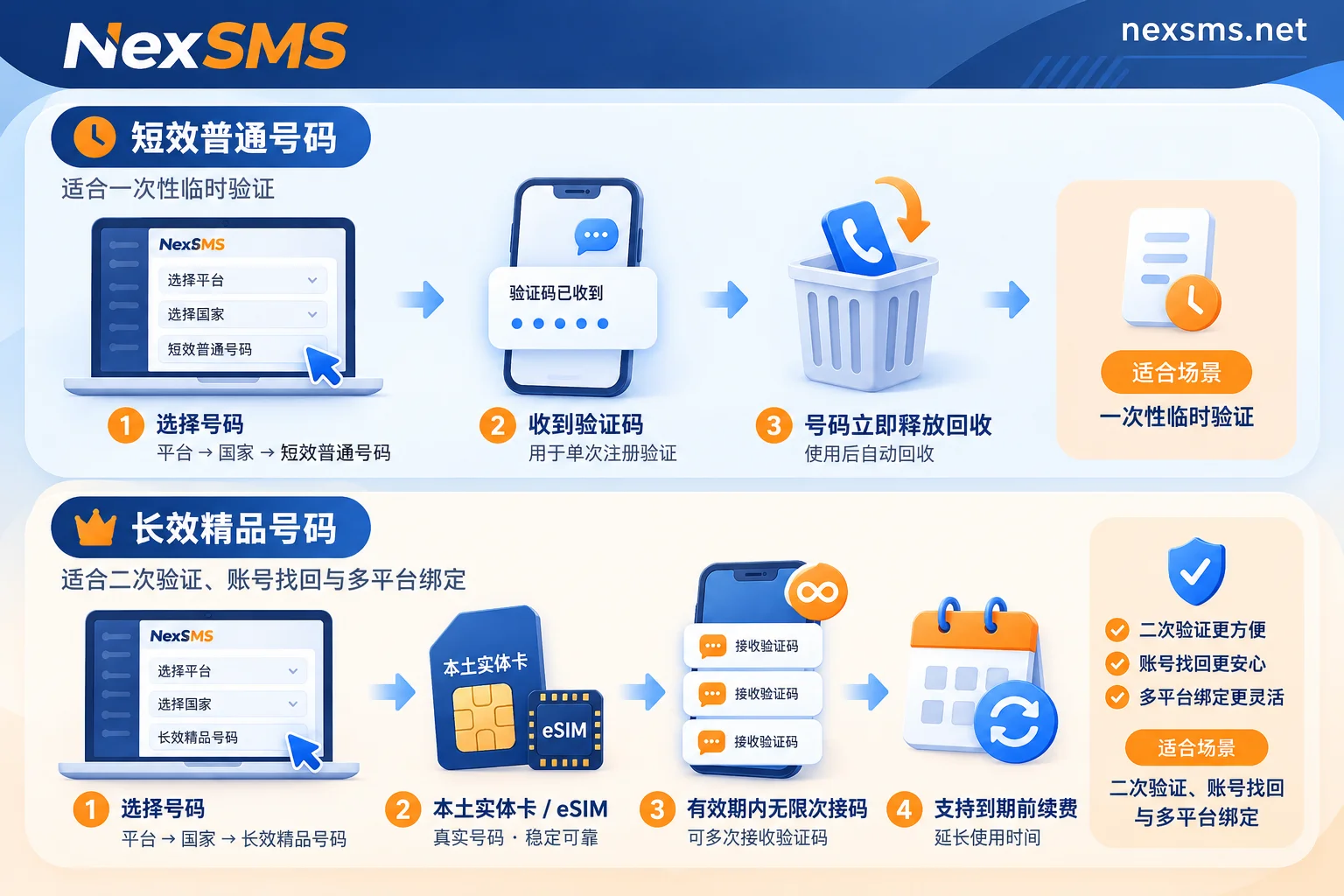
To avoid the above traps, there is only one core logic: before clicking order, first think clearly whether you plan to use this account for 10 minutes or for 1 year.
On the NexSMS product features page, we clearly divide number resources into different tiers corresponding to completely different verification needs:
| Number Type | Billing and Holding Rules | Core Route Characteristics | Applicable Business Scenarios | Risk and Limitation Notes |
|---|---|---|---|---|
| Free public numbers | View verification codes for free after logging in | A small number of US public numbers listed on the official website | Only for functional testing with no privacy requirements and running non-sensitive web processes | Verification codes visible to everyone; never use for any important account |
| Short-term ordinary numbers | Charged per use, short validity period | Covers number segments in multiple countries, dynamically changes with inventory | One-time registration, temporary verification, short-term tool trials | One number can receive only one verification code; cannot be renewed, and the same number cannot be used to receive again |
| Long-term premium numbers | Exclusive during validity period, can be renewed before expiry to continue holding | Real carrier local numbers (local physical SIM cards and eSIM, not virtual landing numbers) | Long-term account operation, secondary verification (2FA), account recovery, multi-platform binding | Priced higher than single-use short-term numbers; remember to renew in time before expiry |
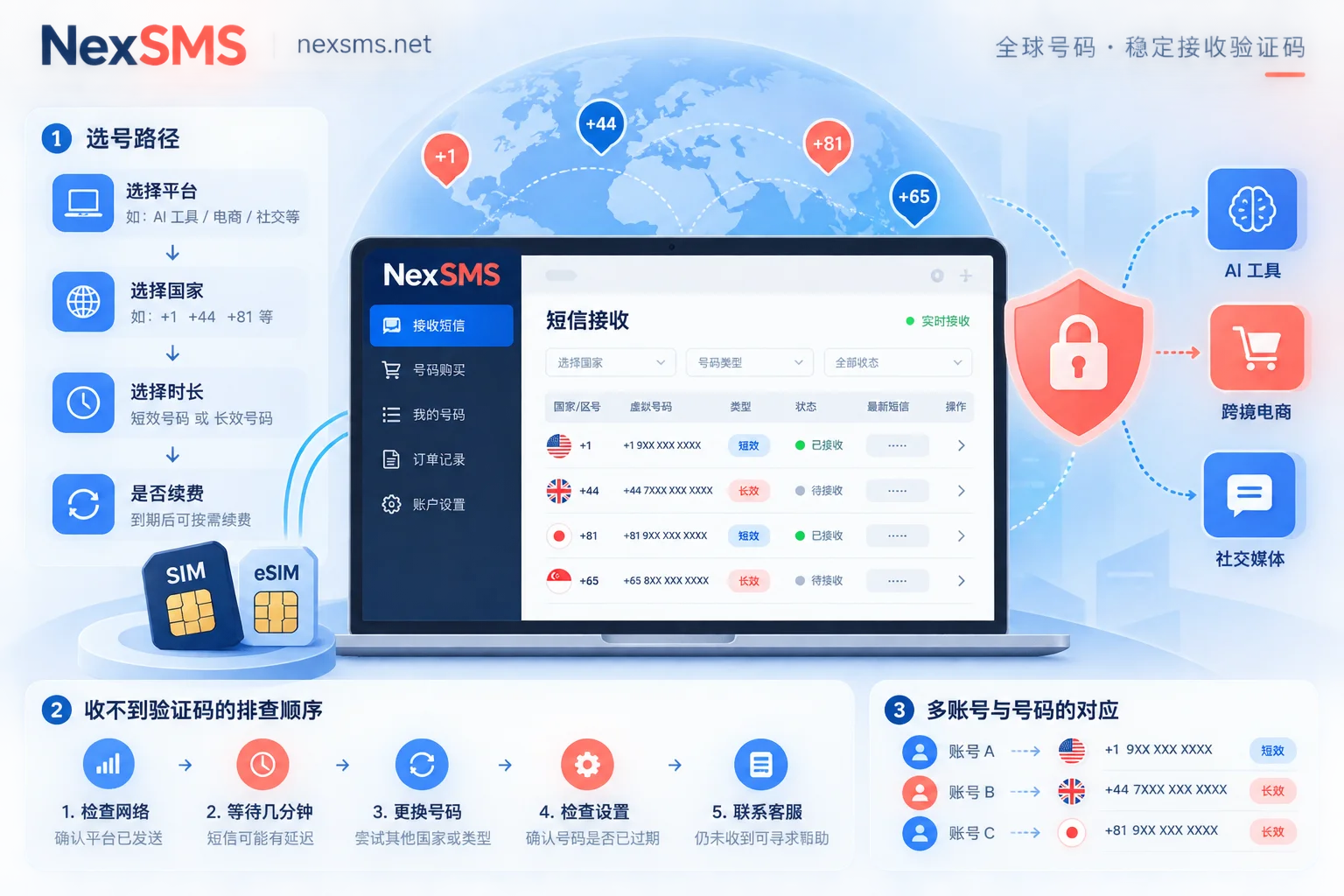
If you just want to temporarily try some non-core website, you can first check the free public numbers page. For regular one-time registration, short-term ordinary numbers billed per use are lightweight enough. But for AI main accounts, core social media, e-commerce seller backends, or payment tools, directly choosing long-term premium numbers (real carrier local physical SIM cards and eSIM) is the worry-free and cost-effective approach—within the validity period, the same number supports unlimited code receiving, completely eliminating the anxiety of "secondary verification means scrapping."
3. Practical Operations for High-Frequency Scenarios: How to Precisely Select Numbers by "Target Application + Country"?
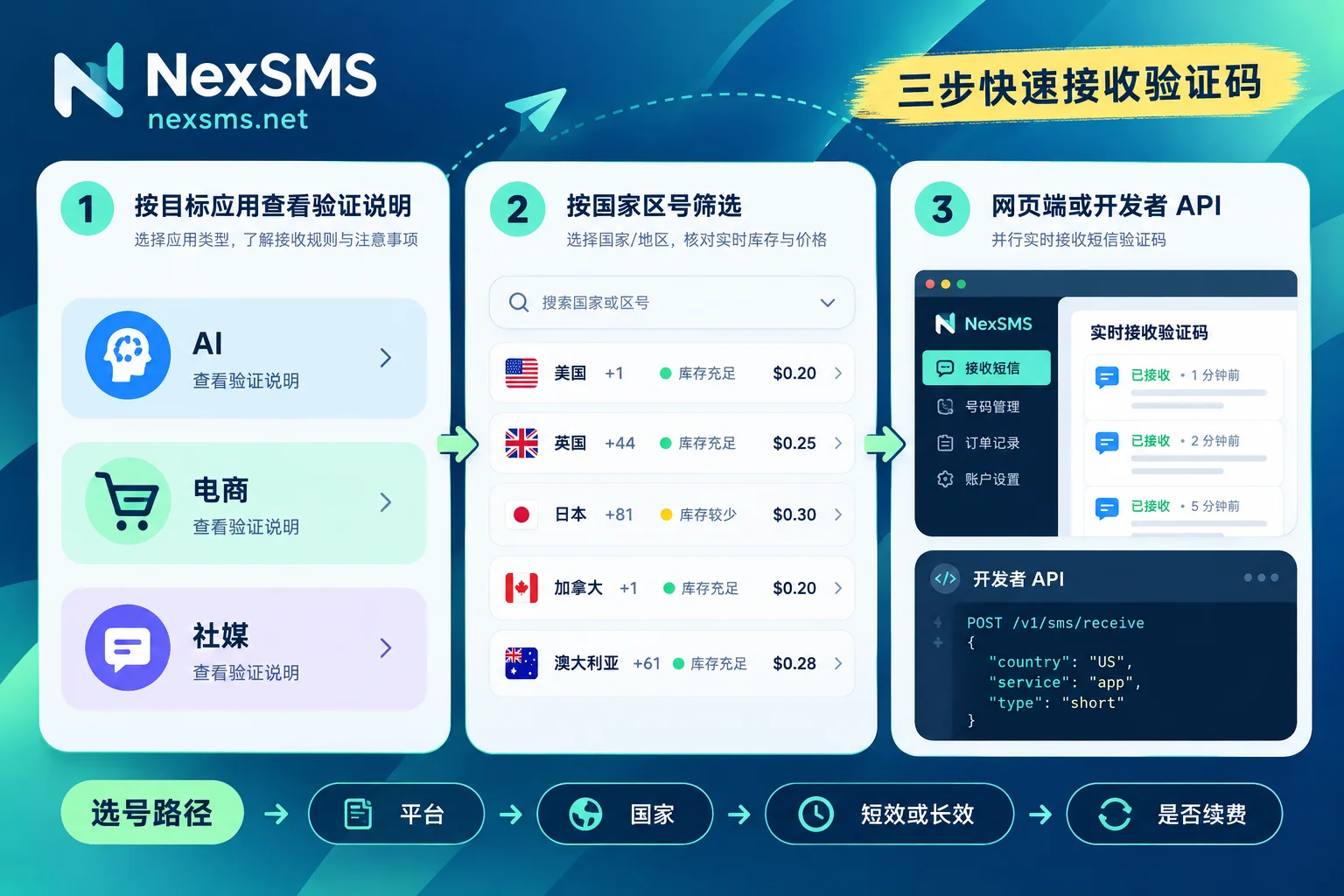
Different platforms have vastly different levels of pickiness about the country ownership of numbers and carrier routes. When selecting numbers on an SMS verification code receiving platform, do not "close your eyes and randomly pick a country code." It is recommended to operate in the order of "lock the application first, then filter the country, then check inventory and price":
1. Overseas AI service registration (OpenAI / Claude / Doubao, etc.)
Large model services are extremely sensitive to virtual number segments. In particular, platforms such as Claude are very strict in blocking VoIP number segments (see Telegram registration shows SMS Fee, Claude rejects virtual numbers: 2026 overseas platform SMS verification pitfall guide). Before registering, you can first consult the SMS verification instructions by application, for example, directly open the OpenAI SMS verification page or the corresponding pages for Claude and Doubao to learn about current verification steps and common issues. If you plan to subscribe long-term, prioritize configuring long-term premium numbers to handle possible subsequent risk control re-verification.
2. Cross-border e-commerce and payment bill verification (Amazon / eBay / PayPal / Xiaohongshu)
E-commerce and financial platforms verify numbers not only during registration. When modifying payment information, logging in from unusual locations, or performing high-frequency operations such as listing products during promotions, they are highly likely to trigger secondary SMS verification. In such scenarios, never make do with short-term ordinary numbers. You must use long-term premium numbers that support renewal and long-term holding to ensure that verification codes can be received in real time on the web throughout the entire store lifecycle.
3. Social media matrix and instant messaging (Telegram / WhatsApp / X / TikTok / Instagram / Facebook / WeChat)
Social media platforms often link phone country codes with recommendation algorithms and account weight. For example, operating US-region content or local life services (such as Gojek, Apple, etc.) requires precisely matching the local country code. You can first enter the select numbers by country page to view phone country codes and common verification uses in each region (for example, if you need a +1 number segment, you can directly visit the US SMS verification page), or go to single-application pages such as the X (Twitter) SMS verification instructions page to check details.
Objective number selection reminder: No SMS verification code receiving platform can promise 100% verification success. Whether a verification code can be successfully delivered and pass review is ultimately determined by the target platform's risk control rules at that time. Number source prices, available countries, and inventory all change with real-time conditions. Before ordering, it is recommended to check the current starting price and number of available numbers by application on the price and inventory inquiry page. Everything is subject to the real-time display on the official website.
4. Team Collaboration and Developer Automation: Manage the Code Receiving Process
When your business upgrades from "individual solo work" to "team multi-account operations" or "programmatic batch testing," buying numbers and receiving codes in a scattered way will bring huge management chaos.
- Friendly to funds and billing cycles: For low-frequency or intermittent users, the NexSMS account balance does not expire (non-transferable), completely avoiding the industry pitfall of "balance reset to zero after a year of non-use." Top-up methods cover cryptocurrency (USDT/BTC), Alipay, and WeChat, enabling smooth settlement whether you are in China or overseas.
- Real-time web code display and long-term renewal ledger: When a team maintains multiple long-term premium numbers, all SMS verification codes are displayed in real time on the web. It is recommended that the team keep an internal spreadsheet record and complete renewal in time before long-term numbers expire (refer to How to allocate mobile numbers when operating multiple accounts: layer by account value, one number per account, and note who renews).
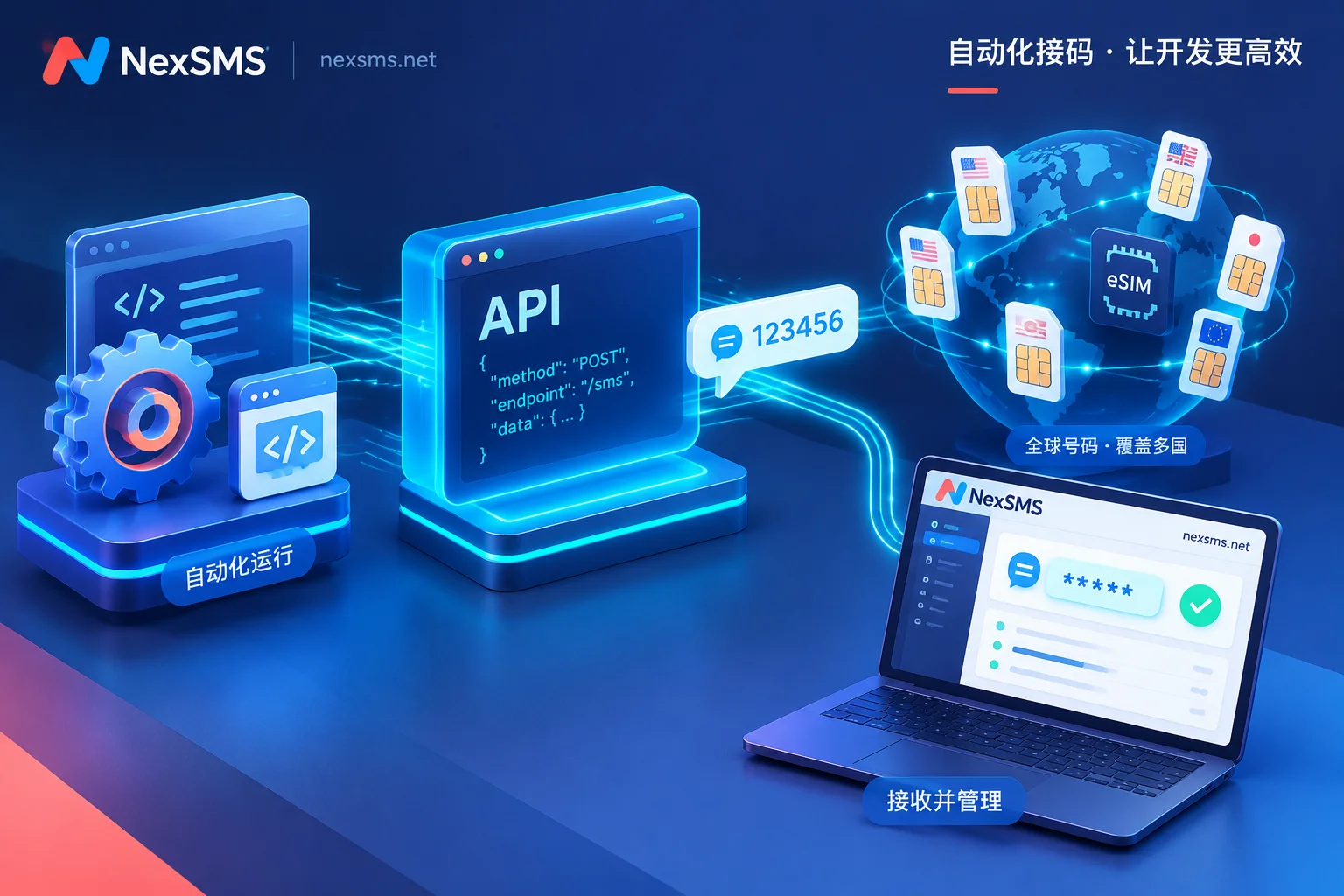
- Developer API parallel access: If you are a developer and need to write number acquisition and code receiving processes directly into automation scripts or testing workflows, NexSMS supports developer API access, and programmatic code receiving can operate in parallel with web-based code receiving. Since the platform does not provide public API documentation, teams with automation integration needs can directly find 7×24 online Telegram customer service through the contact customer service page for integration support (for technical selection ideas, see How to integrate SMS verification API into automated workflows? 2026 developer selection, number tiering, and anti-disconnection guide).
Conclusion: Use a Deterministic Number Strategy to Cope with Uncertain Risk Control
Choosing an SMS verification code receiving platform is essentially choosing a security foundation for your digital assets. Use short-term numbers for one-time testing to control costs, use local physical long-term numbers for core long-term assets to lock in ownership, and combine refined filtering by country and application to avoid detours under strict platform risk control in 2026.
You can now visit the NexSMS login and ordering backend to select suitable numbers based on your target application and country. If you have any questions about number selection or API integration, contact us anytime through 7×24 Telegram customer service.


Comments(0)