 NexSms官方博客
Whether registering for overseas AI tools, building cross-border social media matrices, or setting up overseas e-commerce and payment accounts, as long as you get stuck at the step of "entering a phone number to receive a verification code," most people's first reaction is to search for "overseas virtual numbers."
However, in the risk control environment of overseas platforms in 2026, lumping all "numbers that can receive SMS on web pages or apps without inserting a physical SIM card" under the term virtual numbers has become a cognitive misconception that easily leads to pitfalls. Many people spend time finding numbers, only to either see "this number segment is not supported" pop up directly on the registration page, or to completely lose their accounts just as they start to gain traction because they cannot pass secondary verification.
To solve the problem of cross-border SMS reception, the first step is not to blindly compare which provider is cheaper, but to thoroughly correct the concept of "overseas virtual numbers": what you really need is often not a number with virtual underlying attributes, but a service that allows you to use real overseas numbers online.
I. Why Are the "Overseas Virtual Numbers" You Find Increasingly Failing Verification?
In daily searches, "overseas virtual numbers" has been treated as a universal term. But in the eyes of telecom operators and risk control systems of overseas tech giants (such as Google, OpenAI, Meta, Amazon), numbers that can receive codes on web pages have completely different identity tags at the underlying level:
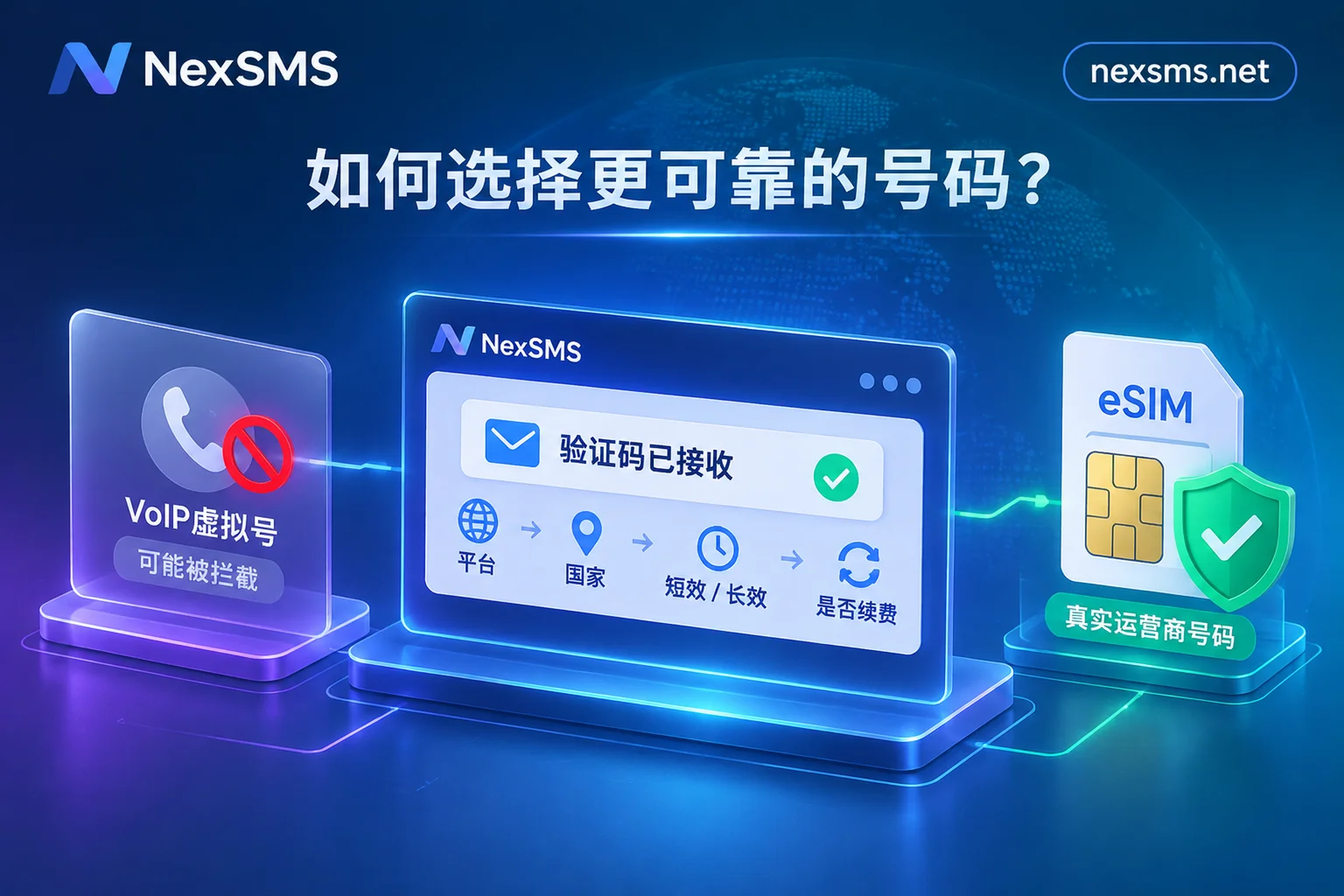
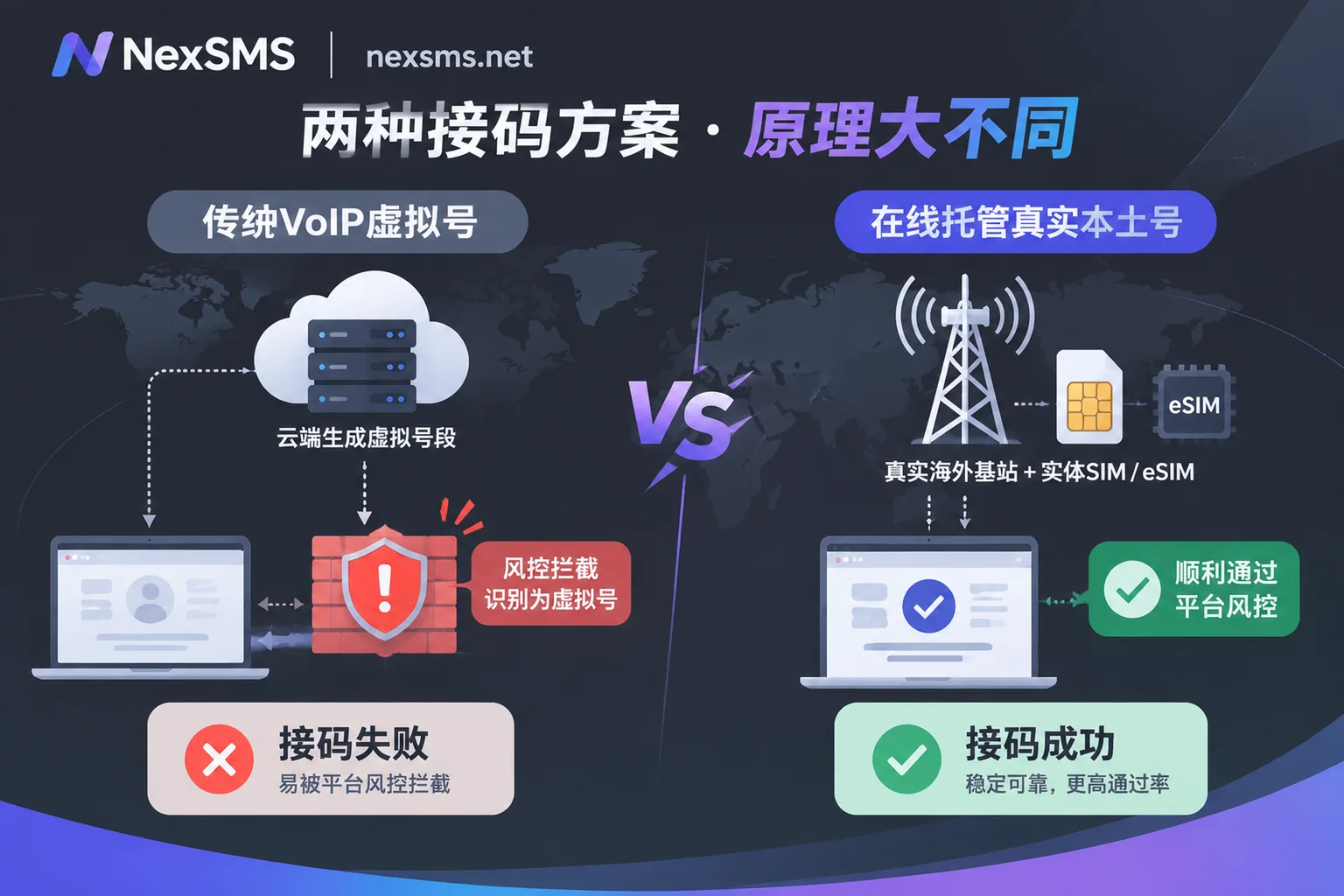
- Network virtual landline numbers (VoIP): These numbers are generated by internet telephony service providers and have no corresponding physical base stations or physical card slots. If you have previously learned about the current situation of Google Voice frequently banning and recycling numbers and TextNow being difficult to pass verification, you will understand why major platforms are intercepting them—because the generation cost is extremely low, and the risk control databases of various platforms have long blacklisted mainstream VoIP number segments, making them highly prone to rejection or instant bans when used for high-value platform registration.
- Online hosted real carrier numbers (physical SIM / eSIM): Users also view verification codes in a web backend, without needing to buy cards or insert SIM cards for roaming across countries, but the number is backed by a real card slot or eSIM of an overseas local mobile operator. In the platform's detection interface, it appears as a normal local mobile network number (Mobile).
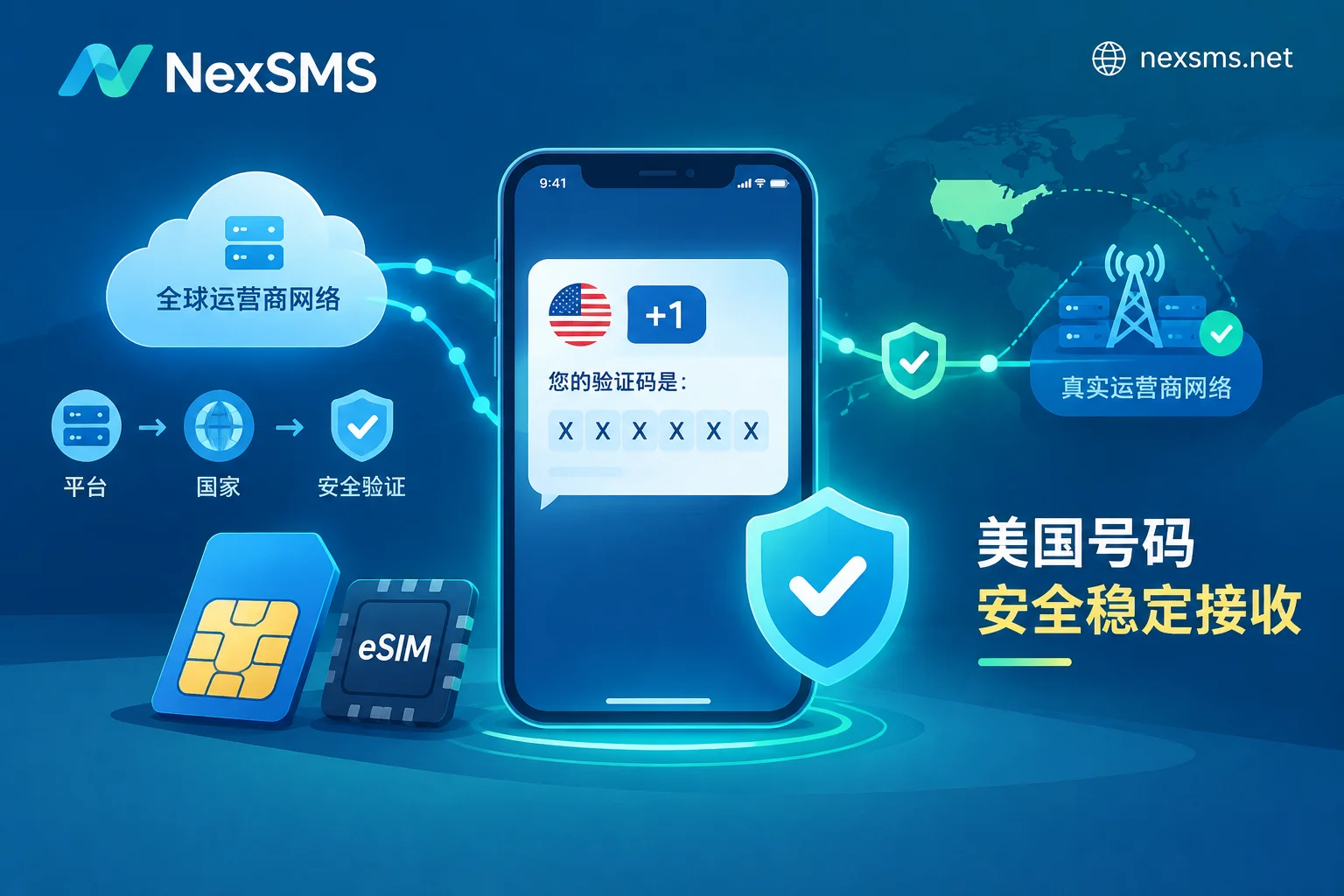
Therefore, when you search for "overseas virtual numbers," your core demand is actually the usage method of "receiving overseas SMS online without inserting a card or roaming", rather than buying a VoIP virtual number segment that is easily seen through by risk control systems. For how mainstream regions like the US identify the underlying number through databases, you can refer to 2026 US Phone Number SMS Verification Guide: Number Selection Logic under LNP Database Detection and 10DLC Tightening.
II. Match by Scenario: How to Choose Among Three Types of Online SMS Verification Solutions?
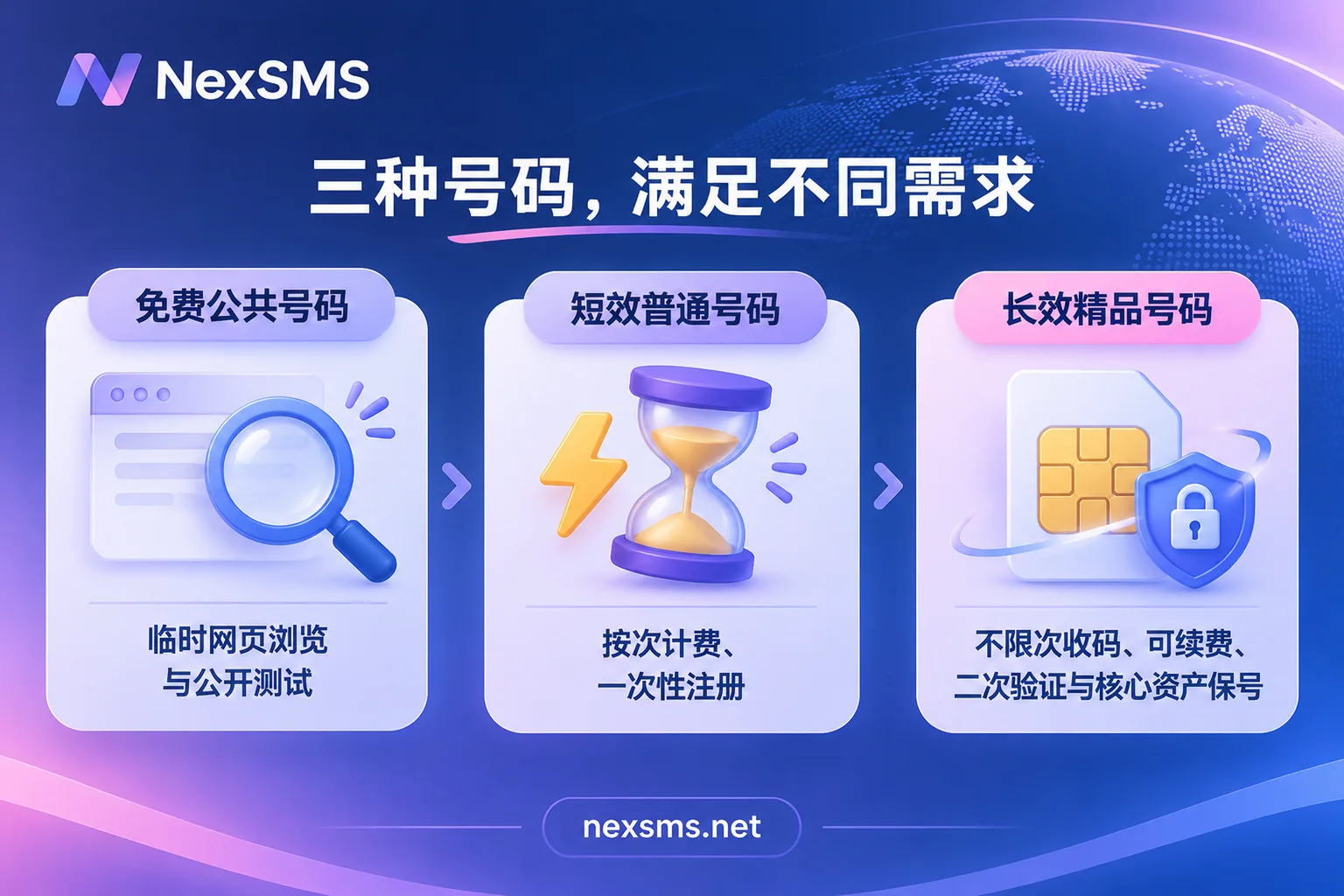
After clarifying the underlying logic, we don't need to "one-size-fits-all" buy expensive long-term packages for businesses of different importance levels. On professional online SMS verification platforms like NexSMS, numbers are clearly divided into different tiers, exactly corresponding to three typical scenarios of overseas business:
1. Casual Web Testing and Irrelevant Browsing: Free Public Numbers
If you just want to temporarily open an overseas information site that requires phone verification to view content, or test the SMS sending process of an obscure webpage, you don't need to spend money at all.
- Applicable solution: You can use the free public numbers provided by NexSMS. The official website lists several US public numbers; after logging in, you can view the verification codes received in real-time on the web page.
- Security boundary: SMS received by public numbers are visible to all logged-in users. As explicitly stated on the official website, absolutely do not use public numbers for any important accounts or services involving personal privacy.
2. One-Time Registration and Short-Term Channel Testing: Short-Term Ordinary Numbers
When doing peripheral social media traffic diversion, testing new platform registration links, or activating some tools that do not require secondary login verification, maintaining a number long-term is obviously not cost-effective.
- Applicable solution: Choose short-term ordinary numbers. It adopts a pay-per-use model with a short validity period; one number is only used to receive one verification code and is discarded after use, not supporting renewal or repeated SMS reception.
- With automation: If a technical team needs to conduct large-scale compliance verification tests in a business system, the number acquisition and SMS reception process can also be integrated into programs via the developer API, working in parallel with the web interface (developers with API integration needs can directly contact Telegram customer service for integration support).
3. Core Business Accounts, Two-Factor Authentication, and Long-Term Retention: Long-Term Premium Numbers
When the scenario switches to main OpenAI/Claude accounts, cross-border e-commerce stores (Amazon/eBay), payment tools (PayPal), or long-term operated WhatsApp, Telegram private domain accounts, using "one-time numbers" for secondary verification of important accounts is tantamount to planting a time bomb. Once encountering remote login re-verification or forced rebinding, not receiving the second code means assets go to zero.
- Applicable solution: You must configure long-term premium numbers. NexSMS's long-term premium numbers are not virtual landline numbers, but real carrier local numbers (sourced from local physical SIM cards and eSIM).
- Core advantage: Not only can they smoothly pass strict risk control that rejects virtual numbers, but within the validity period, the same number supports unlimited SMS reception; before expiration, you only need to renew to continue holding the number, perfectly closing the loop for two-factor authentication (2FA), account recovery, and multi-platform compliant binding.
III. Don't Blindly Try Your Luck: Before Ordering, Filter by "Country + Application" in Both Directions
Many people have another common bad habit when using overseas numbers: randomly buying a number from a country and then trying it in various apps one by one. But in 2026, the risk control strategies of different applications for different country number segments are dynamically adjusted every day (for troubleshooting common errors, you can read 2026 Overseas App SMS Verification Error Troubleshooting Guide).
To reduce ineffective attempts, a more reliable approach is to confirm in both directions before ordering:
- First check the dedicated instructions for the target application: Whether you need to verify OpenAI, Claude, Google, Apple, or Telegram, WhatsApp, X (Twitter), TikTok, Amazon, PayPal, you can first visit the View SMS Verification Instructions by Application page. Each application has an independent page detailing common verification scenarios, specific operation steps, and frequently asked questions.
- Then select a number by country and check real-time inventory: If your business has strict requirements for account attribution (such as local stores or specific regional social media operations), you can go to the Select Number by Country page (for example, if you need a +1 number segment, you can directly view the US SMS Verification Zone). Each country page indicates the international area code, common local verification platforms, and main uses.
- Transparent pricing and flexible settlement: Since number sources change dynamically with inventory, it is recommended to first check the starting price and currently available number count for your target application on the Price and Inventory Inquiry Page. After confirming suitability, proceed to the User Dashboard to log in and place an order. The platform supports Alipay, WeChat, and cryptocurrency (USDT/BTC) top-ups, and account balances do not expire; you are charged only for what you use, with no hidden anxiety about monthly fees resetting to zero.
Conclusion
It is necessary to objectively remind that any SMS verification tool is only responsible for providing a real and stable communication channel for receiving SMS; whether a specific platform can currently pass verification is ultimately determined by the platform's risk control rules at that time and your operating environment.
In 2026, with both overseas compliance and risk control tightening, stepping out of the vague concept of "overseas virtual numbers," understanding the boundary between VoIP and real local cards, and learning to use free numbers for irrelevant testing, short-term numbers for temporary registration, and long-term real numbers to protect core assets—this is the way to manage cross-border accounts that saves both money and worry. If you encounter any questions during number selection or API integration, you can always get manual assistance through 7×24 Telegram customer service.