 NexSms官方博客
Conclusion first: Getting an overseas phone number that can receive verification codes does not necessarily require buying a physical SIM card from overseas or switching to a foreign version phone that supports eSIM.
Many people who just search for "overseas phone number" make two common mistakes: First, they spend money on an overseas number even though the target platform already supports +86; Second, they don't distinguish between data-only cards, VoIP virtual numbers, self-owned maintenance cards, and online SMS receiving numbers, and end up buying something that can't be installed on their phone, fails platform verification, or gets suspended and recycled by the operator after a few months.
If you are in China and want to get a usable overseas phone number cost-effectively and reliably, follow these four steps to avoid pitfalls.
Step 1: Before Spending Money, Confirm These 3 Things
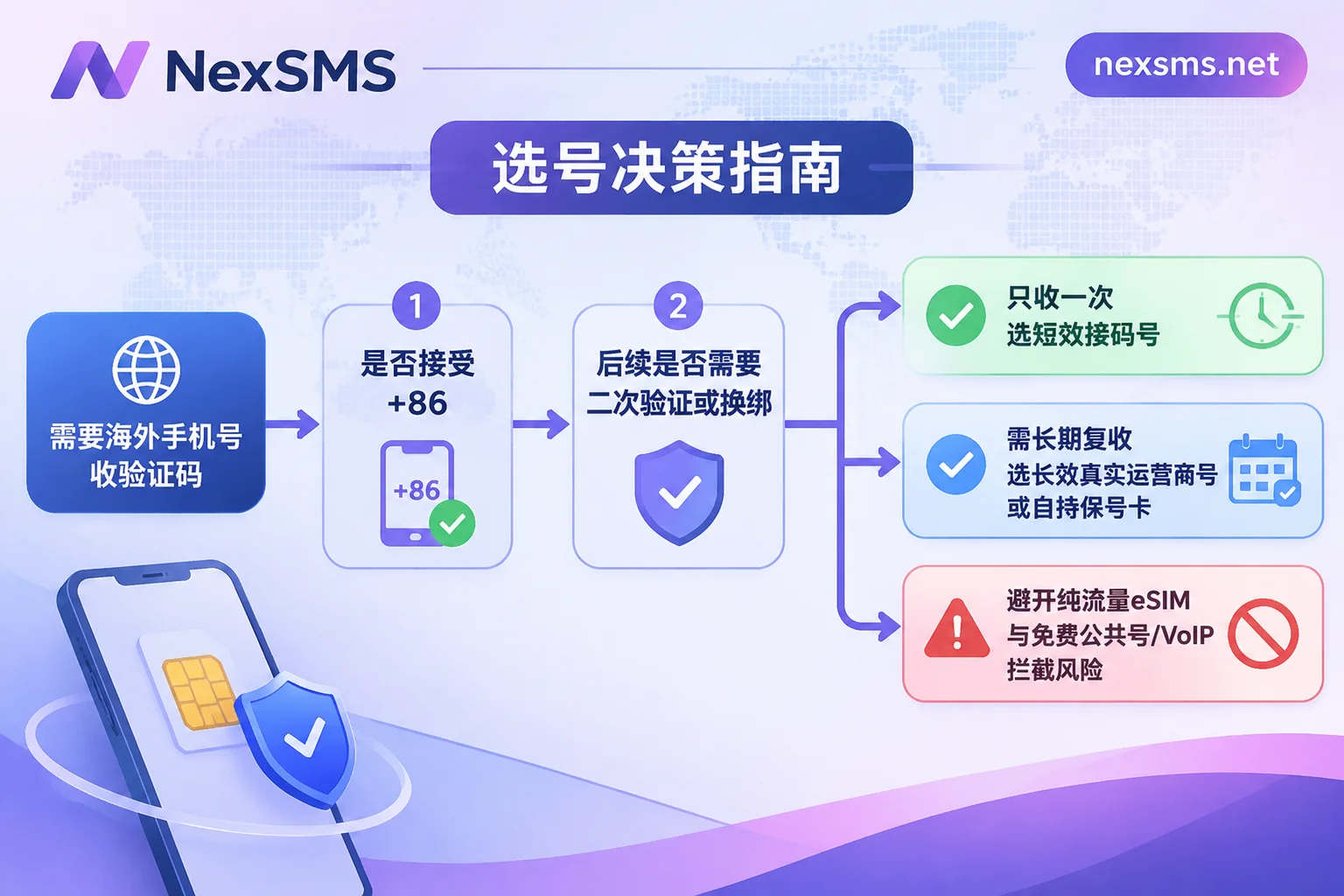
1. Does the target platform really not accept +86?
Many newcomers to overseas markets habitually look for a number first and then register, but many tools and cross-border payment services for global users actually support domestic +86 phone numbers. Before registering, open the verification page of the target platform and check whether +86 is in the area code list, or whether the current step forcibly requires a local overseas number. If you can solve it with your own main number or a domestic secondary number, using a local number is the most hassle-free; only when you encounter not supporting +86, registration failure, or you deliberately want to isolate the registered account from your private main number do you need to prepare an overseas phone number.
2. Will you need to "receive another code with the same number" in the future?
This is the core dividing line that determines whether you should spend a few dollars or a few hundred:
- One-time use only: For example, temporarily testing a website or registering a non-core trial account, you only need to receive that one registration SMS at the moment, and that's it.
- Need to receive again: For example, binding to commonly used AI tools, social media operation accounts, cross-border e-commerce stores, or Apple ID. Later, when you change devices to log in, trigger risk control two-factor authentication (2FA), change password, or rebind, the platform will still send SMS to the original number.
Once there is a possibility of receiving again later, never choose a one-time number just to save money, otherwise you won't receive the verification code next time, and the account will basically be stuck.
3. Can your phone and documents pass the hardware and real-name thresholds?
If you plan to hold a physical SIM card or eSIM from an overseas operator for a long time, first check two practical limitations:
- Limitations of installing foreign eSIM on China version phones: According to Apple's official statement on using eSIM in mainland China, even for China version iPhone models that support eSIM in mainland China, eSIMs provided by overseas operators cannot be installed within mainland China (you need to travel abroad and enable location to activate a local travel eSIM, and there is a limit on the number stored on the device). Most China version Android phones also do not support native overseas eSIM.
- Real-name registration and activation thresholds: For example, after Hong Kong implemented the real-name registration system for smart phone cards, all stored-value cards must be activated with the original valid identity document for real-name registration, and there is a limit on the number of stored-value cards an individual can register with each local telecom operator (currently no more than 10 per operator, and the local authorities are studying further tightening); while some European and American phone cards require activation in a local network environment or renewal with a foreign currency credit card.
Step 2: Comparison of 4 Types of "Overseas Phone Number" Solutions on the Market, Don't Confuse Them
When searching for overseas phone numbers, you will see four completely different products. Their differences directly determine whether you can receive SMS and whether your account will be banned.
| Solution Type | Has real mobile number segment | Hardware and activation threshold | Platform pass rate and risk control | Suitable for whom |
|---|---|---|---|---|
| 1. Travel / data-only eSIM | Mostly no phone number, only internet data | Requires a phone that supports overseas eSIM | Cannot send or receive verification SMS | Only for internet access abroad, do not use for receiving codes |
| 2. VoIP virtual number (e.g., Google Voice, TextNow) | Belongs to VoIP number, not a mobile card number | Mostly requires overseas network and specific regional environment; personal GV requires a US number for auxiliary verification | More and more AI, social media, and payment platforms directly block VoIP number segments | Only for low-risk daily communication or receiving ordinary SMS |
| 3. Self-owned overseas physical card / eSIM (e.g., UK/US/HK maintenance cards) | Yes (real operator number segment) | Requires waiting for physical card delivery or a foreign version eSIM phone; some require real-name registration with documents, and enabling Wi-Fi Calling | High (it's a long-term number under your name), but subject to regional and operator roaming policies | People who hold overseas bank/financial accounts long-term and can actively maintain the number periodically |
| 4. Online SMS receiving platform numbers (e.g., NexSMS) | Clear distinction between short-term and long-term numbers; long-term premium numbers are real operator local physical cards/eSIMs | No hardware threshold, directly get number and view code on the web, supports Alipay/WeChat/USDT recharge | Far from VoIP blocking, precise number selection by country and target app; but subject to platform real-time risk control | Individuals and teams in China who don't want to deal with physical cards, need multi-country number segments, or need immediate use |
Why do many "low-cost overseas cards" disappear after a while?
If you plan to get a self-owned overseas physical card or eSIM maintenance card, besides the activation fee and monthly fee, you also need to calculate maintenance effort. For example, the common UK giffgaff not only requires an active billable action every 6 months (just receiving SMS doesn't count as active), but its roaming fair use policy is mainly for short-term travel (e.g., roaming abroad for more than 63 days within 4 months may trigger restrictions or even termination of service); some US prepaid cards must be connected to stable Wi-Fi Calling in China to receive SMS at low cost. Once you use ordinary international roaming, a few SMS or a mistakenly answered call may drain your balance. For related practical pitfalls, you can also refer to our Giffgaff and Tello maintenance card pitfall avoidance alternative analysis.
Step 3: Don't Want to Buy a Physical Card or Deal with eSIM? Choose Online Numbers by Scenario
If you are in China, don't have an overseas credit card, only have a China version phone, or need to use overseas phone numbers from multiple countries at the same time, directly getting a number and receiving codes on the web via NexSMS is the lowest-threshold approach—no waiting for delivery, no inserting or removing cards, verification codes are displayed in real time on the web page.
However, before placing an order, you must distinguish the purposes of three types of numbers and not choose the wrong type:
Scenario 1: Temporarily testing software, registering an unimportant trial account → Choose "short-term ordinary number"
- How it's billed and works: As seen on the NexSMS product features page, short-term ordinary numbers are billed per use, have a short validity period, and a number can only receive one verification code, used up and cannot be renewed.
- Why not make do with free numbers: NexSMS official website also provides a few free US public numbers (free SMS receiving page, currently you need to log in to view SMS), but the verification codes received by public numbers can be seen by everyone, and the official also clearly warns not to use them for any important accounts. As long as personal privacy is involved or you are afraid of someone else using the number to recover your password, it's safer to spend a little money on an exclusive short-term number.
Scenario 2: Need secondary verification, rebinding, or recovery after registration → Choose "long-term premium number"
- Why not use a short-term number: When registering accounts such as OpenAI, Claude, Google, Apple ID, Telegram, WhatsApp, X, Amazon, etc., even if you successfully get in with a short-term number this time, when you change devices to log in or trigger security re-verification a few days later, the short-term number can no longer receive a second code (for how to choose between these two types of numbers, see Short-term vs. Long-term Premium Number Selection Guide).
- How to use long-term premium numbers: NexSMS's long-term premium numbers come from real operator local numbers (local physical cards and eSIMs, not virtual landing numbers). Within the validity period, the same number can receive verification codes unlimited times. Renewing before expiry allows you to continue holding it, suitable for secondary verification, multi-platform binding, and account recovery.
Scenario 3: Determined to register only one specific overseas app → Directly choose number "by app" or "by country"
- Many times the problem is not that the number is bad, but that the country code and target app don't match. On NexSMS, you can directly check the verification scenarios and precautions for specific apps through the app solution directory (covering common platforms such as OpenAI, Claude, Google, Apple, Telegram, WhatsApp, X, Instagram, TikTok, Amazon, PayPal, etc.), then confirm the current unit price and stock on the price and available inventory page or country SMS receiving page (e.g., US page
https://nexsms.net/sms/united-states/) before getting a number.
Scenario 4: Team multi-account or automated business → Use developer API for parallel code receiving
- If you are a team maintaining multiple accounts, or need to integrate number acquisition and code receiving into your own program workflow, NexSMS supports parallel code receiving via API and web. For specific integration methods, you can get support through the official 7×24 hour Telegram customer service.
Step 4: 3 Boundaries You Must Remember When Using Online Overseas Phone Numbers
No matter which channel you use to obtain an overseas phone number, keep the following three rules in mind before starting, and you can avoid 90% of detours:
- Short-term numbers are irreversible: Once a NexSMS short-term ordinary number is used, it cannot be renewed, nor can the same number be used to receive a second verification code; if you have long-term plans, directly choose a long-term premium number when ordering.
- No platform can guarantee 100% pass: Whether SMS can be sent and whether the account can pass review is ultimately determined by the target platform's risk control rules at that time (including your current network environment, device environment, number location matching, etc.). Choosing a real operator local number only helps you get past the "number type blocked" hurdle, and cannot replace a compliant usage environment.
- For financial and high-value core assets, prioritize your own real-name number: If you are binding to overseas bank cards, securities accounts, or other accounts directly related to large funds, in the long run it is still recommended to prioritize operator physical cards/eSIMs registered with your own documents, or simultaneously enable Passkey and authenticator as backup verification methods in the account backend.
Start Getting a Number Now (4 Steps to Complete)
- Open the NexSMS user dashboard to register and log in (supports Alipay, WeChat, and USDT/BTC recharge; account balance never expires and is non-transferable).
- On the number selection interface, filter by target app and country, confirm the price, current stock, and whether you need a short-term or long-term premium number (the current validity days and charges are subject to the official website's real-time page).
- After clicking to get a number, fill in the number in the target platform's verification box to send SMS, and within seconds to tens of seconds, you can see the verification code in real time on the web page.
- If you bind a long-term premium number, remember to mark the expiry date in your ledger and renew in time before expiry to continue keeping the number.