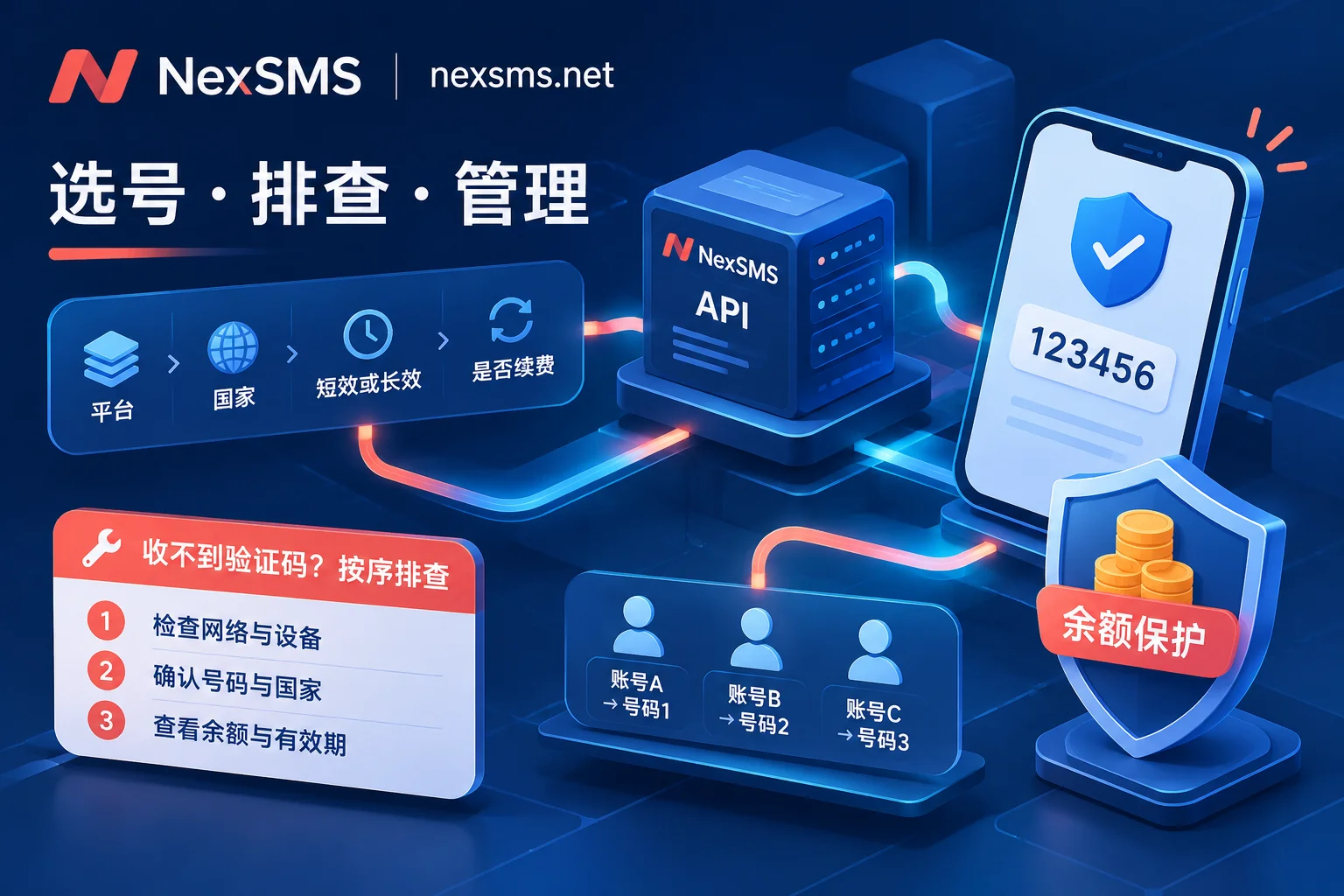
 NexSms官方博客
Direct answer: Legitimate SMS verification APIs typically do not charge when no verification code is received. The industry standard practice is: 'pre-authorize a balance when acquiring a number, officially charge only after successfully receiving the SMS; if no SMS is received within the validity period, the pre-authorized amount is refunded to the account balance upon manual cancellation or order timeout' (specific refund conditions and waiting times are subject to each platform's official rules).
However, many developers still find that actual consumption is much higher than expected after integrating the SMS verification API into their programs. The reason is often not 'charging even when no code is received', but the following three engineering and selection pitfalls:
- Looking only at the listed price and ignoring the success rate: Low-cost VoIP virtual numbers are blocked by carrier detection when clicking to send the code on the target platform. Repeatedly switching numbers and retrying not only drags down the script execution cycle but also incurs various time and proxy losses.
- Timeout retries without idempotency protection: When a number acquisition request times out due to network issues, it is immediately resent. As a result, the upstream may have already successfully placed an order, and one verification is charged twice.
- One-time numbers encountering secondary verification: The code was received and charged at the time, but when the account triggers re-verification a few days later, the original number has been released, the account becomes invalid, and all previous investments are lost.
If you are preparing to integrate an SMS verification API, the most reliable approach is: Don't rush to write code. Spend 10 minutes running through 3–5 numbers on the web, calculate the 'cost per effective verification', confirm the integration threshold and refund rules, and then decide whether to incorporate it into your automation workflow.
1. How Are SMS Verification APIs Billed? Don't Be Misled by 'Ultra-Low Unit Prices'
When comparing SMS verification API prices, don't just look at the '$0.05 per use' stated in the API documentation or price list. You need to factor in three common billing models and hidden losses together.
| Billing Dimension | Common Model | Pitfalls Developers Fall Into |
|---|---|---|
| Per-use number acquisition (short-term) | Pre-authorize on acquisition, charge only upon SMS receipt; refund on timeout or cancellation if not received | Some platforms have a cooldown period for canceling orders (e.g., release only allowed after 2 minutes); or there may be floating deviations between API quotes and actual charges |
| Periodic rental (long-term) | Pay by day/week/month, unlimited SMS verification receptions during the rental period | If long-term numbers are used as one-time numbers and discarded after use, the per-use cost is high; conversely, using short-term numbers for important accounts leads to immediate loss upon secondary verification |
| API activation threshold | Available upon registration, or requires cumulative actual paid recharge to reach a certain threshold before API Key is opened | When established platforms face operational risks, large pre-paid recharges can lead to fund sedimentation or inability to consume in time |
Calculate the Real Cost: Cost per Effective Verification
Suppose API A is priced at $0.05 per use, but its underlying pool is heavily mixed with traditional VoIP number segments. When facing overseas applications with strict risk control, it may take an average of 5 numbers to get 1 that can successfully send and receive a verification code. Not only does the script have to wait through several timeout rounds, but the associated proxy IP traffic and browser instance time are also idling. If API B uses real carrier local numbers, although the unit price is higher, it can reliably pass verification in one or two attempts. The true cost per code = unit price ÷ actual success rate, which turns out to be lower.
On platforms like NexSMS that offer number tiering capabilities, you can split your budget based on task lifecycle: use per-use short-term standard numbers (short validity, one code per use, non-renewable) for one-time registrations or temporary verifications; for core businesses requiring secondary verification, account recovery, or multi-platform binding, switch to long-term premium numbers based on local physical SIM cards and eSIMs (unlimited code receptions for the same number within the validity period, renewable before expiry to continue holding). For the applicable boundaries and detailed features of the two types of numbers, you can directly compare them on NexSMS's SMS verification API product feature page.
2. First Confirm One Thing: Do You Really Need an SMS Verification API Now?
Many people start by looking for API documentation, but in fact, more than half of the scenarios don't require writing an interface at all.
- When to use the web interface directly: You only need to handle a few to a dozen verifications per day, manually assist with new number initialization, or are in the business exploration phase where the target platform's risk control rules are still being frequently tested. Directly selecting country, application, and viewing codes in real-time on the web is much faster to debug than writing scripts.
- When to integrate the SMS verification API: You have dozens to hundreds of verification needs per day, CI/CD automated testing pipelines require unattended registration/login regression runs, or you need to automatically acquire and fill numbers in internal operations systems and AI Agent workflows.
- The more recommended compromise — 'API + Web' in parallel: Put routine batch number acquisition and polling in the program to run automatically; when encountering occasional timeouts, complex CAPTCHAs, or needing to check the original SMS content, operations or developers can directly open the web backend to view the numbers and SMS status under the same account.
Take NexSMS as an example: its developer API supports parallel use with web-based code reception, the account balance is shared between web and program calls, it supports USDT/BTC cryptocurrency as well as Alipay and WeChat recharges, and the account balance never expires (non-transferable). Note that NexSMS does not have publicly available API documentation. If you determine after evaluation that you need programmatic integration, simply obtain the integration method through the official 24/7 Telegram customer service.
Also, a special reminder: Do not use free public SMS verification numbers as an API test number pool. For example, the free public numbers listed on the official website (currently require login to view received verification codes) allow all logged-in users to see the SMS content, which can easily lead to collisions or leakage of verification information. They are neither suitable for formal business nor can they test the success rate of truly exclusive number sources.
3. Do 'Pre-Integration Testing' Before Writing Code: 4 Steps to Save 80% of Trial-and-Error Costs
Before writing the SMS verification interface into the production environment, it is recommended to go through the following four steps of manual verification before coding:
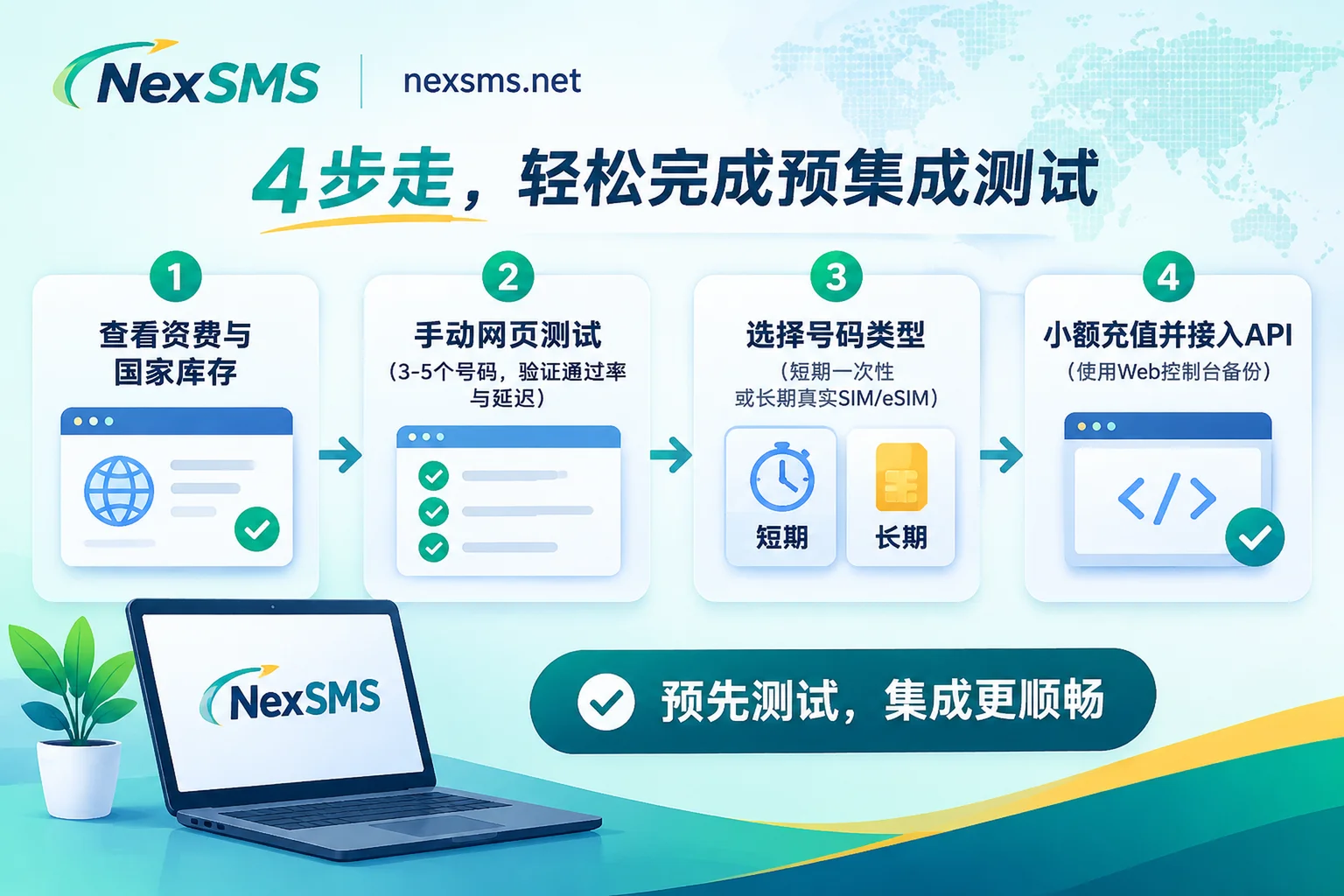
Step 1: Check real-time inventory and starting prices for the target application and country
Do not hardcode a country code in your code based on impression. Different platforms' risk control strictness for various country number segments is constantly changing dynamically. Before placing an order, go to NexSMS's price and inventory page to confirm the starting price and available number count for the target application, then refer to the application SMS verification instructions (covering common services like OpenAI, Claude, Google, Telegram, WhatsApp, X, TikTok, Amazon, PayPal, etc.) and the number selection page by country (e.g., the US SMS verification page) to check common verification precautions.
Step 2: Manually run through 3–5 numbers on the web
After logging into the NexSMS console, use the actual proxy exit and terminal environment of your target business to manually acquire 3–5 numbers and go through the complete verification process. Focus on three indicators:
- After clicking send on the target application, does it directly pop up 'number unavailable / not supported'?
- How many seconds does it usually take for the SMS to be displayed in real-time on the web after clicking send?
- Under the same country, how much difference is there between short-term standard numbers and long-term premium numbers?
Note: Proxy IPs, multi-account browser fingerprint environments, and CAPTCHA recognition are peripheral supporting aspects and are not within the scope of the SMS verification platform's services. During testing, please ensure your network exit is clean and stable to avoid misjudging IP risk control as a number issue.
Step 3: Verify validity periods and refund details
Before writing the logic into the program, be sure to verify the current refund rules, timeout release cycle, and validity period days of long-term numbers for the target platform. Prices, inventory, validity period days, and refund details are subject to dynamic adjustments based on carriers and market supply. Please always refer to the official website's real-time display or customer service confirmation.
Step 4: Run with a small recharge before scaling up
After the established platform SMS-Activate ceased operations at the end of 2025, the biggest lesson from the industry reshuffle for all developers is: Always recharge in small amounts as needed. Never hoard large funds in any SMS verification account at once (for more dimensions to consider platform stability, refer to 'How to Choose an SMS Verification Platform: 2026 Selection Checklist from the Perspective of Established Platform Shutdown and Risk Control Upgrades').
4. Formal Integration of SMS Verification API: 4 Engineering Details to Prevent Duplicate Charges and Code Loss
Once you enter the coding phase, the most money-burning aspects are often the 'exception branches'. The following 4 designs can help you minimize invalid charges:
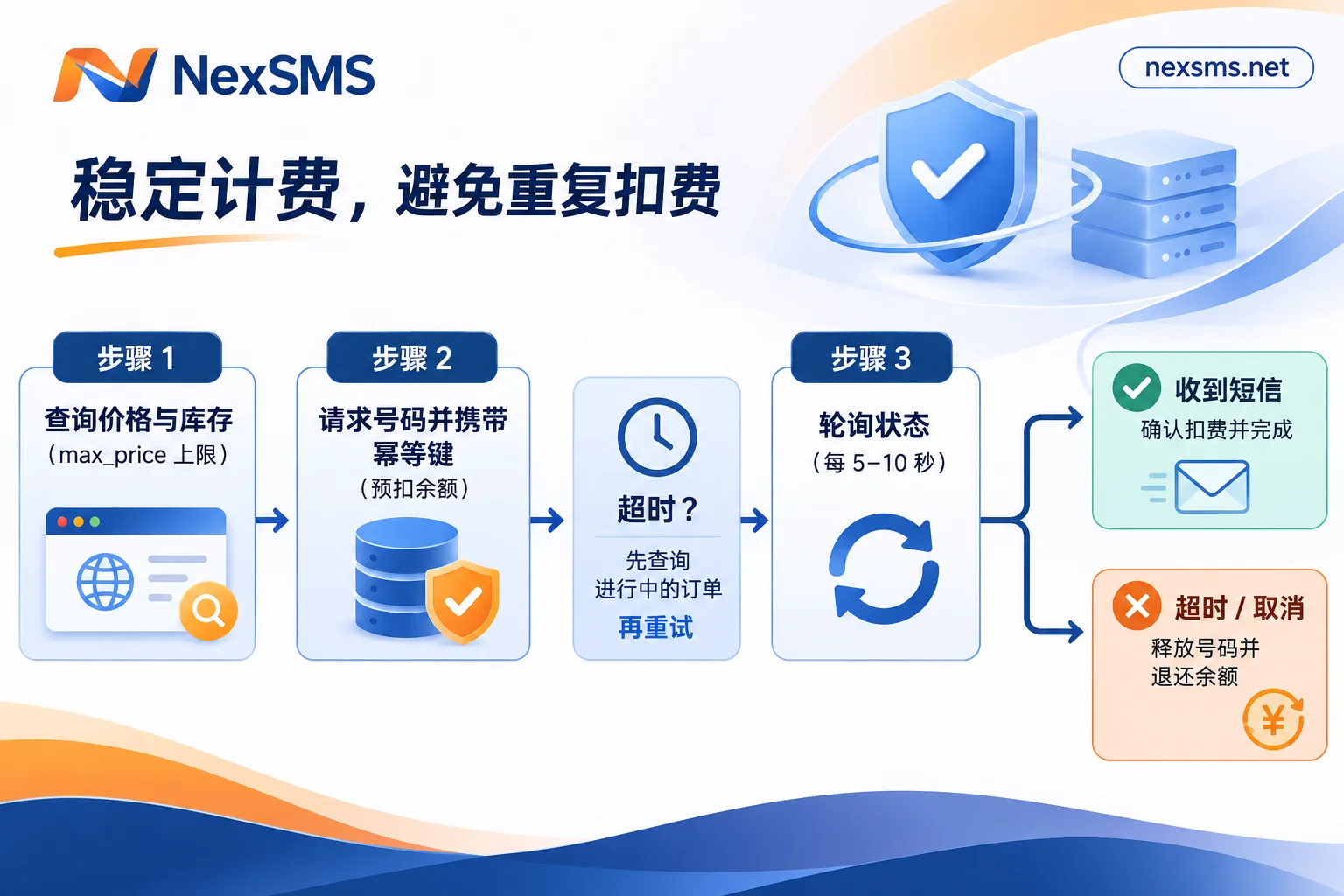
1. Always prevent duplicates in number acquisition: check status before retrying
A network request timeout does not mean the server did not execute the order. If you directly catch the exception and resend the number acquisition request, it is easy to incur double charges where 'the first request actually allocated a number and pre-authorized the balance, and the second request opened a new order'. The standard approach is:
- If the interface supports client-generated idempotency keys, timeout retries must use the same key;
- If the interface does not provide an idempotency field, after a timeout, first call the 'in-progress order query' interface to check whether a new order has been generated, and only re-acquire after confirming none exists.
2. Add a 'maximum acceptable unit price' and consumption circuit breaker
Many overseas SMS verification pools use dynamic pricing. When the number supply for a certain application in a certain country suddenly becomes scarce, the unit price may instantly double. Before acquiring a number, it is recommended to check the real-time quote once and set a local max_price validation: if it exceeds the budget cap, skip directly or switch to a backup country, and combine with hourly/daily consumption cap circuit breakers to prevent script infinite loops from draining the balance.
3. Control polling frequency; don't use 'second-level infinite loops' to trigger rate limiting
SMS usually takes a few seconds to tens of seconds to arrive through international carrier gateways. After acquiring a number, it is recommended to poll for results every 5–10 seconds, and set a reasonable global wait limit; once the timeout is reached without receiving the SMS, explicitly call the cancel or release instruction according to the interface specification, so that the pre-authorized balance returns to the account as soon as possible. For the complete call chain of number acquisition—polling—order settlement and timeout design, you can further refer to two technical practice articles on the site: 'How to Integrate SMS Verification API: Complete Call Chain of Number Acquisition, Code Reception, and Order Settlement' and 'How to Design Code Reception Timeout and Retry for SMS Verification API: First Distinguish Between Request Timeout and SMS Not Arriving'.
4. Key isolation and multi-environment permission control
Never hardcode API keys in front-end code, public repositories, or URL query parameters (URLs are easily recorded in plaintext by proxy servers and logging systems). Manage configurations separately for production and test environments as much as possible, and immediately contact customer service to reset credentials if abnormal calls are detected.
5. Boundaries and Compliance Reminders for SMS Verification APIs
Before deploying automated code reception, you must have realistic expectations about two boundaries:
- No SMS verification platform can promise 100% verification success: Even with a high-availability API and real carrier numbers, whether the verification code can ultimately be received and whether the account can survive long-term after verification is still determined by the target platform's risk control rules at that time (number segment reputation, IP purity, device fingerprint, operation frequency).
- Stick to compliant use: SMS verification APIs should only be used for compliant software automation testing, personal privacy isolation, and registration verification and account maintenance management of your own compliant business accounts. They must not be used for bulk malicious registration, spam sending, or any operations that violate local laws and regulations or the target platform's terms of service.
6. Summary: Action Checklist for Quickly Implementing SMS Verification API
If you want to integrate SMS verification into automation scripts or team workflows, you can proceed in this order:
- First check the price and real-time inventory for the target application and country on the NexSMS pricing and inventory page;
- Based on whether the account requires secondary verification, clearly choose short-term standard numbers or long-term premium numbers;
- Log into the NexSMS workspace, recharge a small amount, and manually test 3–5 numbers on the web to confirm the success rate and latency meet standards;
- Contact NexSMS Telegram customer service to obtain the API integration method, and deploy idempotency duplicate prevention, unit price cap validation, and web manual fallback into your pipeline (for workflow architecture design, you can further read 'How to Integrate SMS Verification API into Automated Workflows').