 NexSms官方博客
Many people think choosing an SMS verification platform is about comparing prices and number quantity, but after ordering, they find the number expires after one use and their account gets flagged. In fact, the core of choosing a platform is the number's "lifecycle"—from payment to stable account use, whether the number remains under your control and whether you can receive codes again later.
The U.S. Federal Communications Commission (FCC) proposed a new rule in April 2026 requiring voice service providers to verify customer name, address, government ID, etc., before activation, strengthening KYC/KYUP checks. This compliance trend means low-quality shared number pools with unclear origins will become invalid first, so choosing a platform requires more attention to number stability.
Check 1: Can the Number Source Be Clearly Explained?
Before ordering, ask customer service: Which country is the number from? What type of provider supplies it? Can it be renewed long-term? If they are vague and only say "it works," be cautious.
The FCC's proposed rule (FCC 26-27) from April 2026 requires service providers to perform strict customer identity verification before number activation, collecting and verifying customer name, physical address, government ID, and backup phone. Although this rule is still in the proposal stage, the trend is clear: number pools with unclear origins will be the first to be cleaned up as regulation tightens.
When asking customer service, you can ask:
- Is this number provided by a real carrier or is it a VoIP line?
- What country is the number assigned to?
- If the platform is scrutinized by regulators, will my number be reclaimed?
Qualifying signal: Customer service can clearly explain the source type and renewal mechanism; disqualifying signal: Customer service only emphasizes "instant receipt" or "guaranteed pass," without mentioning the source.
Check 2: Number Segment and Line Type: What Does the Platform Side Actually Check?
Many users think failure to receive verification codes is due to platform channel issues, but in reality, target apps check number segment attributes during registration. WhatsApp's official help center (updated May 2026) lists unsupported number types: VoIP, toll-free numbers, premium-rate numbers, universal access numbers (UAN), and shared numbers.
These segments are directly blocked at the Carrier Lookup stage, and pure network-layer operations (like clearing cookies or using a VPN) cannot change a number's inherent attributes.
Before ordering, confirm: Is the number a real mobile carrier segment (Non-VoIP) or a VoIP line? If you register for overseas social platforms, try to choose Non-VoIP segments. You can refer to Difference between exclusive virtual numbers and shared numbers to understand the applicable scenarios for both types.
Check 3: Exclusive or Shared: Can Anyone Else See the Code at the Same Time?
How to judge whether a number on an SMS verification platform is exclusive? Look at three points:
- Is there a dedicated occupation period (e.g., only you can see codes for 24 hours or longer)?
- Does it publicly display historical SMS records for that number?
- Does it allow the same number to be resold?
Shared numbers are officially listed as unsupported by WhatsApp because multiple users may receive verification codes simultaneously, easily triggering risk controls. Before ordering, directly ask customer service: "Is this number exclusive? Can others see it when I receive the code?"
Check 4: Occupation Period and Renewal Mechanism: Who Controls the Number During Its Validity?
What's the difference between paid and free SMS verification platforms? It largely lies in the occupation period and renewal mechanism. Free or low-cost shared number pools often provide one-time short-lived numbers that are reclaimed after use; paid long-term numbers support renewal, and the number remains under your control during the validity period.
Before ordering, ask three questions:
- How long is the number occupied?
- After expiration, will it be returned to the public pool?
- Does renewal keep the same number (number unchanged)?
If you need to use a number long-term (e.g., binding an account and continuously receiving notifications), be sure to choose renewable long-term numbers. You can refer to Difference between short-term and long-term numbers to determine which suits your needs.
Check 5: Can You Receive Codes Again? Recovery and Two-Factor Verification Are the Real Thresholds
Registration is just the first door; many accounts later trigger secondary verification: password recovery, two-factor authentication, withdrawal risk controls, etc., all require SMS re-receipt.
The FCC's KYC proposed rule requires service providers to verify during renewals as well, meaning codes sent to low-cost shared pool numbers may not be received once the number is reclaimed, potentially losing access to your account.
Judgment standard: If you need long-term re-receipt of verification codes, don't use short-lived numbers. Before ordering, ask customer service: "Do you support re-receipt? After the number expires, can I still receive SMS sent to that number?"
Check 6: Failure Determination and Refund/Recovery Path
Even the most reliable platform may have code reception failures. The key is the handling mechanism after failure.
Failure scenarios fall into three layers:
- Number segment blocked (e.g., VoIP, shared numbers)
- Target platform risk control (e.g., triggered by frequent registration)
- Channel delay (may arrive a few minutes later)
Before ordering, confirm the refund and replacement rules: Can you get a free number replacement if you don't receive the code? What are the refund conditions? Errors clearly documented by the official documentation (such as WhatsApp's "Unsupported phone number" message) are number segment attribute issues, not channel issues. Does the platform take responsibility in such cases?
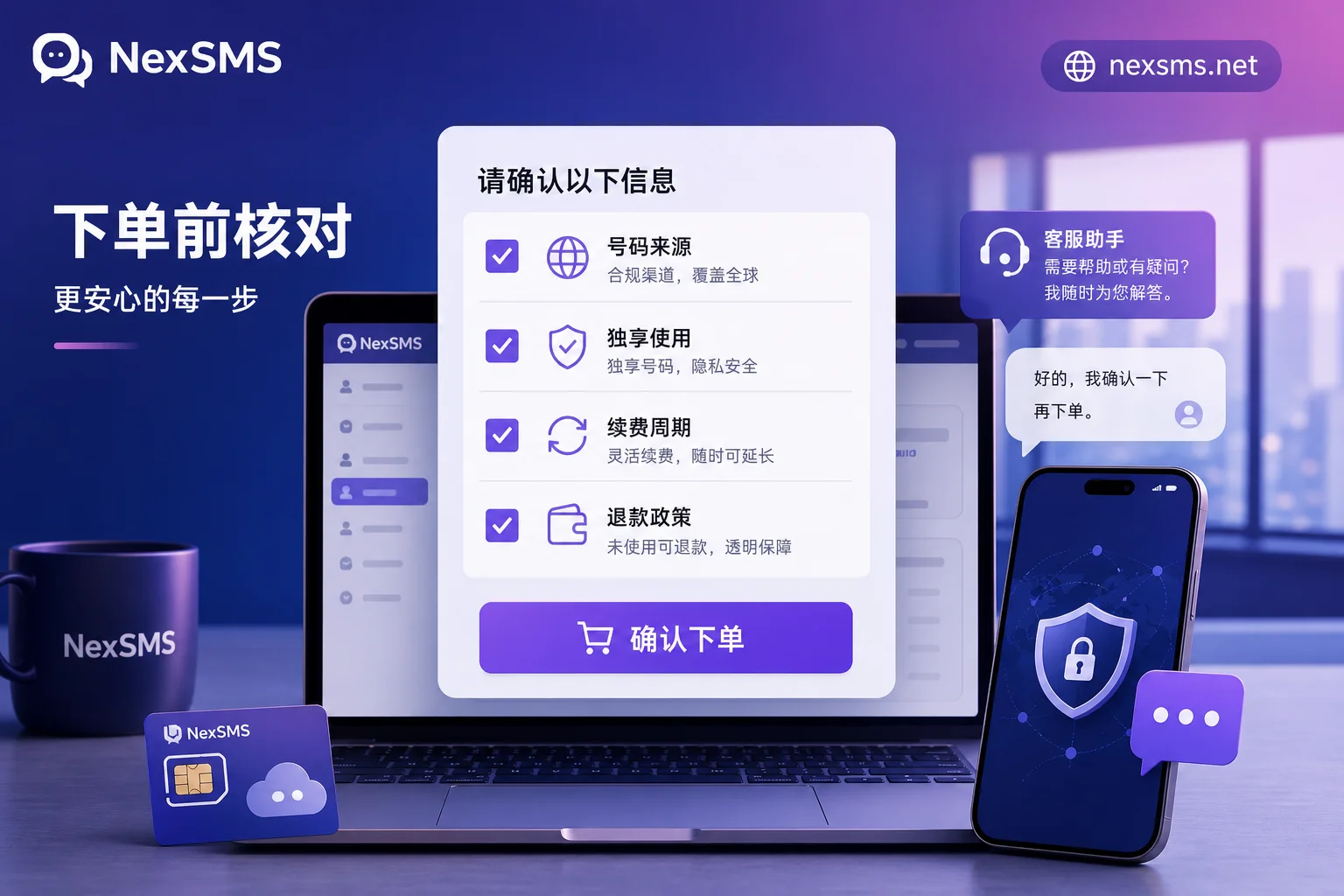
Six-Item Checklist Comparison Table and Pre-order Self-check List
| Check Item | Question Script | Qualifying Signal | Disqualifying Signal |
|---|---|---|---|
| Source | Which country is the number from? What type of provider? | Can clearly explain source and renewal mechanism | Vague, only says "it works" |
| Segment Type | Is it a real carrier segment or VoIP? | Clearly Non-VoIP real segment | Cannot confirm, or VoIP/shared number |
| Exclusivity | Can others see it when I receive code? | Has dedicated occupation period, no simultaneous access | Public history, can be resold |
| Occupation/Renewal | How long is the number occupied? Does renewal keep the number? | Clear occupation period, renewal keeps number | Reclaimed after use, no renewal |
| Re-receipt | Do you support re-receipt? | Supported and long-term valid | One-time, invalid after expiration |
| Failure/Refund | How to handle if code not received? | Clear replacement/refund rules | No after-sales, or passing the buck |
Implementing with NexSMS: Country Selection, Short-term vs. Long-term, Web Code Reception, and API
To put this checklist into practice, look at the public information on the NexSMS official website: supports multi-country, multi-platform number selection, offers short-term one-time numbers and renewable long-term local numbers. Individual users can use web-based code reception, and batch developers can call the API.
Selection advice: Use short-term numbers for one-time registration scenarios to save costs; for accounts requiring long-term re-receipt (e.g., bound to withdrawal wallets), use long-term local numbers, corresponding to the exclusivity and renewal requirements in the checklist. Specific countries and number types are subject to real-time display on the official website.
FAQ
Which SMS verification platform is reliable?
Reliability depends on three points: whether the source is clearly explained, whether numbers are exclusive, and whether there is refund protection after failure. It's recommended to check the platform you're considering against the 6-item checklist in this article, then do a small test order to verify, not a large purchase at once.
What's the difference between paid and free SMS verification platforms?
Free platforms mostly use shared number pools: numbers are public, no occupation period, easily invalidated; paid platforms provide exclusive numbers with occupation periods and renewal mechanisms, supporting re-receipt. The core of charging is the number's "privacy" and "lifecycle," not just the number of SMS messages.
How to judge if a number is exclusive on an SMS verification platform?
Directly ask customer service: "When I receive the code, can others see the SMS for this number?" If the platform provides a dedicated occupation period and doesn't publicly display history, it's basically exclusive; if the number's history is public or can be resold, it's shared.
Why do cheap SMS verification numbers expire after one use?
Low-cost shared number pools often have numbers used repeatedly by multiple people, and target apps' risk control systems identify high-frequency anomalies and directly blacklist the number. Plus, upstream regulation (like the FCC's proposed KYC rules) is tightening, and low-quality sources are cleaned up, making expiration faster.
Can SMS verification platform numbers be renewed for long-term use?
Some platforms offer long-term numbers that support renewal with number retention. Before ordering, be sure to confirm the renewal mechanism and occupation period. Choose renewable long-term numbers to ensure your account can continuously receive verification codes and avoid not receiving SMS during secondary verification.
}


Comments(0)