 NexSms官方博客
When buying and selling on Craigslist, Facebook Marketplace, and OfferUp, protecting your phone number privacy involves two separate things:
- With buyers or sellers: Try not to give out any phone number; keep communication within the platform's built-in messaging. If the other party asks for your number or a verification code under the pretext of "confirming you're a real person," treat it as a scam signal.
- For platform verification: When posting or registering requires phone verification, you can use a number separate from your main one, but it must be a type accepted by the platform. Craigslist and OfferUp explicitly do not accept VoIP numbers; they only accept US-based mobile numbers. For occasional posts, a short-term number works. For long-term account management, building reputation, or linking payment, use a renewable long-term number that can receive codes repeatedly.
Below, we explain these two aspects separately.
What's the risk when a buyer asks for your phone number?
The US Federal Trade Commission (FTC) has specifically warned about this scam. Scammers pose as buyers, claiming they need to "confirm you're a real seller," and ask for your phone number. Once they have it, they use your number to register for Google Voice or other services. The verification code is then sent to your phone, and they trick you into telling them the code. If you relay it, they can use your number's identity to open new numbers or accounts, scam the next person, and even try to access your accounts.
So the most effective protection here isn't changing your number, but developing two habits:
- Never read out or forward a verification code to anyone, no matter how reasonable the reason sounds. Codes should only be entered on the page you are currently operating.
- Use the platform's built-in messaging for transaction communication. If the other party insists on adding your number privately or rushes to move to SMS or other chat tools, be extra cautious.
A leaked real number can also lead to harassing calls and people using your number to look up other information. By separating your main number from second-hand trading, these risks are isolated to a number you can manage separately and discard at any time.
What number to use for platform verification: Check platform rules first
The first idea many people have is to find a free internet phone number. On second-hand platforms, this path is basically a dead end.
Craigslist: The help center states that you must enter a valid phone number to complete verification before posting. It does not support international numbers or VoIP numbers. Two other rules affect operations. First, you can only request a verification code once every 5 minutes. Second, the same number can only be associated with one account at a time.
OfferUp: The support center states it only supports US mobile phone numbers; VoIP numbers cannot pass verification.
Facebook Marketplace: Marketplace is tied to your Facebook account. Meta has not publicly explained how it distinguishes VoIP numbers from mobile numbers; typically, the system judges on the spot after you enter your number. Whether a particular number works can only be determined by the actual prompt. Don't assume it's the same as the previous two, and don't assume it's more lenient.
In other words, the number used for platform verification should ideally be a US-based, real carrier mobile number. Many cheap or free virtual number ranges are VoIP lines; platforms identify the line type before sending codes and reject them, no matter how many times you resend. For the difference between such numbers and real carrier numbers, see What's the difference between real carrier local numbers and virtual landline numbers.
Free public code-receiving pages should also be used with caution. The verification codes on them are visible to everyone, and the numbers have been used repeatedly by many people. If the account will later record transactions or even link payment information, this risk is not worth it. For details, see Which is safer: free code-receiving platforms or paid private numbers.
Short-term or long-term number: Depends on whether you'll need to receive codes again
This step determines the future security of the account, not just whether you can register this time.
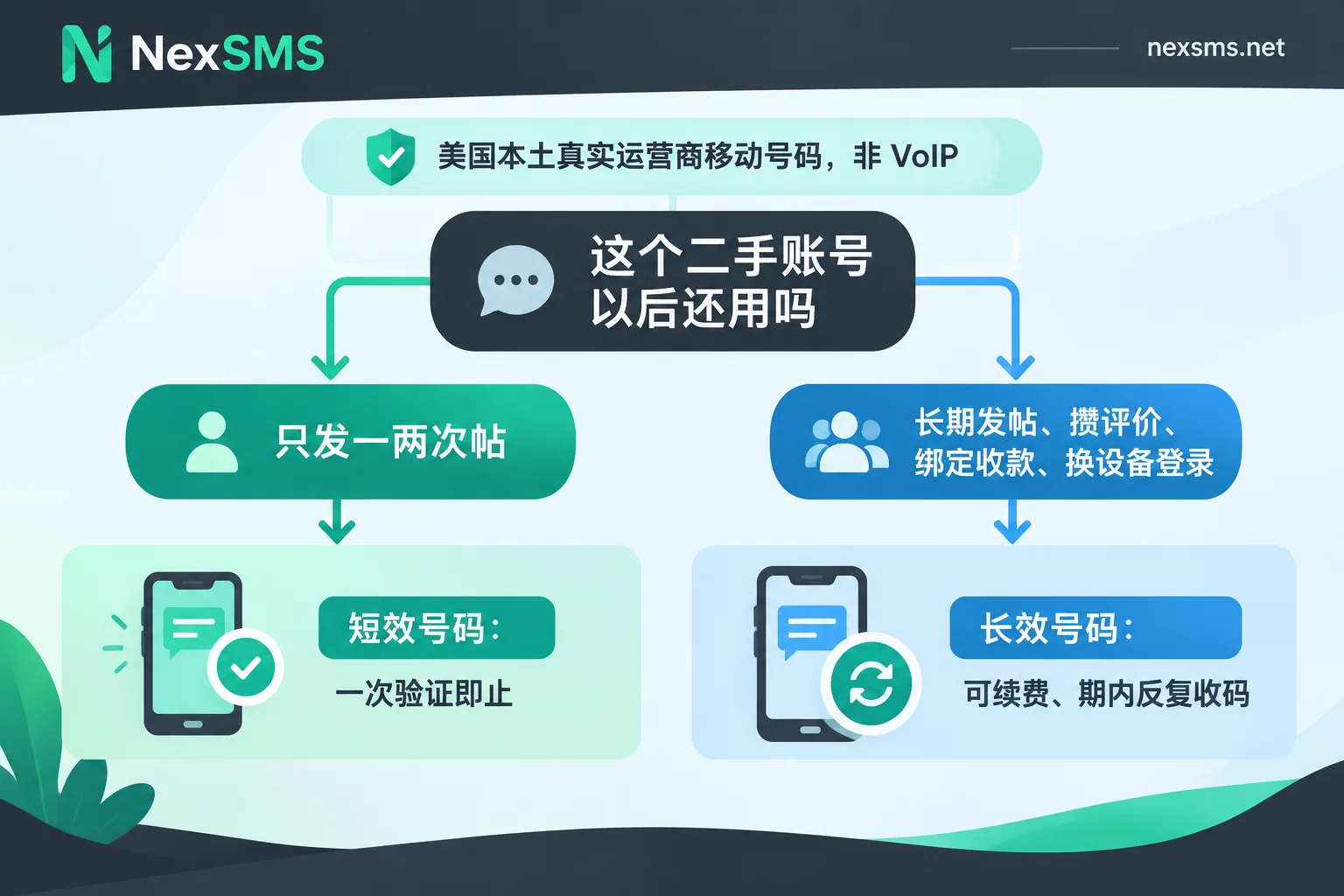
Suitable for short-term numbers: You're just clearing out a few items, posting once or twice, and won't use the account after the sale. A short-term number completes verification once and is done, with low cost. The trade-off is that the number soon no longer belongs to you, and if the account later requires SMS verification, you won't receive it.
Suitable for long-term numbers:
- You will continue posting, accumulating reviews and transaction records;
- The account is linked to payment or payout methods;
- You will log in from different devices and locations, possibly triggering two-factor verification or risk control review.
When an account has abnormal logins or is flagged by risk control, second-hand platforms often require re-verification of the phone number. The platform does not disclose the frequency and threshold for triggering this, but if it happens once and you no longer have the original number, the account may be unrecoverable. Such accounts are better suited to a number that can be renewed and receive codes repeatedly during the holding period.
On NexSMS, these two cases correspond to short-term regular numbers and long-term premium numbers. Long-term numbers are real carrier local numbers (physical SIM or eSIM), with unlimited code reception during the validity period; you can continue holding it by renewing before expiry. The differences and renewal conditions are more fully described in the feature description page. Once decided, you can go to the US number page to pick a number based on the target platform. Whether verification passes ultimately depends on the platform's rules at the time; choosing the right number type is only a prerequisite.
Step-by-step procedure
- First determine the account purpose: one-time clearance or long-term management.
- Choose a number based on purpose: pick a US-based real carrier mobile number. For long-term accounts, choose a long-term number.
- After submitting the number on the platform, wait for the verification code to appear on the code-receiving page before entering it. Craigslist only allows one code request every 5 minutes; if you don't receive it, don't resend frequently. You can troubleshoot layer by layer following the ideas in No SMS received after submitting number.
- If using a long-term number, note down the number, the corresponding platform account, and the expiry date. Renew a few days in advance; don't wait until the expiry day. For specific steps, see How to renew a long-term number before expiry to avoid disconnection.
- After verification, keep transaction communication within the platform and do not give this number or your main number to strangers.
Common misconceptions
- "With a different number, I can give the verification code to the buyer": No. Regardless of whether the number is your main one, whoever gets the verification code can impersonate that number's identity.
- "Use one number for several accounts in rotation": Craigslist explicitly states that the same number can only be associated with one account at a time. One number for your own account is also easier to manage.
- "Short-term numbers are cheap, let's use one for now": If the account will later link payment or build reputation, using a long-term number from the start is much less hassle than trying to recover it after losing the number.
The above practices are all for protecting your personal number in your own legitimate transactions. Impersonating others for verification, bulk account registration, or bypassing platform identity checks violates platform rules and can easily lead to account bans.


Comments(0)