 NexSms官方博客
Every peak-season preparation period in the second half of the year, the topic sellers discuss most in community groups is often not product selection or advertising, but sudden "account security re-verification."
Entering 2026, compliance reviews across major overseas e-commerce and payment platforms have clearly tightened: Amazon is fully rolling out annual certification under the US INFORM Consumers Act. Once triggered, five pieces of information, including a phone number, must be verified within 10 calendar days, or the store faces suspension; TikTok Shop has launched a new trusted-environment assessment system, and any fluctuation in network or device can frequently trigger two-step verification (2FA); and PayPal and eBay, the lifelines of funds, have set up strict SMS verification checkpoints for card binding, large receipts, and withdrawals.
Facing multi-store, multi-region operational needs, buying hundreds of overseas physical SIM cards and maintaining roaming is clearly impractical, so most sellers rely on overseas SMS verification platforms to solve number issues. But in actual compliance tests, some sellers pass reviews smoothly with verification platforms, while others have stores suspended and funds frozen because they "cannot receive the second verification code." The problem is often not the form of SMS verification itself, but choosing the wrong number type from the start.
1. Why do 2026 cross-border e-commerce and payment platforms frequently get stuck on phone numbers?
Many sellers, when starting out, are used to "as long as it can receive the code." But under today's e-commerce and payment risk-control systems, a phone number is no longer just a string of characters for receiving 6 digits; it is a verification indicator for assessing account authenticity and localization weight.
When you click "Send verification code" in the backend, platform risk control completes three things within milliseconds:
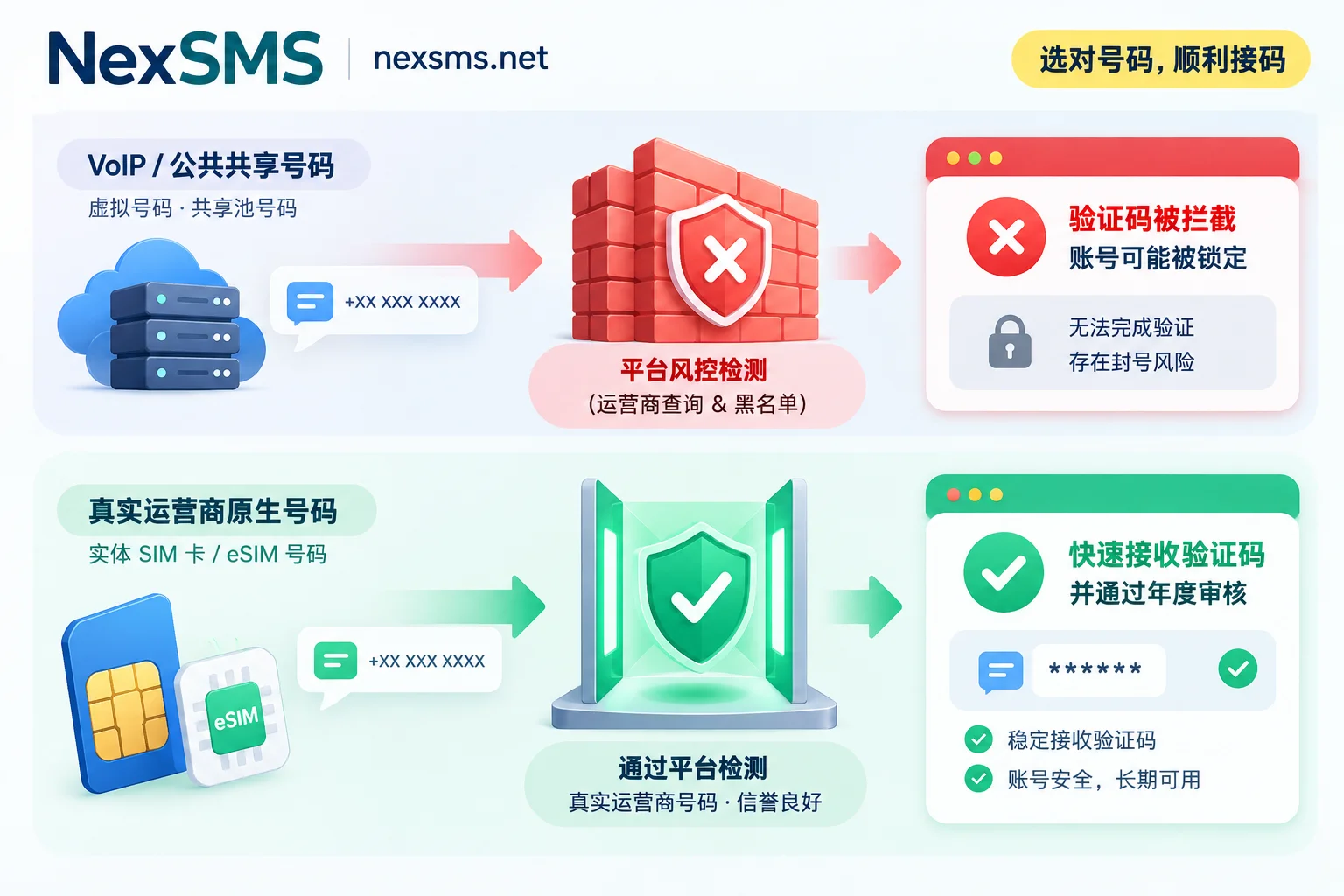
- Identify line attributes (block virtual number ranges): Whether it is the Amazon seller backend, eBay, or US-region PayPal, before sending an SMS, the platform queries carrier databases for the number type. If the result is VoIP (an internet-based virtual landing number), the system often silently blocks it or reports "this number type is not supported." For why such numbers frequently fail, see this previous technical breakdown: What Is a VoIP Phone Number: How It Works and Why It Often Cannot Receive Verification Codes.
- Compare site and number-range attribution: Localized operation compliance requires account information to be highly self-consistent. For example, when registering a US local store or US-region receiving account, using a corresponding
+1local mobile number makes it easier to establish initial trust than mixing number ranges from other countries, reducing the probability of triggering a second review due to "region abnormality." - Check number history contamination: Many sellers, to save money, search for free public verification channels, not realizing such public numbers have already been used by hundreds or thousands of people and have long entered the associated blacklist databases of major e-commerce platforms. Binding one can trigger linked risk control.
2. The Most Painful Lesson: Using "One-Time Short-Term Numbers" for Long-Term Stores and Wallets
In cross-border e-commerce circles, what is more devastating than "not receiving the verification code during registration" is "registration succeeded, but three months later, when orders come in and you withdraw funds, you cannot receive the code."
Many novice sellers, when using overseas SMS verification platforms, do not carefully distinguish the lifecycle of numbers and directly choose the cheapest pay-per-use numbers to bind Amazon stores, core TikTok sales accounts, or PayPal business accounts. Such short-term numbers are designed for "use and discard," with very short validity, only receiving one verification code, and no renewal support.
When your store starts receiving orders, your fund pool accumulates thousands of dollars, or you encounter an annual review like Amazon Inform Act that requires regular confirmation of account information, the platform sends a verification SMS to the originally bound phone number. At this point, because the original short-term number has long expired and been destroyed, you can neither recover the original number nor directly rebind a new number without passing verification through the old one, and the account instantly falls into a "deadlock."
Even if many sellers have enabled TOTP authenticator apps as security advice suggests, SMS verification remains an irreplaceable highest-priority defense line when changing receiving bank cards, handling abnormal logins from different locations, or facing mandatory platform compliance reviews. This is explained in detail in Why Keep a Long-Term SMS Verification Number Even After Binding an Authenticator? The Fallback Role of Real Numbers in Risk-Control Re-Verification.
3. Cross-Border Sellers' Verification Traffic Strategy: Precisely Choose Numbers by Business Value
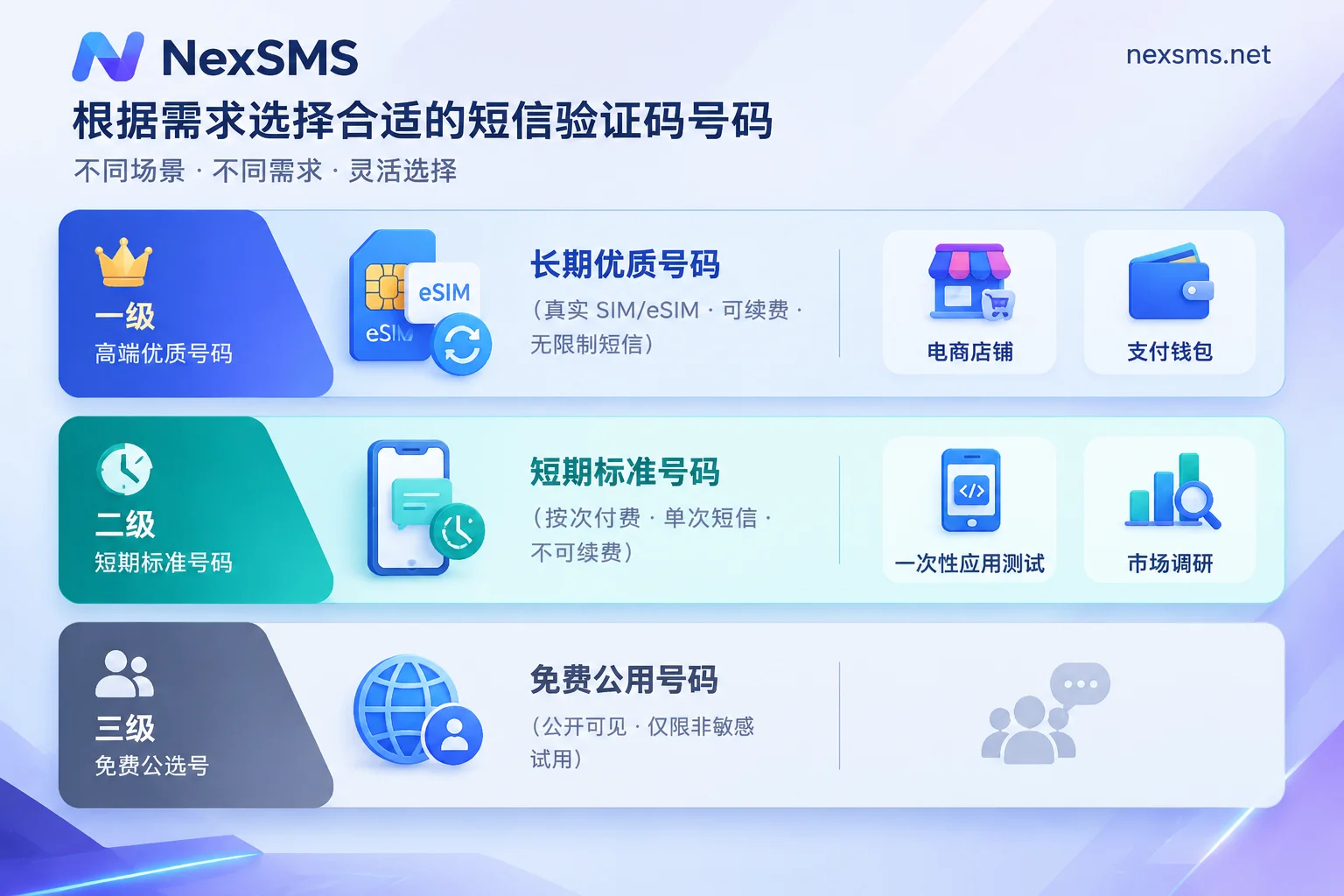
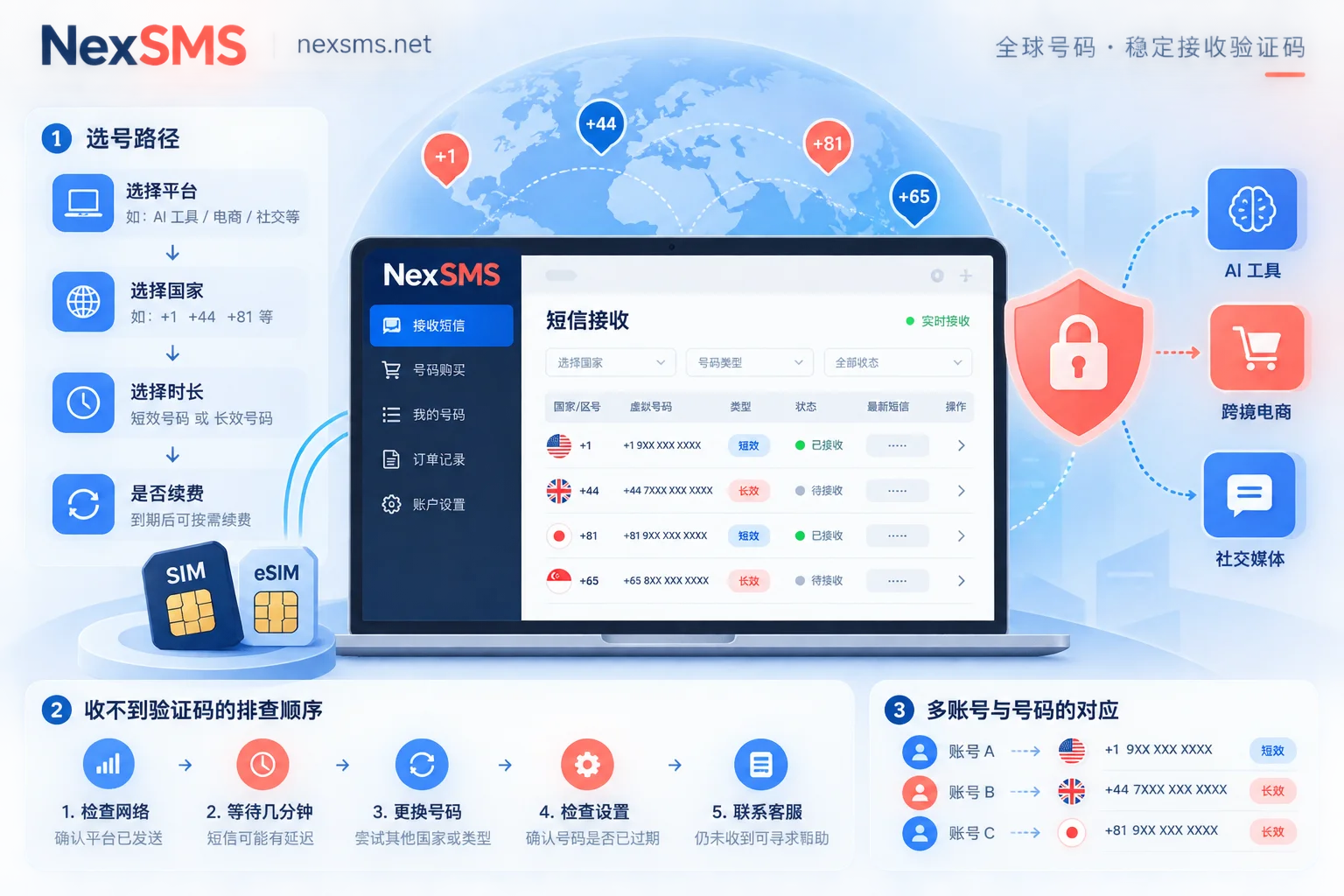
To protect core assets while controlling costs, the correct way to use overseas SMS verification platforms is "number tiering"—matching different number resources according to the lifecycle of the account in the business chain. On the NexSMS platform, numbers are clearly divided into three categories: short-term, long-term, and free public, corresponding to different cross-border business scenarios:
1. Core Asset Tier (Main Store Number / Receiving Wallet / Main Social Media): Long-Term Premium Numbers Are a Must
For accounts that need long-term operation, there are two baseline requirements: first, real carrier lines; second, number ownership that can be extended long-term.
NexSMS's long-term premium numbers use real carrier local numbers (based on local physical SIM cards and eSIMs, not virtual landing numbers). During the validity period, the same number can receive verification codes an unlimited number of times; more importantly, before expiration you can renew at any time to continue holding the number.
- Applicable scenarios: Amazon seller account registration and annual review, PayPal payment binding, eBay store verification, TikTok main operating accounts, and core Google or Apple accounts that need unified cross-platform binding.
- Management advice: Multi-store teams should strictly implement "one store, one number," establish internal ledgers recording the expiration time of each store's long-term number, and complete renewals in advance. For specific collaboration methods, see How Cross-Border Teams Collaboratively Manage Multiple Business Phone Numbers: Number Tiering, Centralized Code Viewing, Ledger Renewal.
2. Testing and Peripheral Tier (Competitor Research / Temporary Registration / One-Time Verification): Use Short-Term Ordinary Numbers as Needed
Not all business actions require long-term account nurturing. If you only need to register a peripheral buyer account to view competitor storefront displays, temporarily experience an overseas tool (such as testing OpenAI, Claude), or perform one-time verification that requires no follow-up maintenance, using long-term numbers would waste budget.
- Applicable scenarios: Use NexSMS's short-term ordinary numbers, billed per use, one number receives only one verification code, and it ends when used, with no need to worry about follow-up management.
- Pitfall reminder: Short-term ordinary numbers cannot be renewed, and the same number cannot receive codes again. Never use them to bind any platform involving fund retention or requiring secondary login verification.
3. Zero-Risk Exploration Tier: The Correct Way to Use Free Public Numbers
As for the common free SMS verification services on the market, the NexSMS official website also provides several US free public numbers (after logging into an account, you can view real-time verification codes on the web page). But as the official website clearly warns: verification codes received by public numbers are visible to everyone, so never use them for any important account or scenarios involving personal privacy or business secrets.
4. Practical Process: How to Choose the Right Country and Application Numbers on NexSMS?
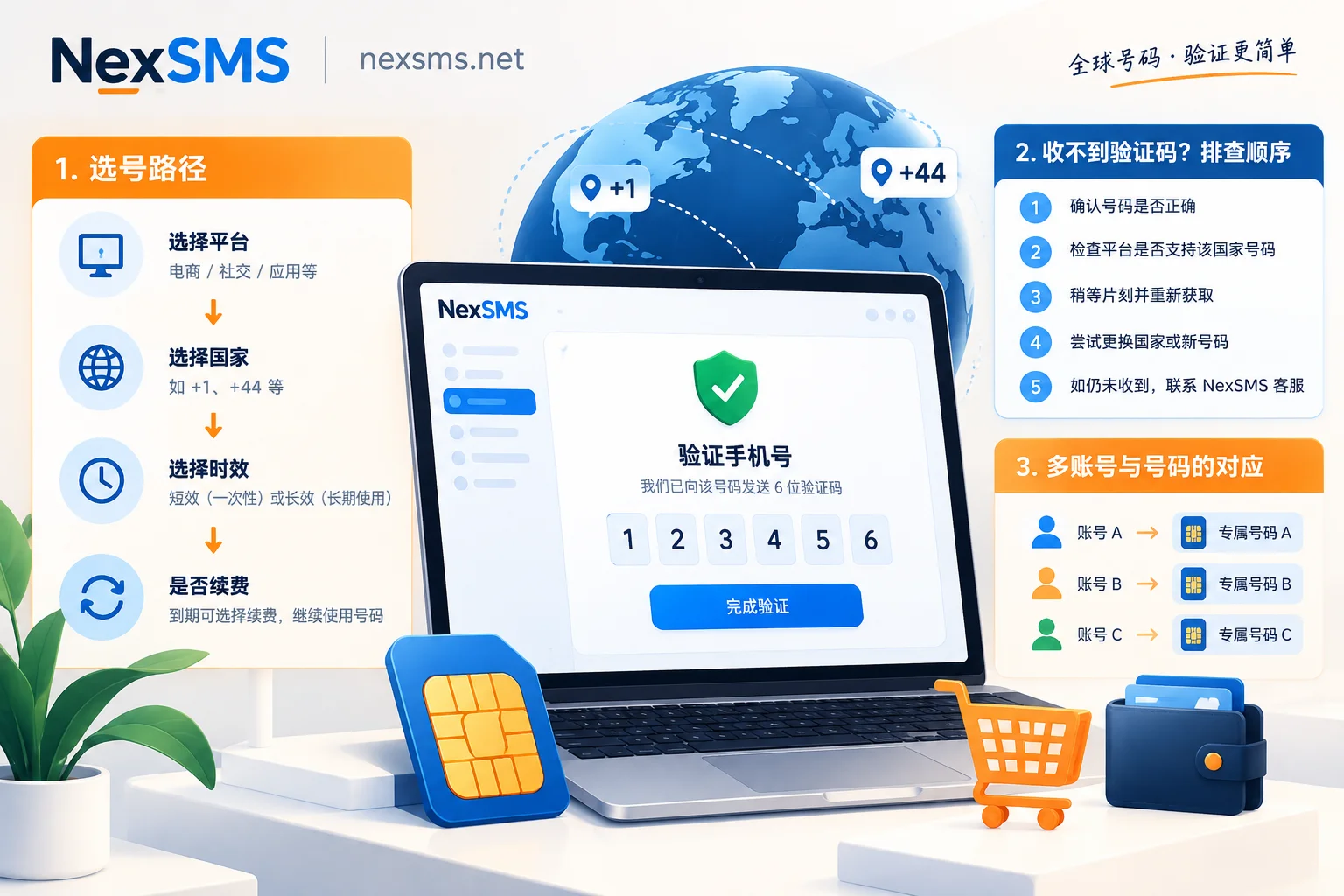
Because telecom rules and platform risk-control strategies across global sites change at any time, no platform dares to promise 100% verification success (actual passage depends on the target platform's risk-control rules at the time and your network and browser environment configuration). But through a standardized number-selection process, invalid attempts can be greatly reduced:
- First check application instructions and real-time inventory: Before ordering, it is recommended to visit NexSMS's application SMS verification solution pages. Whether for e-commerce payment apps like Amazon, PayPal, and eBay; social and traffic apps like WhatsApp, Telegram, Instagram, Facebook, and X (Twitter); or regional lifestyle and content apps like Gojek, Xiaohongshu, WeChat, and Doubao, there are dedicated pages explaining common verification scenarios and operating steps. At the same time, you can check current starting prices and available number quantities by application on the pricing and inventory page.
- Precisely choose countries by target site: If you mainly target the North American market, you can directly enter the US SMS verification page to view available services under
+1area codes; if you operate multiple global sites, you can filter by country in the global country SMS verification list. Number sources change in real time with inventory; when ordering, filter by the combination of "country + application," and what you see is what you get. - Real-time web code viewing or API integration: Individual sellers or small teams can place orders directly in the user workspace, and verification codes are displayed in real time on the web page, with no need to wait for roaming SMS delays. For technical teams that need to batch-manage testing processes, NexSMS also supports integrating number acquisition and code reception into their own programs via developer API, in parallel with web code reception (to integrate the API, you can find 24/7 online Telegram customer service via Contact Us to get integration details).
- Flexible fund management: In response to the payment habits of cross-border practitioners, the platform supports top-ups via Alipay, WeChat, and cryptocurrency (USDT/BTC). Account balances do not expire (note: balances are non-transferable), so even if you slow down new listings after peak season, you do not need to worry about funds being cleared due to expiration like on some older platforms (for related selection details, see 2026 SMS Verification Code Reception Platform Practical Guide: Avoid Balance Clearing and Recycling Traps, Precisely Choose Numbers by Business Cycle).
Conclusion
In the 2026 cross-border e-commerce environment, compliance and risk control have penetrated every pore of daily operations. Rather than hunting for appeal service providers everywhere when stores trigger second reviews and funds are stuck during withdrawal, it is better to straighten out the underlying logic of phone numbers at the first step of store setup and card binding.
Leave one-time testing to pay-per-use short-term ordinary numbers, and entrust stores and receiving accounts that matter to your livelihood to renewable long-term premium numbers from real carriers—using the right overseas SMS verification platform is the only way to make every verification code a stepping stone for business growth rather than a time bomb hanging overhead.


Comments(0)