 NexSms官方博客
Direct conclusion: If you are only using a compliant overseas SMS verification platform to receive SMS verification codes for yourself (e.g., isolating primary number privacy, completing software development testing, or verifying overseas accounts while complying with local laws and the target website's rules), this is normal tool usage and does not equate to participating in illegal black/gray industries. What truly violates the law is renting or lending personal SIM cards, setting up 'SIM card pools' to batch receive verification codes for fraud, and using SMS verification tools to batch register fake accounts for fake orders, exploiting promotions, or carrying out telecom fraud.
However, in 2026, when searching for 'overseas SMS verification platform', what easily leads people into traps is often not just legal misunderstandings, but two types of real risks: first, counterfeit phishing sites and malicious crypto wallet authorization scams that emerged after established platforms shut down; second, choosing free public numbers or one-time numbers, leading to accounts being taken over by others after registration, or encountering secondary verification lockout. Below, we clarify compliance boundaries, anti-fraud key points, and safe number selection methods at once.
I. First Distinguish: What Is the Difference Between Normal Use and Legal Red Lines
Many people who just search this term are frightened by pages of news about 'SIM card pool cases' and 'crime of aiding information network criminal activities', and cannot tell whether registering an overseas tool account will cause trouble. In fact, the core of legal and regulatory crackdowns has always revolved around the black/gray industry chain, not legitimate privacy isolation or software testing:
Legitimate and reasonable common usage scenarios:
- Personal privacy isolation: When registering for non-core overseas websites or temporary trial tools, avoid exposing your domestic primary mobile number to reduce subsequent spam messages and data leakage risks.
- Development and testing verification: Programmers or going-global teams test overseas registration flows, SMS delivery timeliness, and multi-country area code compatibility.
- Compliant cross-border business management: Teams that need to operate multiple compliant overseas stores or social media accounts assign independent numbers to different accounts to avoid exhausting the binding quota of the primary number or cross-linking between accounts.
Legal and risk control red lines that must never be touched:
- Do not participate in 'SMS verification part-time jobs' or rent out personal mobile numbers: Occasionally, tasks are advertised to ordinary people to 'receive one verification code for a dozen or twenty yuan'. Once the downstream uses the verification code for fraud or illegal registration, the person providing the number and forwarding the verification code may be suspected of the crime of aiding information network criminal activities.
- Do not touch 'SIM card pool' batch black industries or register violating accounts on behalf: Using massive non-real-name card slots to batch receive codes for fake orders, exploiting promotions, sending spam ads, or cooperating with telecom fraud is a clear illegal industry chain.
- Do not use SMS verification numbers for high-risk and strong real-name scenarios: For example, bank account opening, political or confidential identity authentication, high-value fund guarantee accounts, etc. Such scenarios do not comply with the target platform's specifications, and once the number changes, it will directly endanger your rights.
Also remember a basic fact: Tool compliance does not mean the target platform will necessarily allow it. Major overseas companies conduct comprehensive risk control based on number line type, IP environment, and operational behavior. No SMS verification platform can guarantee 100% verification success for any service.
II. The 3 Most Common Scams and Financial Traps When Using Overseas SMS Verification Platforms in 2026
1. 'Fake Official Websites' After Established Platforms Shut Down
After the decade-old platform SMS-Activate permanently ceased operations at the end of 2025, a large number of counterfeit websites appeared in the market under the original platform's name or as 'official migration entrances', many of which are direct phishing sites that take money and do nothing. If you entered from forum comment sections, stranger private messages, or search engine ad placements, be sure to verify the official domain and customer service channels first. Never make large deposits right away.
2. 'Malicious Contract Authorization' Disguised as USDT Top-Up
Many overseas SMS verification services support cryptocurrency top-ups, and scammers take the opportunity to create fake pages: when you are about to pay with USDT, the page does not give you a regular receiving address but induces your wallet to pop up a contract call or unlimited Approve authorization. Once you click confirm, the other party can transfer assets from your wallet. Remember: Legitimate top-ups only require transfer payment, never require you to sign a wallet asset authorization contract.
3. Misunderstanding the Criteria for 'Refund if No Code Received'
Many users encounter disputes where 'the number reports an error when entered, but the platform does not refund'. The root cause is failing to distinguish the three situations of 'no code received':
- The number is directly rejected by the target platform upon submission (e.g., the number is not supported or already in use, and the SMS was never sent);
- The target platform indicates the SMS has been sent, but it is never received within the countdown;
- The SMS does arrive, but the verification code is invalid due to number reuse history or input timeout.
The refund trigger conditions and waiting timers vary completely across platforms. If you do not read the billing rules and countdown instructions clearly before operating, it is easy to waste balance. For how to troubleshoot delays and avoid duplicate charges after getting a number, refer to 'How to Use SMS Verification Without Pitfalls? 2026 Compliance Boundaries, Operation Steps, and Anti-Chargeback Guide'.
III. Why Are Accounts Still Stolen or Instantly Banned? First Understand the Differences Between Three Types of Numbers
Even after avoiding fake websites, many people still encounter 'the account was logged in by someone else right after registration' or 'the number is reported unavailable as soon as it is entered'. This is usually not mysticism but incorrect number attributes:
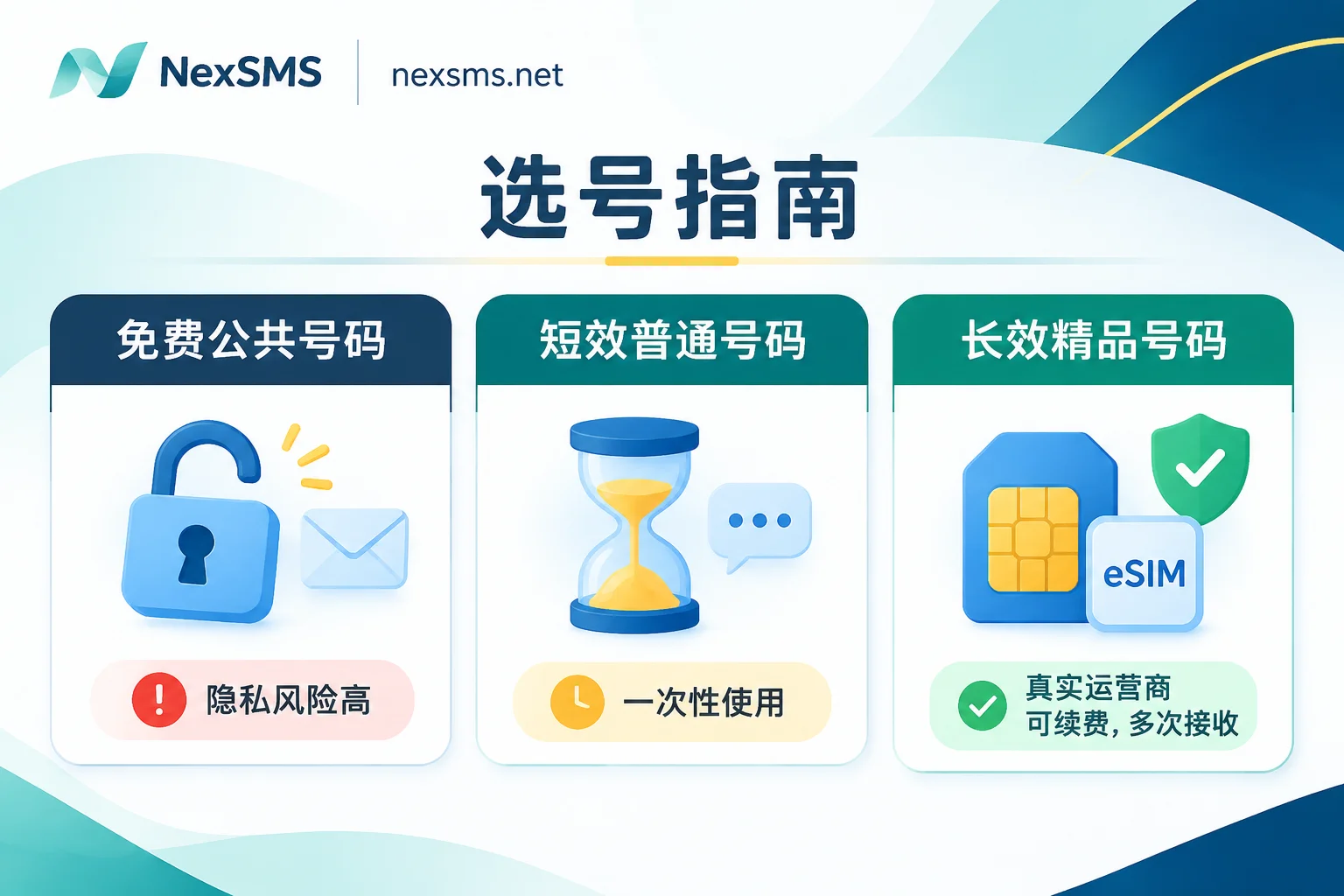
- Free public numbers (highest privacy risk): Public inboxes that anyone can open and view on the web. As long as someone clicks 'Forgot Password' or 'SMS Login' on the target website, they can also see the verification code [3.52]. For a deeper breakdown of hidden dangers, see 'Why Are Free Public Numbers Unsafe? 2026 SMS Verification Code Receiving Platform Security Boundaries and Number Selection Guide'.
- Ordinary VoIP virtual landing numbers (high interception rate): Mainstream overseas applications like OpenAI, WhatsApp, Google, PayPal, etc., now query the number's line type (HLR and carrier attributes) before sending codes. Once identified as a VoIP virtual number segment, they often directly refuse to send verification codes.
- One-time short-term numbers bound to important accounts (high re-verification risk): Short-term numbers are only suitable for completing the current registration. If weeks later you change devices, clear cache, or trigger platform risk control requiring secondary verification, the one-time number cannot be recovered, and the account may be completely locked.
IV. How Can Individuals and Teams Safely Receive SMS? (Taking NexSMS as an Example)
If you have confirmed that your usage needs are legitimate and want to find an overseas SMS verification platform with a clear interface, support for small on-demand usage, and distinct number types, you can follow these steps to minimize account risk and financial loss:
Step 1: First Ask Yourself 'Will I Need to Receive Another Code Later?', Then Choose the Number Type
On NexSMS (nexsms.net), numbers are clearly distinguished by usage period and line attributes. Do not mix them (for a more detailed decision comparison, see 'How to Choose Between Short-Term Numbers and Long-Term Premium Numbers: First Answer "Will I Need to Receive Another Code Later?"'):
- Only need one-time registration or temporary testing: Choose short-term ordinary numbers. These numbers are billed per use, have a short validity period, and each number can only receive one verification code. They cannot be renewed, nor can the same number be used to receive a second code. They are suitable for temporary verification without retaining core assets.
- Need long-term retention, may trigger secondary verification or account recovery: Choose long-term premium numbers. NexSMS long-term premium numbers are real carrier local numbers (local physical SIM cards and eSIMs, not virtual landing numbers). Within the validity period, the same number can receive unlimited codes, and you can renew before expiration to continue holding it. They are suitable for accounts that need long-term controllable code reception, such as main social media, cross-border stores, or multi-platform binding.
- Just want to see the process first and do non-sensitive testing: NexSMS lists several US public numbers on the free public number page (currently you need to log in to view verification codes), but the page also explicitly warns not to use them for any important accounts, because all logged-in users can see received SMS messages.
Step 2: Check by 'Country' and 'Application' Before Ordering, Do Not Blindly Top Up or Buy
- First go to the NexSMS country-based SMS verification page to check the target country's phone area code, common applicable platforms, and current number availability;
- Then go to the application-based SMS verification instruction page to check the common verification scenarios and precautions for specific target services (covering OpenAI, Claude, Doubao, Google, Apple, Telegram, WhatsApp, X, Instagram, Facebook, TikTok, Xiaohongshu, WeChat, Amazon, eBay, PayPal, Gojek, etc.);
- Check the current starting price and available number count for the target application through the price and inventory query page, and complete login and ordering on the official console
https://user.nexsms.net. Specific prices, available country inventory, validity days for short-term and long-term numbers, and refund rules are subject to the official website's real-time pages.
Step 3: Use Official Channels for Top-Up and Integration to Protect Funds
- Small top-ups, no need to worry about clearing: NexSMS supports Alipay, WeChat, and cryptocurrency (USDT/BTC) top-ups, and account balances do not expire (non-transferable). There is absolutely no need to deposit large amounts into the platform at once; just top up a little as you use it.
- For program automation integration, contact official customer service directly: If you are a developer and want to integrate number acquisition and real-time web-based code reception into your business program, note that NexSMS currently has no public API documentation. Do not search online for third-party 'unofficial interface scripts' of unknown origin. Directly obtain legitimate integration methods through the official website's 24/7 Telegram customer service entrance.
V. 30-Second Self-Check List Before Payment
- Check usage: Only for personal privacy isolation, testing, or compliant overseas business. Do not touch proxy reception part-time jobs or high-risk real-name scenarios.
- Check entrance: Confirm the browser is opening the official domain. Reject unfamiliar mass-distributed links and 'top-up pages' that require unlimited wallet authorization.
- Check lifespan: For important accounts, resolutely do not use free public numbers, and do not use non-renewable short-term numbers to gamble on not triggering secondary verification.
- Check inventory: Check the real-time inventory and prices of the target country and application before ordering, and maintain a clean matching local network environment.
- Reinforce promptly: If you used a short-term number to complete registration, enter the account and bind an authenticator or passkey in the security settings as soon as possible to reduce future reliance on SMS verification alone.