 NexSms官方博客
When you find your phone continuously receiving verification codes from unfamiliar products, or suddenly receiving marketing calls, your primary number may have already leaked in some link. The core actions to prevent your primary phone number from leaking online are only two: reduce the number of entry points where your primary number appears on the internet, and diversify account recovery and two-step verification away from a single primary number, rather than just blocking spam messages.
In August 2025, NIST SP 800-63B Rev 4 officially classified phone-network-based SMS OTP as a restricted authenticator, clearly stating it is vulnerable to SIM swapping, number porting hijacking, and SS7 protocol man-in-the-middle attacks. On August 7, 2026, security service provider Zscaler also ceased supporting SMS verification codes in its identity authentication services. These two signals indicate that the industry is downgrading the trust level of SMS verification, and once your primary number is used for account recovery, attackers may take over your email, social media, or even payment accounts.
Below, we break down six entry points for primary number leakage and provide a three-tier judgment: "must use primary number / can use short-term number / need long-term local number."
Entry Point 1: Directly Leaving Primary Number During Platform Registration
Registration scenarios are the most direct entry point for primary number leakage. Many one-time tool sites, price comparison websites, trial SaaS, and even forums require a phone number for verification. These sites might only send a verification code once, but your primary number permanently remains in their database. Once the database is breached or leaked internally, your primary number is exposed.
The judgment criteria are simple: Does this registration involve money? Does it require long-term repeated verification code receipt? Is it tied to real-name identity? If all three answers are no, then there is no need to use your primary number.
Specific action: Direct all such low-value registrations to an isolation layer; for which scenarios short-term and long-term numbers are suitable, refer to difference between short-term and long-term numbers before deciding.
Entry Point 2: Recovery Methods and Two-Step Verification All Hanging on the Same Primary Number
This is the most dangerous and easily overlooked entry point. When your email, social media, cloud drive, and payment recovery methods all point to the same primary number, and 2FA also relies on SMS, the primary number becomes the "master key" to your entire digital identity. If an attacker can perform SIM swapping (forging your identity to reissue your SIM card) or exploit SS7 protocol vulnerabilities to intercept SMS, they can easily reset all your associated accounts, causing chain losses.
The aforementioned NIST SP 800-63B Rev 4 only classifies SMS OTP as a restricted authenticator rather than banning it because it requires organizations to provide phishing-resistant or unrestricted alternatives; Zscaler, on the other hand, directly discontinued SMS verification codes in its own authentication services, requiring migration to TOTP or FIDO2. You can harden in these ways:
- Migrate 2FA for high-value accounts (email, payment, social media) from SMS to TOTP apps or FIDO2 keys.
- Downgrade the SMS channel to a backup recovery method, not a strong dependency.
- Set an independent porting PIN for your carrier account to prevent number porting hijacking.
- Use different recovery entry points for different assets (bank, social media, work) to avoid all-or-nothing loss.
If your primary number is already used for multiple important accounts, prioritize this step; it is the most critical remediation action.
Entry Point 3: Publicly Exposed Contact Information for Customer Service, Logistics, and Storefronts
In business scenarios, numbers must be public—customer service hotlines, logistics contacts, storefront leave-behind information. These positions cannot be hidden; hiding them would only harm business. So you cannot rely on "hiding," but on "swapping."
Separate the publicly displayed number from your personal primary number, allowing crawlers, copying, and complaints to land on replaceable business numbers. For small overseas teams, you can divide tasks like this: use one long-term local number for pre-sales consultation, another for after-sales follow-up, and yet another for logistics contact, each isolated from the others.
Note that publicly exposed numbers need to be usable long-term and renewable; you cannot use short-term numbers. Because customers might call back months later, and if the number becomes invalid, business is lost.
Entry Point 4: Reverse Lookup via Social Profiles, Groups, and Contact Book Matching
Many people overlook the reverse lookup path on social platforms. Your profile page may directly display your phone number, group member lists may expose numbers, and contact book matching functions can bind numbers to real names and social relationships, upgrading "a string of digits" to a "socially engineered identity profile" that can be targeted.
You can self-check like this:
- On platforms like WeChat, QQ, and Telegram, disable the "find me by phone number" option.
- Before leaving historical groups, remove the number from your profile page.
- Restrict contact book synchronization permissions to prevent the platform from reading your contact book to match friends.
These actions can significantly reduce the risk of reverse association.
Entry Point 5: Residual Associations from Third-Party Logins and Historical Bindings
Registering accounts with your primary number and then authorizing third-party logins, such as "login to a website with WeChat," causes your primary number to spread through the authorization chain to that website's database. A single authorization revocation does not mean downstream parties have deleted your data.
Auditing the authorized application lists on each platform and revoking unused authorizations one by one are necessary steps. For services you still need, switch to an independent email as the primary identifier instead of a phone number.
This way, even if a downstream service leaks, attackers cannot directly associate it with your primary number.
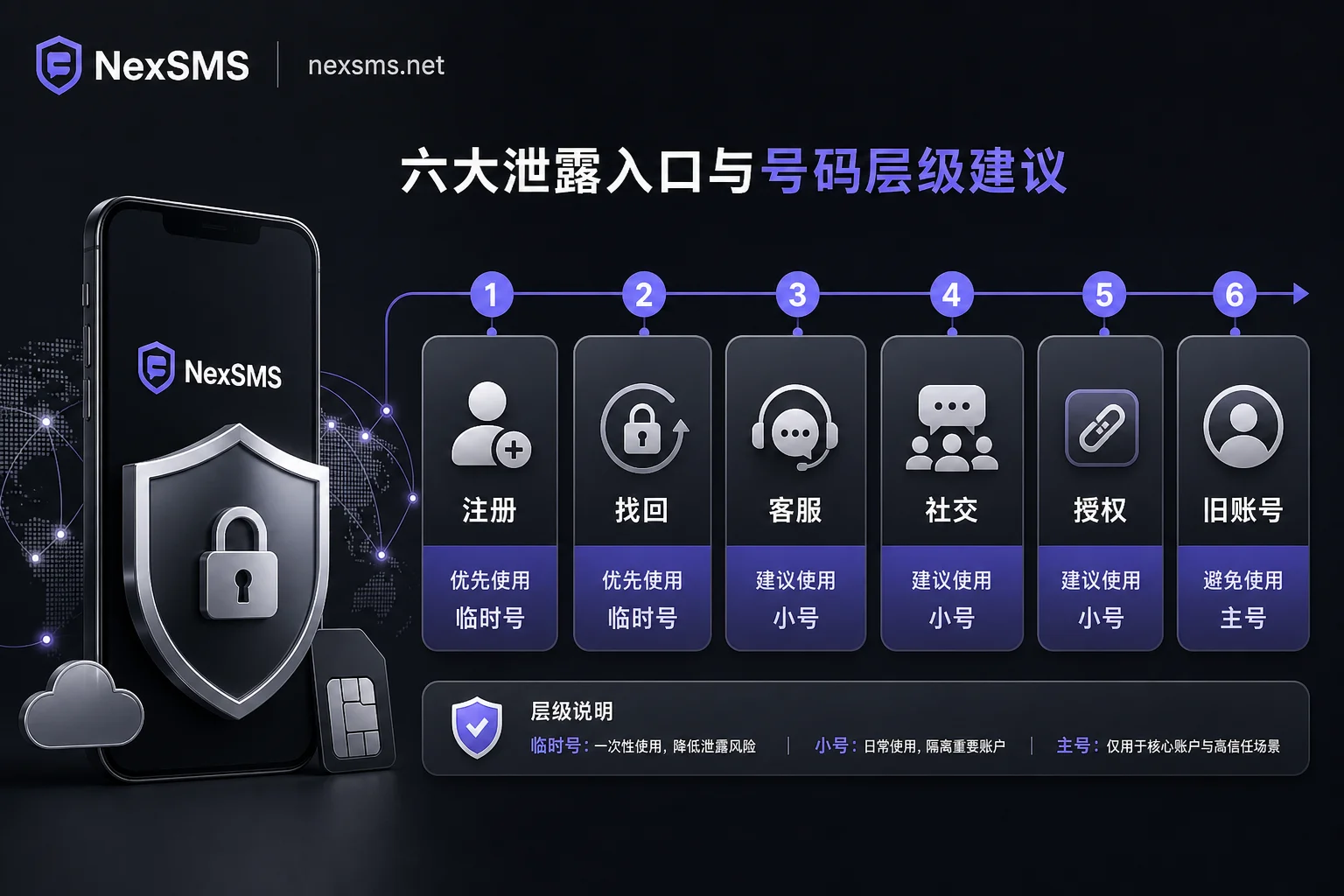
Entry Point 6: Secondary Exposure from Old Accounts and Reassigned Discontinued Numbers
Two types of residual risks deserve special attention: first, old accounts you have abandoned but are still bound to your primary number; second, old numbers you abandoned have been recycled by the carrier and now belong to others, causing accounts still bound to that number to be recovered by the new holder via SMS verification.
Handling order is as follows:
- Rebind before deactivating: Change the bound phone number of important accounts to a new number or email, then deactivate the account.
- Before deactivating, confirm that the recovery method has been migrated to avoid losing the account after the number is recycled.
- For old accounts that truly cannot be unbundled, change the password and remove payment information and personal data.
To answer "Can old account bound phone number be unbundled"—as long as the platform supports rebinding, usually yes; if the platform has stopped service or you cannot log in, it may be impossible to unbind, so you can only clear sensitive information as much as possible.
Comparison Table of Six Entry Points
This table breaks down how to prevent primary phone number leaks into individually actionable steps:
| Entry Scenario | Duration of Exposure | Need Long-term Repeated Verification? | Recommended Number Tier | Notes After Replacement |
|---|---|---|---|---|
| Platform registration (low value) | Short-term, one-time code | No | Replaceable short-term number | Short-term numbers are disposable, not for important accounts |
| Recovery & 2FA (high value) | Long-term | Yes | Must use primary number or TOTP | Primary number only for real-name scenarios like banking; 2FA prioritizes TOTP |
| Customer service/logistics public display | Long-term | Yes | Need long-term local number | Ensure renewability; dedicated number exclusively for business |
| Social profiles/groups | Long-term | No | Can use long-term local number, or not display | Disable search, remove number from profile |
| Third-party login authorization | Long-term | No | Can use long-term local number, or independent email | Regularly revoke unnecessary authorizations |
| Old accounts/discontinued numbers | Long-term | No | Need rebind or clean | Rebind before deactivating; if cannot unbind, clear sensitive info |
Note: The tier that must use the primary number is reserved for bank, real-name, and personal identity verification scenarios. Number layering is meant to isolate the primary number's exposure, not to evade real-name verification or forge identity.
Building an Isolation Layer Beyond the Primary Number: Division of Labor Between Short-Term and Long-Term
Choose a national number based on the market of the target platform, using short-term one-time numbers to handle one-time code reception for low-value registrations.
Renewable long-term local numbers on NexSMS can be retained on a monthly renewal basis, suitable for positions requiring long-term repeated verification and public display; web-based verification code reception suits sporadic scenarios, while developer APIs and pay-as-you-go usage facilitate ledger management for teams.
Also, be reminded that public free number pools have globally visible verification codes and are already flagged for abuse by major platforms, so they are not suitable for bearing any accounts requiring long-term retention. Therefore, the isolation layer should choose controllable exclusive numbers, as emphasized in difference between exclusive virtual numbers and shared numbers.
Remediation Order After a Leak Has Occurred
How to prevent primary phone number leaks is prevention; if it has already leaked, follow the order below. But before acting, take 10 minutes to confirm the scope of the leak:
- Open Have I Been Pwned (https://haveibeenpwned.com),用你的常用邮箱和主号查询是否出现在已知数据泄露记录中。
- Log into major platforms (WeChat, Alipay, email, banking apps) and check "login devices and security logs" for verification code requests from unfamiliar devices or unusual times.
- Observe whether you continue to receive verification codes from unregistered platforms; such prompts often mean your number is being used in credential stuffing attempts.
After confirming the scope, harden in this order:
- Harden carrier account: Set porting PIN to prevent number porting hijacking.
- Migrate 2FA for high-value accounts: From SMS to TOTP or FIDO2.
- Clean up platform exposure: Disable social profile numbers, revoke excess authorizations.
- Direct new registrations to the isolation layer: First choose a short-term number on NexSMS to handle new low-value registrations; you don't have to replace all numbers at once.
Self-check checklist:
- [ ] Has a porting PIN been set for the carrier account?
- [ ] Is 2FA for banking, payment, and email not entirely SMS-dependent?
- [ ] Are there any public phone numbers in social profiles?
- [ ] Has the authorized application list been cleaned?
- [ ] Have old accounts been unbundled or cleared of sensitive information?
If you "keep receiving verification codes from unknown platforms," it usually means your number has been used for registration or credential stuffing attempts by others. At this point, harden as described above promptly rather than verifying each code one by one.
FAQ
Can I use my primary phone number only for receiving bank verification codes?
Yes, but there is some risk. Banks are high-value scenarios, so using your primary number for bank verification is reasonable, but it is recommended to also enable carrier-level protection (such as porting PIN) for the primary number, and consider using hardware keys or in-app bank verification if supported to reduce SMS dependency. As for number layering, you can reference virtual number types that support receiving bank 2FA verification codes, but real-name and identity verification scenarios should still use the primary number.
What to do if I don't want to leave my real phone number when registering a website?
Use a short-term one-time virtual number, disposable, without exposing your primary number. But note that short-term numbers are not suitable for services requiring long-term verification code reception; in that case, choose a long-term local number. Platforms may require SMS verification, but that doesn't mean you must use your primary number.
Has SMS 2FA been banned?
It has not been banned. NIST defines it as a "restricted authenticator," still usable with risk compensation or when no alternative exists, but it is recommended to upgrade to TOTP or FIDO2. Zscaler's discontinuation is proactive, not regulatory.
How to divide short-term and long-term numbers?
Short-term numbers are for one-time codes and low-value registrations; long-term numbers are for long-term repeated verification or public display (e.g., customer service). Short-term numbers are low-cost but non-renewable; long-term numbers are renewable and more stable, and should be planned with multi-account number management.
Will turning off contact book sync affect normal use?
Generally no. Turning off contact book sync only affects functions like "recommend friends by number," not actively adding contacts. However, you may lose the possibility of using "match contacts in your contact book" functionality; weigh the trade-offs and decide.


Comments(0)