 NexSms官方博客
Will virtual numbers be recycled by carriers? Yes—what gets recycled is the usage right, not the provider shutting down. Phone numbers are a limited resource; carriers lease them to users as a usage right, and no number is ever permanently owned by a single user.
The U.S. Federal Communications Commission (FCC) Reassigned Number Database (RND) rules require voice service providers to enforce an aging period of at least 45 days after a number is permanently disconnected before it can be reassigned, and to report disconnections to the RND monthly. This means recycling is a regulated industry standard, not a provider running away.
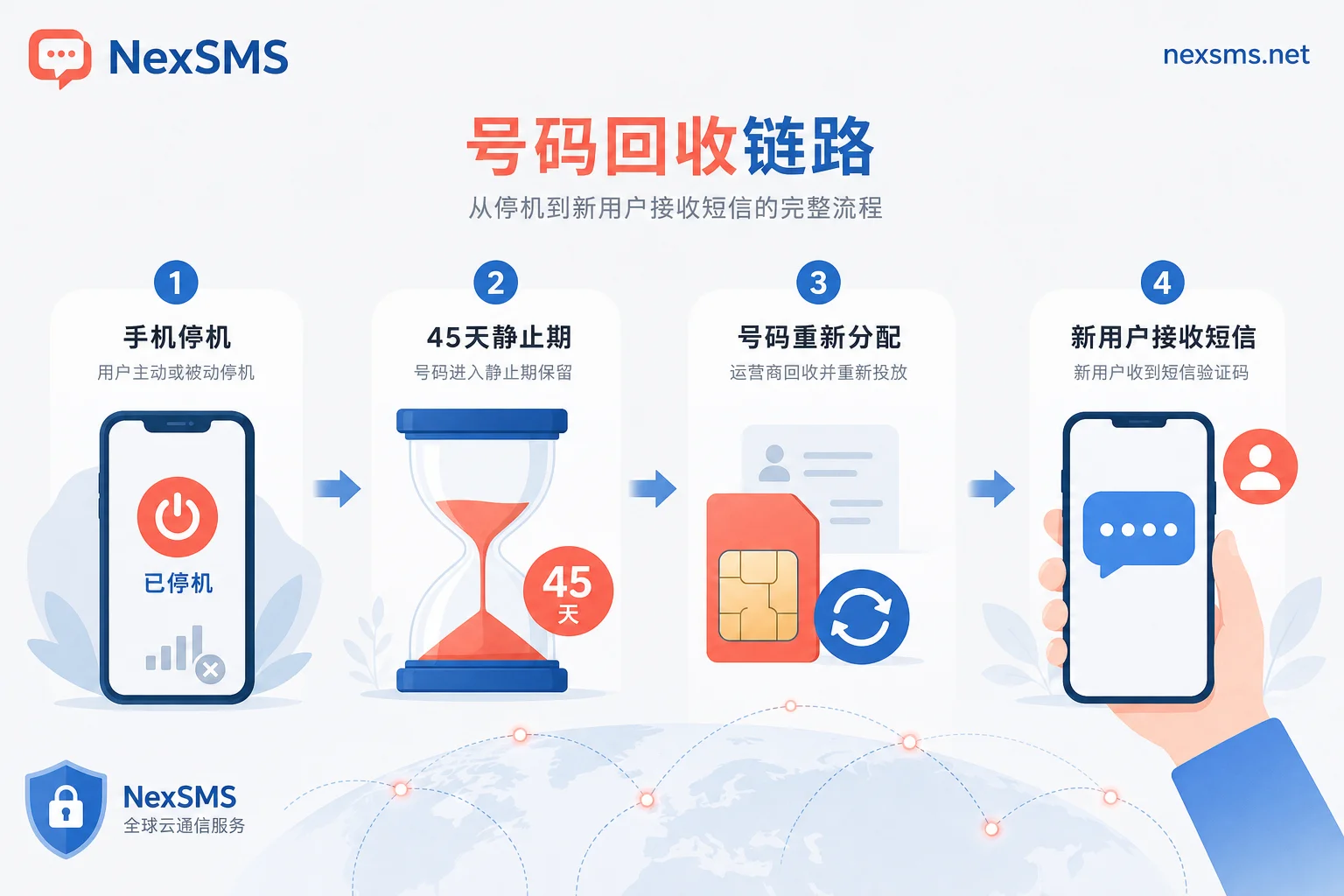
Will Virtual Numbers Be Recycled by Carriers—Yes, and the Recycling Goes Through These Four Steps:
A number goes from inactive to falling into someone else's hands roughly in four steps:
- Deactivation: You stop renewing, or the provider marks the number as permanently disconnected due to long-term inactivity.
- Aging Period: Under FCC rules, the number enters a cooling-off period of at least 45 days, during which it is not assigned to new users.
- Reassignment: After 45 days, the number is released back into the number pool, waiting to be assigned to the next applicant.
- New Holder Takes Over: Once a new user activates the number, the usage right transfers.
For you, the recovery window is only between steps 1 and 2: as soon as you realize the number is about to be deactivated, immediately unbind or rebind the associated accounts. By step 4, it's too late.
Will Virtual Numbers Be Recycled by Carriers: Why the 45-Day Aging Period Doesn't Protect Your Accounts
The original purpose of the aging period is to prevent callers from misdialing the new number holder; it addresses the question of "who the call goes to." It does not clean up the number's binding records across internet platforms. So interpreting it as "safe after 45 days" is a misconception—once the aging period ends, the number can still receive SMS sent to that number, including verification codes.
Princeton Evidence: Verification Codes and Reset Texts Still Arriving on Recycled Numbers
A 2021 Princeton University study sampled 259 reassignable numbers and found that 66% (171) were still linked to active accounts of previous holders on mainstream platforms, about 40% had associated credential leaks, and nearly 10% continued to receive previous users' two-factor authentication (2FA) passwords and security notifications within a week. This shows that carrier-level recycling cannot remove the binding traces left online.
What You'll Face After the Number Is Recycled: Login Failures, Broken Recovery Chains, and Account Takeover Without a Password
Based on the data above, you're likely to encounter three types of consequences:
- Daily login failures: You can no longer receive the SMS verification codes for two-factor authentication, leaving you stuck at the login screen.
- Broken recovery chain: When you forget your password, the platform sends a reset link to the old number, you don't receive it, and the account is permanently lost.
- Account takeover without a password: Worse, the new number holder receives your verification codes and directly initiates "forgot password," resetting and taking over your account without knowing your original password.
Simply changing your password does not eliminate this takeover path—because SMS verification codes are a key in themselves.
Which Accounts Must Never Be Tied to Recyclable Numbers: A Three-Category Guide
Not all accounts require a "permanent number," but some accounts become a hassle once disconnected. Allocate your numbers according to this table:
| Account Type | Examples | Suitable Number Type | Reason |
|---|---|---|---|
| One-time registration, trial | Temporary verification code, signing up for infrequently used small sites | Short-term number | Use and discard; recycling is fine |
| Needs re-login, recovery, withdrawal | E-commerce, social media, payment accounts | Renewable long-term number | Number stays under your control for normal login and recovery |
| Banking, primary email | Online banking, personal email | Own primary number or app authenticator | Highest security level; avoid relying solely on SMS OTP for a single number |
When allocating numbers according to this table, purchase short-term and long-term separately—NexSMS's short-term numbers handle one-time registrations, while renewable long-term local numbers support accounts that need re-login. If you're still using one-time phone numbers for important accounts, switch them out immediately. Cross-border teams doing multi-account number management should also follow this principle.
Short-Term Number Pools vs. Long-Term Numbers: Will Numbers from SMS Platforms Be Bought by Others Again?
Short-term one-time numbers are inherently a "public number pool"—whoever buys it can receive subsequent SMS for that number, including previous users' verification codes. So will numbers from SMS receiving platforms be bought by others again? As long as the number is returned to the pool, it will be—this is the core difference between exclusive virtual numbers and shared numbers.
Renewable long-term local numbers, on the other hand, are exclusively controlled by you during the renewal period; others cannot get them. Only when you stop renewing do they enter the recycling process. So, do long-term virtual numbers need constant renewal? Yes, for accounts that require long-term re-login, renewal is essential; for accounts involving funds, also refer to types of virtual numbers that support receiving bank 2FA codes. NexSMS offers both short-term numbers and renewable long-term local numbers—the former for one-time registrations, the latter for accounts that need re-login, recovery, and withdrawal; it doesn't promise numbers will never be recycled, but you have exclusive control during the renewal period.
Three Things to Do Before the Number Expires: Unbind, Rebind, and Add Backup Verification Methods
If your number is about to expire, do these three things in order:
- Unbind or rebind: Change the bound numbers on all accounts to new, long-term controllable numbers.
- Migrate the second factor: Change verification methods for important accounts like banking and email to app authenticators or backup email.
- Save recovery codes offline: Print or store the platform's recovery codes on an offline device, not just in your phone.
When processing the account list in batches, first handle accounts with funds and real-name verification, then social and e-commerce, and finally one-time registrations; and set clear milestones: "review binding status 7 days before expiration, complete key account rebinding 30 days before expiration." Also set renewal reminders and review binding status one week before expiration. Specific unbinding paths and renewal grace periods for each platform depend on the terms of the service provider you use.
FAQ
How long before a number is reassigned after deactivation?
Under current regulations, carriers must wait at least 45 days after an aging period before reassigning a number. The exact number of days may vary slightly by carrier and region, but 45 days is the legal minimum.
Can I recover my account after the virtual number expires?
If the number hasn't been reassigned yet, you still have a chance to renew and recover it. Once it's assigned to someone else, you'll have to rely on other verification methods (such as backup email, security questions) to try to recover the account, which is risky.
What should I do if the bought virtual number suddenly stops working?
First, check if it's expired or in arrears and renew it promptly. If the number has already been recycled, immediately contact the platform's customer service to explain, and use backup verification methods to reset the account binding to prevent takeover by the new holder.
Is changing the password enough to be completely safe?
No. Research has shown that new number holders can still initiate "forgot password" via SMS OTP, bypassing the original password to reset it directly. Changing the password is just the first step; the key is to unbind the old number.
Do long-term virtual numbers need constant renewal?
Yes. As long as you want to continue using the number to receive verification codes or recover accounts, you must keep it renewed. If you stop renewing, the number enters the recycling process and may be bought by someone else later.
Will virtual numbers be recycled by carriers?
Yes. If a number's renewal stops or it remains unused for a long time, it enters the recycling process and is eventually reassigned to a new user. Therefore, important accounts must use long-term numbers and keep them renewed.


Comments(0)