 NexSms官方博客
Virtual number privacy protection only narrows the contact entry point exposed externally; it does not affect platform-side verification of number attributes or historical bindings after number recycling. The NIST SP 800-63B Rev 4, published in August 2025, classifies SMS OTP as a restricted authenticator, a authoritative classification that changes our baseline for understanding number security.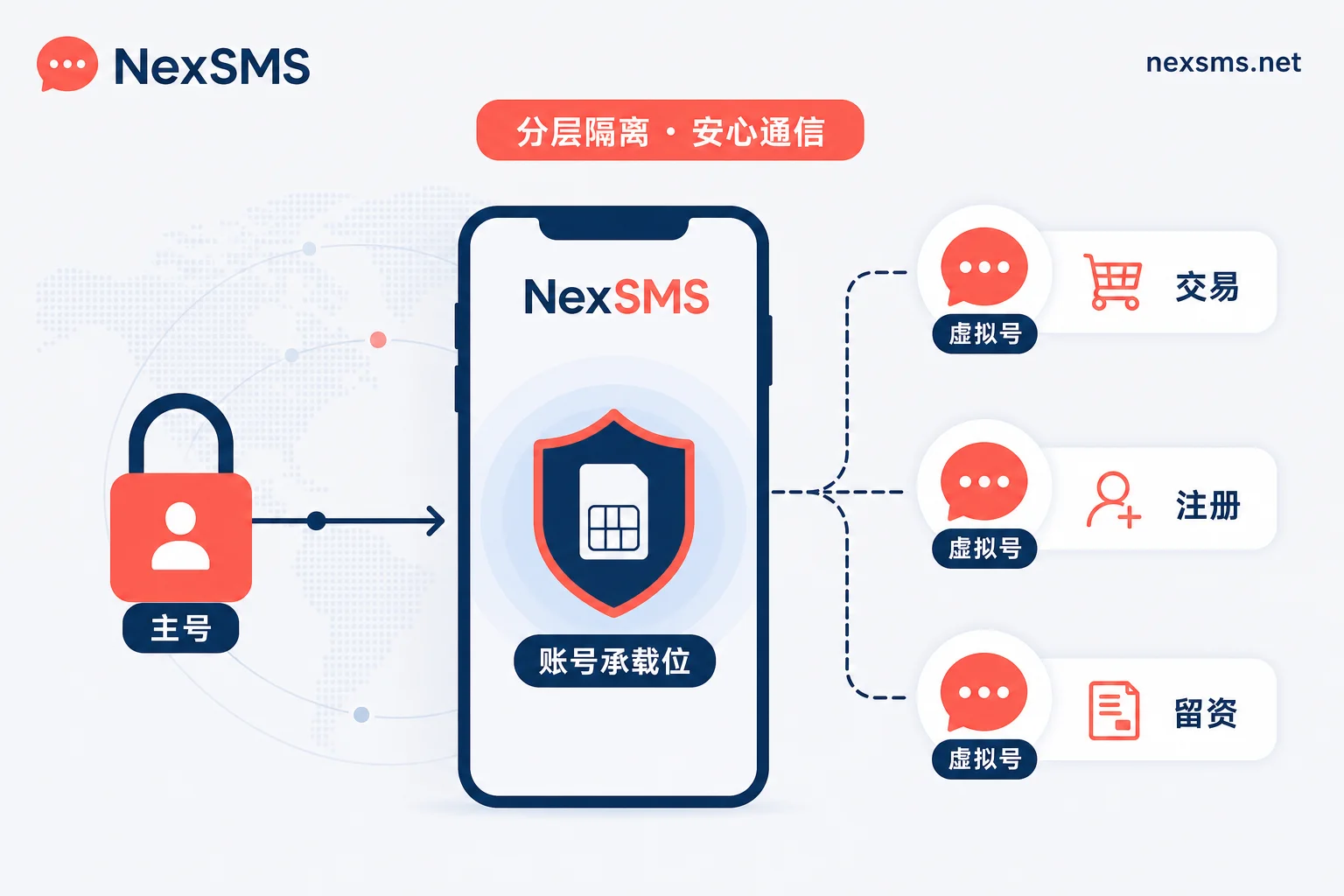
How Virtual Number Privacy Protection Works
The core role of a virtual number in the communication chain is to replace the entry point that is publicly exposed and can be actively contacted by others. When you use a virtual number, strangers, platform forms, or temporary registration services only receive a set of digits with no direct mapping to your real identity. This mechanism effectively breaks the direct link between external harassment sources and your primary mobile number.
However, it must be clear that virtual numbers do not change the binding logic inside accounts, nor do they alter the platform's underlying judgment of the number's attributes. The number itself still belongs to the carrier or pool manager, so its protective effect is strictly limited to the “exposure layer,” and it is not applicable to the “carrier layer” that needs to receive verification codes consistently over the long term.
Where It Works: Shrinking Primary Number Exposure in Stranger Transactions, Platform Forms, and Temporary Registrations
Virtual numbers are effective in isolating the following three scenarios:
- Second-hand transactions and local meetups: Prevents buyers or sellers from using the number to search for social profiles after the deal.
- Platform and merchant membership registration: Prevents mandatory phone fields from being used for marketing calls or data resale.
- One-time registrations and coupon collection: Use and discard; no need to receive further verification codes.
These positions share low trust and high turnover. Removing your primary number from these high-frequency exposure points significantly lowers the risk of reverse lookup and sustained harassment. Understanding how to prevent primary mobile number leaks on the internet helps with the specifics of shrinking primary number use.
Where It Fails 1: Platform-side Number Attribute Verification Does Not Waive Due to Privacy Requests
Many users mistakenly believe that any non-real number will pass verification, but that is not true. Mainstream platforms not only check the number's country of origin but also evaluate line type (mobile vs. fixed VoIP), carrier lookup data, and the number's historical usage. If the network environment does not match the number's ownership, verification may be rejected even with privacy needs. This has nothing to do with privacy; it is purely a number attribute issue. Currently, no major platform has published specific risk-control thresholds, only qualitative attribution to internal security scoring mechanisms.
Where It Fails 2: After Number Rotation, Residual Bindings Drag Privacy Back
U.S. FCC Order 23-95 requires that disconnected numbers must go through at least a 45-day quiet period before re-entering the number pool for reassignment. This means virtual numbers have high liquidity and ownership transfer characteristics.
This leads to two consequences: First, the virtual number you use may be held by someone else after expiration, and any account recovery links or subsequent SMS previously tied to that number will fall into the new holder's hands. Second, the new number you obtain may carry historical bindings from the previous user, receiving verification codes and notifications not meant for you. This privacy risk stems from number ownership transfer, not from whether the number is labeled “virtual.” To learn whether virtual numbers can be recycled by carriers, pay attention to quiet period rules.
Key Differences Between Exposure and Carrier Positions
For clearer understanding of number roles, the table below contrasts the two positions:
| Dimension | External Exposure Position | Account Carrier Position |
|---|---|---|
| Typical scenarios | Second-hand trades, merchant forms, temporary registrations | Long-term accounts, platform accounts requiring secondary OTP receipt |
| Number visibility | Strangers, third-party platforms, potential attackers | Only the owner and trusted services |
| Need for secondary OTP receipt | No (use and discard) | Yes (requires stable OTP reception over time) |
| Tolerable expiration risk | High (loss does not affect core assets) | Extremely low (if recovery is solely tied to this number, change of ownership means recovery chain transfers to another) |
| Recommended number type | Short-term, disposable, low-cost | Long-term, exclusive, renewable |
Mixing these two types leads to both privacy and usability failures: if you set the carrier position to a short-term number, once it expires and cannot be renewed, the account recovery chain is permanently interrupted; if you set the exposure position to your long-term primary number, all external harassment will directly reach your core personal life. This is why later we advocate adding non-SMS verification methods to core accounts.
Rebinding and Rearranging Backup Verification When Primary Number Has Already Been Shared
For users who have already left their primary number across multiple platforms, the first task is to replace unnecessary external contact positions with disposable numbers. Then, check which important accounts have recovery and two-step verification solely tied to the primary number. During this process, implementing virtual number privacy protection should also consider upgrading verification methods.
According to NIST standards, organizations continuing to use SMS OTP must warn of risks and provide unrestricted alternatives (such as Passkey or hardware keys). Therefore, “changing the number” does not equal security; the key is not having a single number carry all account entry points. Prioritize enabling MFA methods that do not rely on SMS for core accounts, thereby relieving the primary number from verification pressure.
Division of Labor Between Short-Term and Long-Term Numbers
For different needs, we suggest the following allocation strategy:
| Specific Scenario | Recommended Number Type | Rationale and Risk Notes |
|---|---|---|
| Second-hand transactions and meetups | Short-term disposable numbers | Destroy after the deal to prevent later harassment; risk: cannot receive verification codes, so not suitable for platforms needing after-sales tracking. |
| Merchant membership and form submissions | Short-term disposable numbers | Blocks marketing call channels; if subsequent actions like points redemption are needed, confirm whether email login is supported. |
| One-time registration for codes | Short-term disposable numbers | Use and discard; no further OTP needs, conforms to exposure position definition. |
| Platform accounts requiring secondary OTP | Renewable long-term local numbers | Ensures you can receive password reset links; numbers in public pools with multiple holders and residual bindings are unsuitable for positions that require re-receiving codes. |
| Long-term accounts with recovery and 2FA | Own primary number + non-SMS MFA | Highest security level; strictly forbid using any recyclable virtual number as the sole recovery method. |
| Enterprise customer service numbers | Dedicated long-term numbers | Maintains brand consistency and customer trust; regularly clean up permissions of former employees to prevent number abuse. |
FAQ
Can a virtual number hide your real mobile number?
Yes. A virtual number acts as an intermediary layer, presenting a separate number identifier to the outside world, thereby cutting off the direct path to your real primary number. However, number ownership and usage records are held by carriers and pool managers; ordinary strangers and generic platforms cannot access them. Cases beyond that scope are not covered here.
Can others find me through a virtual number?
Generally, no. Strangers using standard search engines or social apps cannot directly reverse-look up your real identity from a virtual number. But if the platform leaks its user database, or if the number is reassigned after the quiet period, the new holder will receive verifications and notifications tied to that number, potentially indirectly linking to some behavioral traces of the previous or current user.
Is it safe to leave a virtual number in second-hand transactions?
Relatively safe, especially for one-time deals. It effectively prevents buyers from continuing to harass you or sell your info after the transaction. However, if disputes arise and the platform needs to verify identity, a virtual number may reduce communication efficiency or result in restrictions due to not being a real-name user. We recommend keeping screenshots of key chat logs.
Which steps during account registration with a virtual number are most prone to leaking privacy?
There are risks. The main concern is the number recycling mechanism. Per FCC rules, numbers have at least a 45-day quiet period after disconnection, then may be reassigned. If you do not unbind in time, a new holder could use the “forgot password” feature with SMS codes to take over your account, viewing historical orders or private messages.
After deactivating a number without renewal, who gets old accounts and old SMS?
It depends on whether you have completely unbound. If not unbound, the new holder can reset the password via SMS and log in. For such scenarios, we recommend using short-term numbers from NexSMS for external exposure positions, while for accounts needing long-term carrier, choose renewable long-term local numbers and manage them via web-based SMS reception, ensuring migration before expiration. See multi-account number management to avoid disconnection.
We suggest readers first classify their numbers into exposure and carrier positions, then decide which to replace with disposable numbers and which must remain renewable long-term numbers. For those needing numbers in multiple countries or web-based SMS reception, visit NexSMS to choose the appropriate number type, and complete unbinding and rebinding before expiration.


Comments(0)