 NexSms官方博客
If you find that the default verification code option has disappeared when logging into important office systems or online accounts, don't be surprised. Not long ago, cybersecurity giant Zscaler announced that its authentication service would discontinue SMS one-time password (SMS OTP) verification starting August 7, 2026. Many security-conscious users, aiming to prevent SIM swapping risks, have begun using SMS verification code services to isolate their real phone numbers.
This decision is not without reason. In recent years, hackers have frequently bypassed two-factor authentication (2FA) through social engineering and carrier management vulnerabilities. Deeply binding all online services to a single real physical number is becoming the weakest link in the security chain of users' digital assets.
Behind the 1055% Surge: Inherent Security Flaws of Physical SIM Cards
According to data released by Cifas, the UK's fraud prevention service, SIM swapping cases recorded in its National Fraud Database have exploded over the past year, surging 1055% year-on-year. This fraud method, also known as "SIM card replacement attack," can efficiently breach almost all SMS barriers.
The root cause of SIM swapping's frequent success lies in human factors within the communication chain, rather than technical flaws in the communication protocol itself. Criminals typically exploit the following methods to breach carriers' defenses:
- Identity verification is superficial: Carrier customer service often relies on static data such as birthdays and call history when verifying customer identity, which is easily purchased on the black market.
- Temptation and insider risk: Some criminals use high financial incentives or social engineering to bribe frontline staff at carrier outlets.
- Linked accounts vulnerable: Once the physical number is hijacked, attackers can easily reset linked email, social networks, and various asset management platforms.
When a phone number is hijacked, all third-party applications bound to that number become defenseless against the attacker. Many peripheral platforms used for everyday registrations, once data is leaked, often become sources for attackers to reverse-search users' primary phone numbers and then execute targeted phishing attacks.
Giants Abandon SMS: Why SMS Verification Became a Restricted Technology
As security vulnerabilities increase, regulators and industry standard setters have also changed their stance. The U.S. National Institute of Standards and Technology (NIST), in its Digital Identity Guidelines (SP 800-63-4), has classified SMS OTP based on the public switched telephone network as a "restricted authenticator." This means SMS verification is no longer recommended in federal and high-security scenarios.
Additionally, state attorneys general jointly submitted a petition to the Federal Communications Commission (FCC) in July 2026, urging further tightening of rules to cut off fraudsters' access to legitimate phone numbers. Public data shows that in the past year alone, victims suffered economic losses of nearly $2 billion from phone and SMS fraud.
This industry consensus has prompted many companies to adjust their verification mechanisms. For users, during the transition period before major service providers fully phase out SMS verification, frequently using a primary SIM card to receive various registration codes not only invites harassment but also exposes personal traces. Many users, when registering for ordinary social or entertainment accounts, tend to choose SMS verification codes to avoid leaving traces of their primary number.
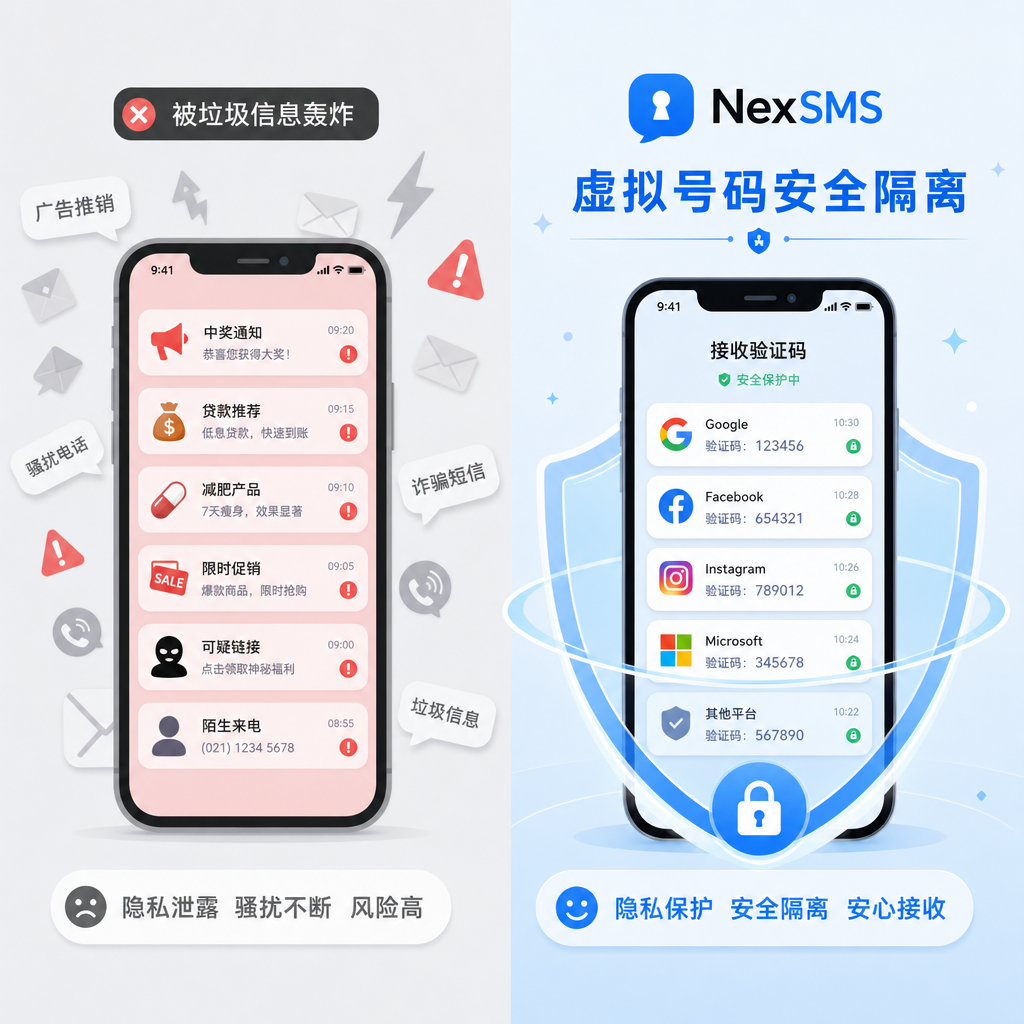
Isolation and Defense: The Role of SMS Verification Codes in Risk Management
In preventing identity theft and fraud, the core logic is to minimize the exposure surface. This means there must be a physical isolation wall between users' core assets (e.g., bank cards, primary email) and non-core services (e.g., temporary social accounts, various tools).
Using NexSMS's virtual numbers is a crucial part of this isolation wall. When users register on new platforms via SMS verification codes, the verification process is completed independently in the cloud. This means that even in the event of a severe database breach, hackers can only obtain a virtual number that cannot be used for physical location or SIM swapping.
This isolation method significantly raises the barrier for attackers. Since virtual numbers are not associated with any mobile carrier's frontline customer service channels, social engineering attacks fail at the first hurdle. For developers who frequently need to register test environments or ordinary users who value privacy, this defense is not only low-cost but also highly effective.
Building a Security Barrier: Protecting Personal Digital Assets from the Source
Facing escalating cybersecurity threats, relying solely on carriers' passive protection is insufficient. Building a multi-layered digital security strategy has become a must for self-protection in the digital network.
Protecting account security can be approached from the following dimensions:
- Bind hardware keys or authenticator apps to core accounts.
- Stop directly providing your real phone number on any forums or temporary websites.
- For peripheral, one-time application services, use virtual numbers for registration and verification.
- Regularly check the signal status of your primary number; if you experience unexplained network outages, contact your carrier immediately to lock the account.
Through scientific classification management and using services like NexSMS to hide the real physical phone number behind the scenes, you can minimize the risk of becoming the next victim of SIM swapping. In the future online environment, such conscious security isolation will gradually become a basic habit for every digital citizen.


Comments(0)