 NexSms官方博客
Let's put the conclusion upfront: A private temporary number means that during the time you rent it, only you can see the SMS messages received on that number—the records appear in your own dashboard or API response, not on a publicly accessible web page. This single difference places it on a completely different level from "free public SMS numbers" in terms of privacy and success rate.
As for choosing between short-term and long-term, the only criterion is: Will this account need to receive SMS on this number again in the future? If yes, choose long-term; if you're sure it's only for one-time verification and you'll rely on email or authenticator apps afterwards, choose short-term.
Below, we clarify the conditions and exceptions behind these two decisions.
The Two Major Drawbacks of Public Free Numbers
Free public SMS pages use a shared inbox: the number is displayed on the page, and anyone can see all recent messages received by that number. This implies two things.
First, the content itself is exposed. Verification codes, password reset links, account balance alerts—anything sent to that number becomes publicly available. If someone obtains your registered email and waits for a reset SMS on a public inbox, they take over the account. This is not a theoretical risk; automated scraping of SMS from public inbox pages for credential stuffing and account takeover is a long-standing phenomenon.
Second, there's collective punishment at the risk-control level. These number ranges are repeatedly used by many users for registrations, and major platforms have long added them to disposable number identification databases (GSMA and others also promote governance and shared lists for such misuse). The result is that the same number may have been used dozens of times on a platform. When you try to use it again, you either get a "number invalid" prompt or your registration succeeds but is soon cleaned up in batches. Security research also indicates that disposable numbers are used on a large scale for fraudulent activities, making platforms increasingly aggressive in blocking these ranges.
Therefore, the truly legitimate use for public free numbers is to verify things you don't care about: trying out a website's features, testing your own product's SMS flow, or claiming a one-time download permission. Any account that will later carry your identity or funds should not go down this route.
If you just want to see what real-time incoming SMS looks like first and confirm the path works, the free public US number page allows you to see codes without registration. Use it as a test run for the verification process, not as a home for your account.
What Private Temporary Numbers Solve—and What They Don't
Private numbers are exclusive during the assigned period: SMS only goes to your backend, and it cannot be found on public web pages. This directly eliminates the first drawback—no one will be waiting on a public page for your reset SMS. At the same time, because the number is not shared with others during that period, it significantly reduces conflicts like "this number has already been registered."
However, it does not solve the entire second problem. Whether a number can pass verification on Google, Telegram, WhatsApp, or a bank app depends on the platform's real-time risk-control rules at that moment, as well as the number's own attributes—whether it's a VoIP termination number or a local SIM/eSIM issued by a carrier. Two number ranges from the same country and same provider can yield different results on the same platform. No SMS service can guarantee a 100% success rate; be wary of any that do.
This is why it's worth spending an extra three minutes checking number attributes before purchase, rather than just looking at price. For specifics on what to check, refer to How to Choose an SMS Platform: 6 Number Metrics to Verify Before Ordering.
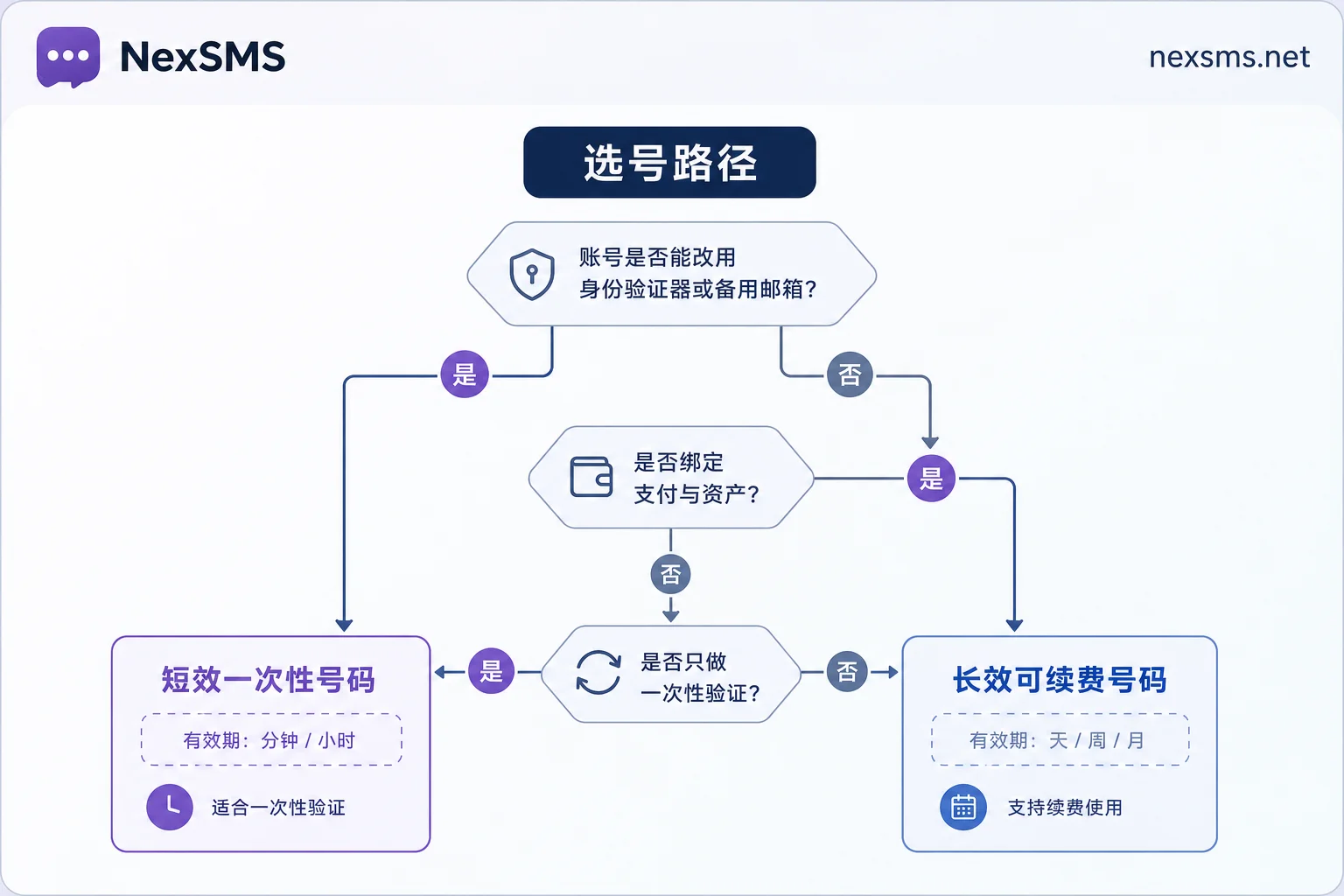
Short-Term or Long-Term: Based on Account Lifecycle
Short-term private numbers are billed per use or by very short durations (typically minutes to tens of minutes). After verification is complete, they enter a release period, after which they no longer belong to you and cannot receive SMS again. They are cheap and available on demand, but the cost is non-retroactivity.
Long-term numbers are something else: real carrier numbers from operators (physical SIM and eSIM, not virtual termination numbers) that can be renewed and receive unlimited SMS during the validity period. They cost more, but the number remains yours.
Run through the following questions, and the answer usually becomes clear:
1. After registration, can I immediately switch secondary verification to an authenticator app (TOTP) or backup email?
If yes, short-term suffices. If no, and the platform only supports SMS 2FA, you must choose long-term—otherwise, you won't receive codes on future logins from different locations and will lock yourself out.
2. Will this account hold payments, assets, or business interactions?
If yes, go straight to long-term. Don't save that money. The cost of losing the number far exceeds the price of the number itself.
3. Will the platform perform security spot-checks or require reverification of the phone number after weeks or months?
Major social media and email services do this irregularly. You can't predict when it will happen, so for any long-term account, you need the number to remain available.
4. Is this just a one-time download, claim, or test?
Then short-term is designed for exactly this scenario.
There's another time-related point often overlooked: Long-term numbers must be renewed before expiry to keep holding them. Set a calendar reminder; don't wait until you fail to receive codes. The mechanism for numbers being recycled after long inactivity is covered in more detail in Can Virtual Numbers Be Recycled by Carriers?.
For specific differences between short-term and long-term, and how renewal fees work, see NexSMS Number Types and Renewal Instructions.
Practical Operational Order
If the order is wrong, you waste money. Follow this sequence:
Step 1: Determine the target platform and country. Many services adjust the content version, available payment methods, or even account language based on the number's country code. Changing this later is troublesome. So first decide which market the account will serve, then select a number from that country—for example, the US number page, and similarly for other countries.
Step 2: Check any additional requirements from the platform. Some services only accept mobile number ranges, some reject specific VoIP prefixes outright, and some registration pages perform preliminary number format and carrier validation before allowing you to click "send." For platform-specific verification points, see the solutions pages for various platforms.
Step 3: At the platform, advance to the "send verification code" step before getting the number. The validity of short-term numbers starts from allocation. If you fill out the registration form completely and stop at the last step, then get the number and enter it, the success rate is notably higher.
Step 4: Immediately do follow-up actions after receiving the code. Go to account settings, bind a backup email, enable an authenticator app, and download and store recovery codes offline. This step determines whether you'll depend on the number in the future. If you do this, releasing a short-term number is fine; if you don't, you've handed the key to your account to a number that won't belong to you in a few minutes.
Regarding the reliability of SMS verification codes and which accounts should switch to passkeys or TOTP, the article Layered Selection of SMS OTP and Passkeys is a good follow-up.
When You Don't Receive Codes, Troubleshoot in This Order
- Check whether the platform actually sent it. The registration page usually shows "sent" or a countdown. If it didn't even trigger sending, the problem lies in number format or pre-blocking of the number range. Switch numbers, don't wait in vain.
- Wait a full cycle before judging. International SMS routing has latency. Not receiving within 30 seconds doesn't mean failure, but after two to three minutes it's safe to assume it's not working.
- Try a different number range from the same country. Blocking is often range-specific, not country-wide.
- Switch countries. Some platforms tighten registration traffic from certain countries; switching markets often goes through directly.
- Check other environmental factors on your side. If you're logged into multiple accounts on the same platform from the same device/IP, risk control may block you on dimensions beyond the number. That part isn't the number's job—multaccount isolation is handled by NexBrowser, network egress is NexIP's domain, and email identity is NexMask's. The number is just one link in the chain.
Platforms like Google have obscure rejection reasons, often with multiple causes; Three Causes of Google Account SMS Verification Rejection provides a deeper breakdown.
Places Where You Should Never Use Temporary Numbers
Regardless of private or public, short-term or long-term, avoid relying on temporary numbers for these:
- The sole verification method for banking, securities, or payment accounts. Once the number is lost, recovery is painful, and many institutions require the number to match your real-name info.
- Government, tax, medical, and similar identity-consistency services.
- Your primary communication identity (work email recovery, company system login).
- Scenarios requiring long-term incoming calls via that number—many SMS reception numbers only support SMS; verify voice capability separately.
For a more complete list, see Where Can One-Time Phone Numbers Be Used? 4 Places to Avoid.
Finally, a note on scope: this approach serves your own legitimate verification needs—protecting your primary number from exposure, registering overseas services, and maintaining your own multiple accounts. It does not apply to bypassing real-name or KYC requirements, batch account farming, or receiving codes for other people. This isn't just a rule issue; those uses will push the number into a platform's high-risk list, eventually making even normal registrations fail.
If your primary number is tied to too many places and you want to offload new registrations and external contact, How to Protect Your Primary Mobile Number Privacy can be read alongside this article.


Comments(0)